Archive by Author

Quick Smoke: La Gloria Cubana Rabito de Cochino

22 Apr 2017

Each Saturday and Sunday we’ll post a Quick Smoke: not quite a full review, just our brief verdict on a single cigar of “buy,” “hold,” or “sell.”

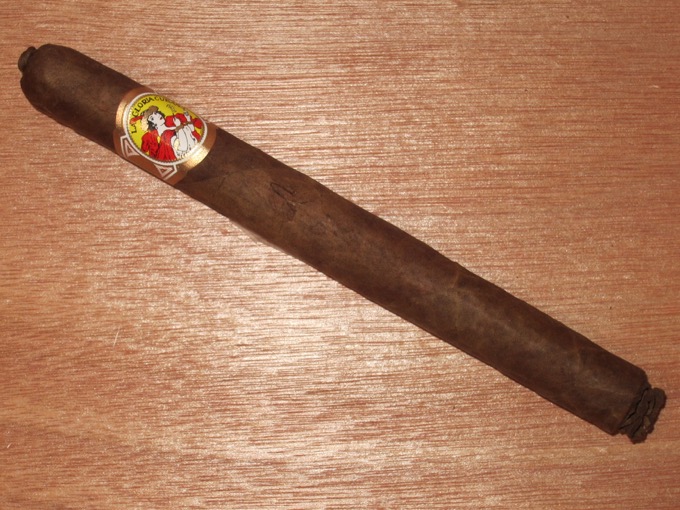
LGC-Rabito-de-Cochino - 1

A few years ago, La Gloria Cubana released Rabito de Cochino (6.5 x 46), which was packaged in bundles of three tied together with yellow ribbon. I missed the release when it came out, but recently secured a three-pack. With an Ecuadorian wrapper around Dominican and Nicaraguan filler, Rabito de Cochino seems like a well-aged version of the classic Serie R blend in a lonsdale format with a pigtail cap. The profile is full-bodied with heavy leather flavors and lots of wood spice. Construction and combustion are flawless. This was originally around $15 for a bundle of three; currently, you can find these for around $3 per cigar if you shop around. That’s outstanding value.

Verdict = Buy.

–Patrick S

photo credit: Stogie Guys

Cigar Review: Jaime Garcia Reserva Especial TAA 2017

19 Apr 2017

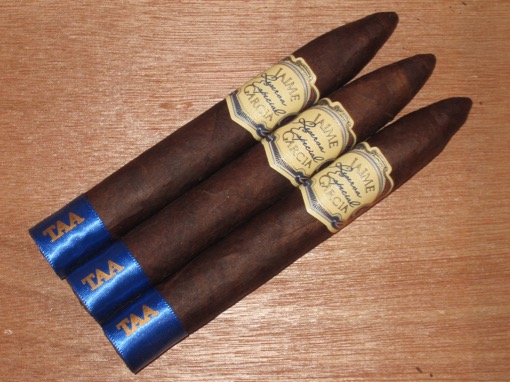
Jaime-Garcia-RE-TAA17 - 1

Jaime-Garcia-RE-TAA17 - 1 (1)In 2011, My Father Cigars released a Jaime Garcia Reserva Especial in a box-pressed torpedo size exclusive to members of the Tobacconists’ Association of America (TAA). In 2017, the same size is back again for TAA, a small association of 80 or so cigar retailers that includes many of the most prominent U.S. tobacconists. (In case you come across the 2011 version, you can differentiate the two by noting only the 2017 edition has “TAA” printed in gold on the blue foot band.)

I don’t think it’s unfair to say the Jaime Garcia Reserva Especial line is overshadowed by the eponymous My Father lines, much like tobacco patriarch Don José “Pepin” Garcia overshadows the talents his son, Jaime. But my experience smoking four of the Jaime Garcia Reserva Especial TAA 2017 cigars serves as a reminder that Jaime Garcia’s talents aren’t to be overlooked.

Like the entire Jaime Garcia Reserva Especial line, the $9.50 TAA edition (6.125 x 52) features a dark, oily Broadleaf wrapper around Nicaraguan binder and filler tobaccos. The exact differences between the TAA edition and the regular sizes aren’t disclosed, but reports are the TAA blend is tweaked and the 2017 version uses tobaccos that are extra aged (compared to the 2011 TAA).

A savory oak flavor dominates the cigar, which also features an abundance of unsweetened chocolate and black coffee. Other flavors include a subtle syrupy sweetness and pepper that particularly comes through on the retrohale.

Construction on each of the cigars was flawless. The box-pressed torpedo shape concentrates the flavors nicely on the palate. The taste is largely consistent from start to finish, but the chocolate and pepper both build towards the final third as the profile ramps up from medium-bodied to medium- to full-bodied.

The Jaime Garcia Reserva Especial TAA 2017 is a classic Broadleaf maduro smoke. It is rich and balanced with equal parts subtle sweetness and spice. This cigar makes me want to revisit the regular offerings in the Jamie Garcia Reserva Especial line. It earns a rating of four stogies out of five.

[To read more StogieGuys.com cigar reviews, please click here.]

–Patrick S

photo credit: Stogie Guys

Quick Smoke: Viaje Summerfest 2010 Robusto

16 Apr 2017

Each Saturday and Sunday we’ll post a Quick Smoke: not quite a full review, just our brief verdict on a single cigar of “buy,” “hold,” or “sell.”

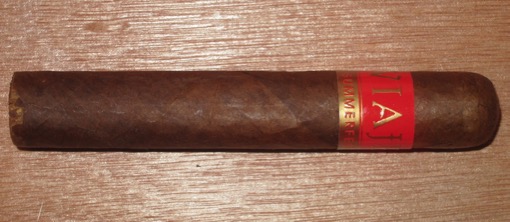
Viaje-Summerfest-2010 - 1

Today I smoked a cigar you could consider a bit of a unicorn. Only 50 boxes of 30 cigars were ever made of the Robusto edition of the debut 2010 Summerfest cigar, which, according to Viaje brand owner Andre Farkas, was a factory mistake. (Other Viaje Summerfest vitolas, including the 2010 Torpedo, which was the non-mistake version of the 2010 release, are known for having a shaggy unfinished foot.) The Nicaraguan puro features sourdough bread notes along with cinnamon, light spice, and buttery notes. It’s well-balanced and medium-bodied, though there is a peppery spice that builds in the final third. Well-constructed, this is an example of a well-made, well-executed smoke that was good when it debuted and has improved with age.

Verdict = Buy.

–Patrick S

photo credit: Stogie Guys

Quick Smoke: Joya Red Robusto

9 Apr 2017

Each Saturday and Sunday we’ll post a Quick Smoke: not quite a full review, just our brief verdict on a single cigar of “buy,” “hold,” or “sell.”joya-red-sq

joya-red-toro

Introduced in 2014, Joya Red represented a new profile for Joya de Nicaragua, and a move away from the longer “Joya de Nicaragua” branding in favor of just “Joya.” The Nicaraguan Habano wrapper has a nice shine that looks good with the gold and red band. Flavor-wise, it’s tasty with toasty wood, cappuccino, and just a touch of pepper. Joya de Nicaragua has always been known for full-bodied Nicaraguan puros, but I’ve always felt their versatility was demonstrated by the mild Cabinetta series. Joya Red continues to show off that versatility with tasty medium-bodied flavors at a fair price.

Verdict = Buy.

–Patrick S

photo credit: Stogie Guys

Commentary: Thoughts on Boutique Cigars, Cigar Snobs, and Wine

5 Apr 2017

wine-cigars

If you prefer boutique cigar makers, are you an enlightened cigar smoker, or a cigar snob?

A wine column I read in the Wall Street Journal recently reminded me of this debate. Here’s the key passage:

A wine snob’s philosophy might be summed up in six words: Big is bad, small is good. From winemakers who tout the tininess of their yields to retailers, sommeliers, and collectors who wield the “boutique” word, small is a synonym for quality. Big, on the other hand, is almost automatically assumed to be bad. Any wine produced in large quantities by a large winery must surely be the work of a machine and a marketing team and not a sensitive and caring family.

And yet there are plenty of exceptions to this wine snob rule. There are many good, even world famous, wines made by big wineries and some real dreck turned out in tiny amounts by winemakers who are a one-man or one-woman show. What are the real virtues of small versus large?

I’ve always said there are many parallels between wine and cigars, and this is no exception. The personal connection—forged, perhaps, by meeting a cigar maker at an event, or simply because you can more easily identify the single person most responsible for the cigar you’re smoking—is a large part of the propensity towards boutique makers.

But the analogy between wine and cigars isn’t perfect. The smallest winemakers turn their grapes into wine on their own equipment. (I know someone who buys grapes and uses equipment in their own garage to make wine.) Whether a small vineyard or an even smaller garagiste, they make their product on-premises: crushing, pressing, and fermenting.

For cigar makers, “boutique” brands are mostly rolled at someone else’s larger factory. There are, of course, exceptions—RoMa Craft Tobac owns and operates its own factory, Nica Sueño, for example—but most cigars identified with boutiques are actually made at a larger factory owned by someone else.

Bigger cigar makers are more likely to  be involved in growing their own tobacco than smaller ones, but just about everyone is buying some tobacco, especially highly-valued wrapper leaf. When it comes to wine making, some of the best wines are produced from the grapes of a single vineyard, emphasizing the unique characteristics of the terroir. Meanwhile, the best cigars show off the skills of the blender, combining different types and primings of tobacco, and often using multi-country blends. (Puros—cigars made from tobacco entirely from one country—are the exception, not the rule, today.)

A larger-scale wine maker gets economies of scale from larger fermentation tanks and more automated bottling lines. But whether a cigar factory makes 100,000 cigars a month or 100,000 cigars a day, each handmade cigar is made the exact same way. A skilled bunchero and rollero will pretty much have the same output in a large factory as they will in a small operation. Making each cigar is a labor-intensive process that, so far, no technology has been able to reproduce to the quality that premium cigar consumers expect. Marketing can be done at scale, but advertising can only get a consumer to try a cigar once, not go back for another.

Arguably, the biggest advantage smaller companies have is they don’t need a cigar to be sold in large numbers for it to be a success. A cigar line that sells 20,000 units a year may be relatively insignificant for a company that moves millions and millions of units. For a small operation, though, 20,000 units sold can be a huge success. This lets smaller brands appeal to a more niche audience. (Although, increasingly, large companies are making limited-release cigars that use limited tobacco stocks that might not be available for a larger release.)

What does all this mean? Fundamentally, while you can appreciate craft or boutique cigar companies, yes, there is something snobbish about automatically dismissing a cigar because the company behind it is a multi-national corporation. The truth is, cigar makers of all sizes have their advantages.

Small cigar companies make excellent cigars. So do large ones. Ultimately, each cigar must stand on its own and provide the consumer good value. With so many good cigars out there, there’s little reason to smoke mediocre cigars.

–Patrick S

photo credit: Flickr

Quick Smoke: Rum Barrel-Aged and Nicaraguan Tobacco Experimental Blend

2 Apr 2017

Each Saturday and Sunday we’ll post a Quick Smoke: not quite a full review, just our brief verdict on a single cigar of “buy,” “hold,” or “sell.”

GCC-fuma-exp - 1

So here’s a cigar you’ll never smoke (since only one was ever made). One of the best parts of the many factory trips I’ve been on is experimenting with blends. Generally, a dozen or more types of tobacco are laid out. You pick out a combination and hopefully a skilled roller is there to turn your concept into a smokable fuma. It’s a humbling experience that gives you real appreciation for the difficulty of creating an enjoyable blend. A few months ago, I did this on a visit to General Cigar’s Dominican factory, which has some of the largest tobacco stocks in the world. One fuma I created used two types of rum barrel-aged tobacco (Dominican Piloto Cubano and Estelí ligero), which I combined with Seco (ASP and Estelí) and Viso tobaccos from Nicaragua. I had the blend draped in an Ecuadorian Sumatra wrapper. The some of the tobaccos from the rum barrels were a little too wet at the time, so I decided to wait to smoke it until now. I’m not going to say the experiment turned out amazing, but with a little sweetness and lots of wood spice, I actually would smoke this again. That’s the low bar against which I judge this experiment a success.

Verdict = Hold.

–Patrick S

photo credit: Stogie Guys

Cigar Review: CAO Consigliere Associate

29 Mar 2017

CAO-consigliere- - 1

When The Sopranos debuted on HBO in 1999, the series ushered in a new era of television, one where the most exciting and edgy viewing wasn’t available from the networks or even in the theater, but on cable, especially premium channels (and, later, on streaming services). By 2006, when its sixth and final season began, The Sopranos was a cultural icon, complete with its own licensed cigar.

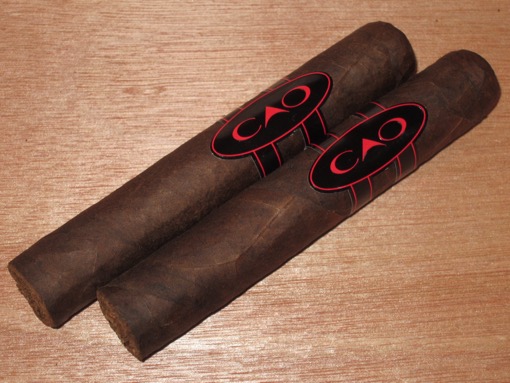
CAOconsigliere - 1If you watched The Sopranos, you probably noticed how frequently Tony lights up a cigar: in his car (in the opening credits), by the pool, at the Bing, at Vesuvio, outside Satriale’s Pork Store, and on and on. With that as the backdrop, CAO partnered with the show in 2005 to create the CAO The Sopranos Edition line of cigars.

The line featured three sizes: Associate (5 x 52), Soldier (6 x 54), and a belicoso called Boss (7 x 56). Later, a Tony Soprano Signature (6.5 x 60) was added. All were packaged in boxes that looked like the trunk of of an old Cadillac. For what it’s worth, I thought this presentation was extremely unique and creative.

In 2013, six years after the show finale, CAO (now under the STG/General Cigar umbrella) announced CAO Sopranos was being discontinued. But that wasn’t to be the blend’s final act. Last year, the cigar was resurrected as Consigliere. The primary band remained the same, but the red trunk-style box and Sopranos-branded secondary foot band now sleep with the fishes.

The blend, however, remains unchanged with a Brazilian Mata Fina wrapper and Honduran binder around filler from Nicaragua, Colombia, and the Dominican Republic. The three original sizes and names all returned, with prices slashed almost in half (presumably, some of the savings came from no longer having to pay a licensing fee to The Sopranos and/or HBO).

I smoked three of the robusto-sized Associates for this review. Out of the gate, each is dominated by heavy leather notes along with charred oak and light pepper. Bread and rich espresso notes have an extended cameo. The full-bodied smokes featured excellent construction. The flavors don’t change much until the end where the spice and leather ramps up even more, joined by a savory meatiness.

I never smoked the original CAO Sopranos much, perhaps because for $10+ the line was in some pretty elite company price-wise at the time. With the Associate selling for $7 now, it is definitely worth another look.

I often find cigars that were full-bodied a decade ago seem more medium-bodied today. That isn’t the case with this blend, which remains a heavy, leathery (if not exactly balanced) smoke. It’s enough to earn the CAO Consigliere Associate a rating of three and a half stogies out of five.

[To read more StogieGuys.com cigar reviews, please click here.]

–Patrick S

photo credit: Stogie Guys