Search results: site-policy/images

Quick Smoke: Romeo y Julieta Exhibición No. 4 (Cuban)

18 Feb

Each Saturday and Sunday we’ll post a Quick Smoke: not quite a full review, just our brief verdict on a single cigar of “buy,” “hold,” or “sell.”

My previous experiences with this Cuban have ranged from, “Eh, not worth the price,” to, “Excellent, as long as you age it for a year or more.” I recently gave the Exhibición No. 4 (5 x 48) another shot, this time with a specimen that had been in my possession for over a year. What a disappointment. The bland profile tasted of dry wood and ammonia. The physical properties were good, but who cares about construction when you invest $8-11 and a year of humidor space to get a crummy-tasting stick? I’m starting to think my good experiences with this smoke were mere anomalies.

Verdict = Sell.

–Patrick A

photo credit: Stogie Guys

Cigar Review: NHC Surrogates Bone Crusher

15 Feb

If you only pick up cigars from your local shop then you probably haven’t heard of the Surrogates Skull Breaker and Bone Crusher cigars. These cigars are only available from New Havana Cigars (NHC), an online-only shop based in Columbus, Ohio.

Unlike most online retailers, NHC’s selection is limited to a handful of more boutique cigarmakers like Tatuaje, Illusione, Viaje, E.P. Carrillo, and 7-20-4, including many hard to find limited releases. NHC has featured a number of exclusive smokes—including the NHC Selección Limitada (a box-pressed size of the Tatuaje Brown Label) and the My Uzi Weighs a Ton Bait Fish (a corona size of the Drew Estate MUWAT)—but Surrogates is the first truly new brand created by NHC.

Last August, NHC owner Dan Welsh described his thinking about the line this way: “I wanted to create a brand for NHC that would bring new customers and service our loyal customers. Looking at our business over the last four years, it was obvious that our clients demanded something special. One thing that was missing was constant availability… Surrogates was created to solve the problem of choosing whether to save or smoke that special vitola. The answer, is both.”

Beyond saying the cigar is created “utilizing a new source” (implying it isn’t made at any of the factories where the cigars he stocks are produced) Welsh reveals few details about the blend, except that the wrapper is broadleaf and it is “made in Central America.” In its current listing on the site a few more details are revealed, as the description says the cigar’s origin is Nicaragua, as is the wrapper and filler.

Shrouded in a bit of intended mystery, one is left to smoke the cigar and evaluate it on its own terms. Available in two sizes, Skull Breaker is a belicoso that measures 5.25 inches with a ring gauge of 52 and Bone Crusher (the subject of this review) is a parejo that measures 5.25 inches with a ring gauge of 54. The Bone Crusher samples I smoked are clearly well-made. The dark, nearly vein-free wrapper is framed by dual matte black bands. The cigar produces a perfectly even burn and sturdy ash that holds for well over an inch.

Bone Crusher yields heavy smoke with a density that coats the palate. Its extremely full-bodied flavors are dominated by espresso, earth, and leather. There’s a bit of pepper at the start but also some lingering bitterness, especially towards the end. All in all, Bone Crusher seems an appropriate name for this cigar. It’s powerful, flavorful, and one of the most full-bodied cigars available anywhere. But all that power comes with a price, as there’s no subtlety or finesse, and little in the way of balance.

Still, it is a cigar that can be enjoyed under the right circumstances: a full-stomach and a strong drink help. And while it’s a bit too powerful to be a favorite of mine, it’s a cigar I might turn to when I want a true flavor bomb. At $7.50 each and $120 for a box of 20, it’s worth a try if you’re a fan of strong cigars. So even though it lacks finesse, the NHC Surrogates Bone Crusher earns a favorable rating of three and a half stogies out of five.

[To read more StogieGuys.com cigar reviews, please click here.]

–Patrick S

photo credit: Stogie Guys

Cigar Tip: Time, The Forgotten Ingredient

13 Feb

Ask a cigar smoker why a cigar tastes the way it does and you’ll surely hear about the tobacco used and the proportions in which they are blended. Maybe they’ll mention the time of day the cigar is smoked or what drink, if any, they accompany the cigar with. But largely forgotten is one of the most important variables: time.
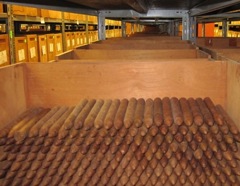
Tobacco is organic matter, which means that chemically it will change with time. During a cigar’s life, the tobacco changes, and that impacts the flavor. Today I’m breaking down aging into three basic categories:

Factory Aging

Some change, like curing and fermenting in tobacco barns or at the cigar factory, takes place relatively quickly. Other critical aging time, like time spent aging tobacco before it is rolled, or the time the rolled cigars are spent in an aging room before being boxed and shipped, can take place over weeks, months, or years. If you’ve ever smoked a cigar fresh off a rolling table you’ll remember how different that cigar would taste from the finished product, even though the difference may only be 15 of 60 days before the cigars go in the box. Obviously, unless you make your own cigars, you have no control over the factory aging process.

Short-Term Aging

Most critically (and often over-looked) is short-term aging or resting. Most people do this without even realizing it. The most obvious way is letting the cigars settle from shipping, often for a week or two, particularly when it’s extremely hot or cold out, and if your cigars may have been sitting a hot delivery truck for a few days.

Another common form of short-term aging is to let cigars get past what is often called the “sick period,” where the cigar emits ammonia and can be downright unpleasant to smoke. Cubans are known to get “sick” far more than non-Cubans, so often a six-month or more resting period is needed.

Long-Term Aging

The most discussed type of aging is long-term aging, where cigars can be aged for years or even decades. A few non-Cuban cigar makers put dates on their boxes, and all Cuban cigars have box dates, making it easier to precisely age your cigars.

Cuban cigars are notorious for benefiting from (some would say needing) time to age, often a year or more. And while most of the focus with long-term aging is on Cuban cigars, non-Cubans will also change, sometimes for the better, with months or years. Just remember that aging a bad cigar will only leave you with an old bad cigar.

Prime candidates for cigars to age are ones with full flavors that need some smoothing around the edges. Like fine wine, cigars tend to smooth out and add complexity and balance over time, trading fuller body for subtleties, though eventually cigars (like wine) lose too much flavor. So be sure to try your cigars every so often to make sure that time is making them better, not worse.

–Patrick S

photo credit: Stogie Guys

Quick Smoke: Tatuaje Exclusive Series Proto 3 (Saints & Sinners 2011)

12 Feb

Each Saturday and Sunday we’ll post a Quick Smoke: not quite a full review, just our brief verdict on a single cigar of “buy,” “hold,” or “sell.”

What’s the difference between the Tatuaje Fausto Avion 11 and this prototype from Pete Johnson’s Saints & Sinners club? I can’t tell by searching online about the latter, and I’ve never tried the former. The makeup seems to be the same—Nicaraguan binder and filler tobaccos surrounded by a dark Ecuadorian Habano wrapper—and the flavors are similar to those described by my colleague in his review of the Fausto Avion 11. These include pepper, dry wood, nuts, and some syrupy sweetness on the finish. If there is no difference, I’m inclined to put the Fausto Avion 11 on my shopping list because the Proto 3 is a delight.

Verdict = Buy.

–Patrick A

photo credit: Stogie Guys

Quick Smoke: Romeo y Julieta Wide Churchill (Cuban)

11 Feb

Each Saturday and Sunday we’ll post a Quick Smoke: not quite a full review, just our brief verdict on a single cigar of “buy,” “hold,” or “sell.”

The legendary Romeo y Julieta Churchill was joined by the robusto-sized Short Churchill in 2006. In 2010, this third Churchill variation was added, measuring in at 5.5 inches long with a ring gauge of 55. Technically a “montesco” size, this Cuban puro is surprisingly well-constructed, with a golden wrapper, firm feel, and triple-cap. It’s a very flavorful, medium- to full-bodied smoke with flavors of roasted nut, coffee, and cedary wood. With deep flavor, balance, and excellent construction, it’s the best Cuban cigar I’ve smoked in awhile (including the vaunted Cohiba Behike).

Verdict = Buy.

–Patrick S

photo credit: Stogie Guys

Cigar Review: Tabacos Baez Serie SF Robusto

9 Feb

Short-filler, mixed-filler, “Cuban sandwich.” There are many names for cigars that don’t use 100% long-filler tobacco (tobacco that runs the entire length of the cigar), but the selling point for such cigars, no matter the name, is always the same: more bang for your buck.

In theory at least, it makes plenty of sense. Cigar factories are always trimming tobacco leaves down to the sizes they need for their premium offerings. If instead of being tossed, those trimmings are used in mixed-filler cigars, the price of the raw materials goes down even though the quality of tobacco is the same as a cigar many times the price.

But I’ve always been skeptical. Are cigar makers really going to make a $3 cigar taste the same as their $8 line? Plus, doesn’t the short-filler (and the looser draw and quicker combustion that goes with it) mean that it isn’t even possible to create the same flavors? With that in mind, I thought it was it was time to try a mixed-filler cigar again. After all, there was a time, back when I was just out of college and my budget was extra tight, when they were regulars in my cigar rotation.

For the task, I chose Don Pepin Garcia’s Tabacos Baez Serie SF, made at the My Father Cigars factory in Nicaragua. The green secondary band says “Serie SF” for short-filler, although technically it’s mixed filler with 70% long-filler and 30% short-filler.

The Nicaraguan puro features a Habano wrapper that, while hardly flawless, seems of high grade. The cigar isn’t particularly soft, although once I began smoking it I found a loose, airy draw and an unpredictable ash, both features characteristic of mixed-filler cigars. As for flavor, it’s medium-bodied and dominated by cedar flavors that, while hardly unpleasant, certainly aren’t all that interesting. There’s a hint of pepper at the start, and coffee and nut notes as the cigar progresses.

So is it going to dazzle an experienced smoker? I doubt it. But priced around $2.50 each, it’s at least as good as I’d expect and maybe even better. Sure, the bits of loose tobacco that end up in your mouth are annoying, but using a punch cutter instead of a guillotine helps.

Though it’s been awhile since I most recently had them, I think two of Pepin’s other mixed-filler cigars, the Ashton Benchmade and Tatuaje Series P, are just a bit better, and certainly this smoke doesn’t compare to most of Pepin’s long-filler premium cigars. Still, if you’re on the golf course or mowing your lawn, the Serie SF wouldn’t be a bad choice. That earns the Tabacos Baez Serie SF Robusto a rating of two and a half stogies out of five.

[To read more StogieGuys.com cigar reviews, please click here.]

–Patrick S

photo credit: Stogie Guys

Cigar Review: Nestor Miranda Grand Reserve

8 Feb

Back in 2009, the folks at Miami Cigar & Co. teamed up with Don Pepin Garcia to create the Nestor Miranda Special Selection, a limited release made by Pepin in Nicaragua. The Rosado version of that series ended up being one of my favorite smokes of that year.

The partnership between Miami Cigar and Garcia is still going strong, as evidenced by the debut of the Nestor Miranda Grand Reserve during the summer. This cigar, available only in a torpedo size (6.1 x 52), is made at the My Father Cigars factory in Nicaragua and priced at about $12. When my local tobacconist put it on special for $9.50, I thought it was high time to take it for a test drive, so I bought a handful to review.

The Grand Reserve makes a good first impression with a beautiful cap, an intricate band of emerald and gold, and a clean Connecticut broadleaf wrapper with minimal veins. Underneath, the Nicaraguan binder and filler tobaccos are packed evenly to produce a firm feel from head to foot with no soft spots. And I would be remiss to forget to mention the delightfully pungent pre-light aroma of milk chocolate and hay.

Clipping the cap yields an easy draw that concentrates each puff to a relatively fine point on the palate. Once lit, this is where the dry woodsy spice is focused. But while the spice is focused on the tip of the tongue, the rest of the palate certainly gets involved quickly as notes of earth, coffee, and caramel round out the flavor.

Smoking through the nose and paying close attention is rewarded with a taste of cashew. Aside from this nuttiness, more creamy notes come into play at the midway point, making this a truly complex and balanced smoke. So many wonderful elements are present, including spice, cream, sweetness, and earthiness.

As you would expect from a super-premium, the physical properties are excellent. Each of my samples exhibited a solid white ash, a smooth and consistent draw, and a straight burn line that stays lit evenly.

Only 10,000 of these torpedos were produced. I really enjoyed the Nestor Miranda Grand Reserve, so I think I’ll be heading over to my tobacconist soon to see if they have more in stock. If they do, I’ll be OK with shelling out $12 for each—and I’ll be really pleased to find them still listed for $9.50. Don’t pass up on your own chance to try this cigar, which is worthy of four and a half stogies out of five.

[To read more StogieGuys.com cigar reviews, please click here.]

–Patrick A

photo credit: Stogie Guys