Search results: site-policy/images

Stogie Reviews: La Aurora Barrel Aged Belicoso

11 May

When I think of things that are barrel aged I think of wine, bourbon, beer, and rum. But, thanks to José Blanco and the oldest cigar company in the Dominican Republic, now I think of stogies too. And for that I am grateful.

La Aurora Barrel Aged BelicosoThis blend, which debuted in August 2007 at the IPCPR Trade Show, features tobacco aged in oak barrels that were once home to Dominican rum. The process doesn’t necessarily infuse the leaves with a rum taste; rather, it speeds up the fermentation process. And while this idea isn’t new to the people over at La Aurora, the Barrel Aged blend is the first cigar they’ve made with 100 percent barrel aged tobacco.

They seem to have found a winning concept. The Belicoso (6.25 x 52), one of four vitolas in the line, was named the 14th best cigar of 2008 by Cigar Aficionado. The magazine imparted a rating of 92, writing the stick is “one of the company’s top cigars since its landmark 100 Años.”

With a dark, russet-colored corojo wrapper and a pre-light aroma of sweet chocolate and nuts, this cigar is downright appealing right out of the cellophane. The oily texture and hardened veins impart a feeling of age, even though the tobacco is likely only a few years old at this point.

The initial flavor is spicy with dominant hints of coffee beans, clove, and that straightforward tobacco taste that’s typical of corojo tobacco. The Dominican and Nicaraguan binder and filler leaves produce plenty of complexity yet zero harshness.

Sweet, woody, earthy…there’s a lot going on here. A touch of bite on the finish joins in the fray down the home stretch, and there it remains until you’re forced to set the nub down for good.

Fortunately, the physical properties mostly live up to this cigar’s $6.50-9 price tag. The draw is easy and smooth and the white, finely layered ash holds strong until tapped. I only wish the burn didn’t require as many touch-ups to stay even.

That aside, this is an outstanding choice for someone who enjoys the raw taste of a well-balanced, nicely constructed cigar. I applaud José Blanco and his colleagues for experimenting with the barrel aged concept. And I give the La Aurora Barrel Aged Belicoso a solid rating of four stogies out of five.

[To read more StogieGuys.com cigar reviews, please click here.]

–Patrick A

photo credit: Stogie Guys

Quick Smoke: Rocky Patel Vintage 1992 Petit Corona

10 May

Each Saturday and Sunday we’ll post a Quick Smoke: not quite a full review, just our brief take on a single cigar.

While I originaly reviewed this little fireplug of flavor last November, I recently found myself smoking another with a good cup of coffee on a warm, sunny day. The wrapper seems to have gotten even more oily in those six months. The smoke was a pleasing mix of chocolate, earth, nut, and some cedary spice—similar but not exactly as I had remembered it. With that flavor and no construction issues, I can continue to heartily recommend this cigar for an abundance of flavors when you’re short on time.

Verdict = Buy.

–Patrick S

photo credit: Stogie Guys

Guest Quick Smoke: La Gloria Cubana Sabrosos (Cuban)

9 May

Each Saturday and Sunday we’ll post a Quick Smoke: not quite a full review, just our brief take on a single cigar. The following is a Guest Quick Smoke, submitted by a StogieGuys.com reader. If you’d like to submit your own for publication, please contact us.

La Gloria Cubana Sabrosos (Cuban)

This long stick (6.1 x 42) is quite the trickster. I was tempted to give this a “sell” rating despite its $5 price tag—something I expected out of a cigar from 2000 when Cuba experienced quality control issues. The first half included notes of hay and nothingness. The second half, however, was well worth the wait with lush buttery tones and a period of intense floral flavors. The final quarter brought forward some typical Cuban spice and the very end features an intense salty taste. Although this vitola was discontinued in 2002, many dealers have backlogs from this period, on which they still charge standard prices because of the inherent construction risks. If you’re lucky enough to avoid plugs and uneven burns, the cigar is well worth the $5.

Verdict = Buy.

–Submitted by Chris Verhoeven of Hilton Head, SC

photo credit: Stogie Guys

Stogie News: Golf Course Smoking Bans Spreading

7 May

Spokane, Washington ran into some resistance recently when it’s public officials attempted to expand the city’s already expansive outdoor smoking ban to include municipal golf courses. Only after “an outcry from players and smoking rights advocates” did the city council back off on its attempt to ban cigar smoking on the city golf course. At least for now. Jimenez

Ban advocates on the city council said they’d “wait for people to calm down” before trying to pass the bill again, possibly in a year or so. Apparently they see no connection between the lack of “calm” and their action to sever the longstanding link between golf and cigars.

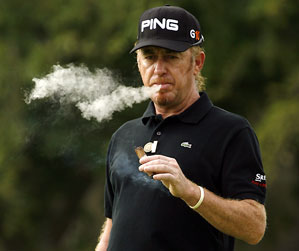
Many professional golfers, including Rocco Mediate, Davis Love III, and Darren Clarke, are cigar smokers who will take their stogies on the course with them. Spanish golfer Miguel Ángel Jiménez (pictured), winner of 18 professional tournaments, is often seen playing tournaments with a Cohiba.

Amateur golfers are even more likely to light up a cigar, given that, for them, the golf course is simply a place to relax and have fun, not a job. In fact, with it’s open spaces and generally smoke-friendly attitude, the golf course may be the ideal place to smoke a cigar. But that doesn’t mean anti-tobacco advocates aren’t trying to ban smoking on the golf course, and even with some success.

While the Spokane golf course ban failed, such a ban would hardly be unique. Jurisdictions in Hawaii, California, Colorado, Indiana, Texas, and Minnesota have already pushed smoking bans to include the greens, fairways, tee boxes, and bunkers of local golf courses. A public smoking ban that covered Torrey Pines, host to last year’s U.S. Open, meant that spectators were banned from smoking, although golfers were still permitted to smoke.

Patrick Reynolds, the turncoat heir to the R.J. Reynolds tobacco fortune who is now a spokesman for the Foundation for a Smokefree America, stated that the golf course smoking ban was “cutting edge” but “reasonable.” He also told a local reporter that the law would combat litter.

With statements like that, it seems that there is likely to be many more fights over outdoor golf course smoking bans in the coming months and years.

–Patrick S

photo credit: Timeinc.net

Stogie Reviews: Rocky Patel Decade Emperor

5 May

When he launched his cigar operation in the mid-nineties, few expected an outsider like Rocky Patel to survive for a decade. He had no Cuban heritage and no ancestral roots in an industry dominated by firms that are often family owned and operated for generations.

RP Decade EmperorRocky, however, did much more than merely survive the cigar boom. Bolstered by critical acclaim, blockbuster sales, and a reputation as one of the hardest working men in the business, his star rose to iconic status. And his Decade blend celebrates how he achieved ten years of success “against all odds.”

Speaking of odds, odds are you’ve probably tried at least one of the original four vitolas offered in the Decade lineup since they were released in November 2007. These smokes have garnered tremendously high ratings from Cigar Aficionado which, as one retailer recently told us, has driven consumer demand to the point of shortages on B&M shelves.

But most of you likely haven’t yet had the opportunity to sample the newest Decade size: the six inch by 60 ring gauge Emperor. Released in March, this cigar was born of Rocky’s success with wider sticks and intends to capitalize on the current “thicker is better” trend that’s reverberating throughout the industry.

While the Robusto, Lonsdale, Torpedo, and Toro Decade cigars are all box-pressed, the formidable Emperor boasts a typical parejo shape. That’s about where the differences end. It too is handmade at Nestor Plasencia’s El Paraiso Factory in Danlí and is composed of a dark Ecuador Sumatra wrapper and binder and filler tobaccos from Nicaragua.

Fairly soft to the touch, the Emperor yields an abundant pre-light aroma of cherry and chocolate. Its generous proportions include plenty of texture and tooth but few veins or seams.

From the very beginning you can tell this is the sort of cigar that has an incredible amount of flavor with very little strength. I encountered tastes of cocoa, nuts, and cream with a long, spicy finish. No harshness to be found. Of equal importance is the fact that the plentiful resting smoke produces an intoxicating scent that’s akin to a Vintage ’90 or ’92.

The white ash is soft, sandy, and flaky, and the draw—as you’d expect from such a wide cigar—is very clear. Unfortunately, the burn requires more touch-ups to stay even than I’d like from a stogie that retails for approximately $10-13 apiece.

Not withstanding that flaw, this marvelous 120-minute smoke includes enough subtlety and nuance to impress seasoned cigar veterans and enough forthrightness and accessibility to win over newbies. That’s why I’m giving the Rocky Patel Decade Emperor four and a half stogies out of five.

[To read more StogieGuys.com cigar reviews, please click here.]

–Patrick A

photo credit: Stogie Guys

Stogie Reviews: Padilla 1932 Churchill

4 May

Over a year ago, Don Pepin Garcia and Ernesto Padilla announced they would no longer be collaborating to make Padilla cigars. The partnership had produced some of Padilla’s most popular and highly acclaimed smokes, including the Padilla Miami, the Padilla 1948, and 1932.

Padilla 1932All three cigars were blended by Pepin and produced at his Miami or Nicaragua factory, but are now are made completely by Padilla. After the split, Padilla moved forward with a plan to open a small cigar factory in Miami’s Little Havana. But despite the separation—which came about because Pepin was focusing on his many other clients, including Tatuaje, 601, San Cristobal, and Pepin’s own Don Pepin Garcia brand—many of the Pepin-made Padilla cigars are still popping up.

The handful of Padilla 1932s that I sampled for this review are from the Pepin-era. This series of photos demonstrates the differences, of which the most notable is the font used in the word Padilla: in the Pepin-era smoke, Padilla is in bold capitals; the newer band features Padilla in script. Given the timing of the split, I can conclude that my Pepin-made 1932s have at least one year of age.

Underneath the ornate band, the Padilla 1932 features a nearly flawless, deep brown Nicaraguan corojo wrapper that surrounds Nicaraguan criollo binder and Nicaraguan Cuban-seed filler. The seven inch by 50 ring gauge Churchill is firm to the touch, and has a well-made triple cap. Pre-light, the foot gives off an aroma of earth.

Once lit, I was greeted by a complex smoke of licorice, spicy cedar, roasted cashews, and bittersweet chocolate. The full-bodied taste is complex and balanced with a long, dry finish. As it progressed to the midway point, it became slightly milder, developing a bit of toffee sweetness. Some of Pepin’s characteristic peppery spice also came to the forefront. The construction was also impressive: no touch-ups were needed, the draw was deliberate but not difficult, and the ash held admirably.

The 1932 is fuller-flavored than the Padilla Miami and more complex than the 1968 blend. Once the toffee and pepper kicked in in the second half, it particularly reminded me of a combination of two of my favorite smokes: the Coronado by La Flor and the Pepin-made EO Cubao.

The cigar was created as a tribute by Ernesto Padilla to his late father, Heberto Padilla, a well-known Cuban writer and poet who was placed under house arrest by the Castro regime for “subversive” writings. Heberto was born in 1932, and it’s an impressive tribute.

At around $12 per cigar, it’s priced appropriately for the reliably complex, balanced, and, most of all, enjoyable flavors it provides. All of which earns the Padilla 1932 Churchill a rating of four and a half stogies out of five.

[To read more StogieGuys.com cigar reviews, please click here.]

–Patrick S

photo credit: Stogie Guys

Quick Smoke: EO 601 Serie “Blue” Toro

3 May

Each Saturday and Sunday we’ll post a Quick Smoke: not quite a full review, just our brief take on a single cigar.

EO 601 Serie “Blue” Toro 

I was anxious to see how this habano maduro-wrapped cigar would perform after some time my humidor. While the Toro (6.25 x 52) wasn’t noticeably different than when I reviewed it fifteen months ago, it certainly wasn’t disappointing. Flavors of dark chocolate and roasted nuts dominate this stogie, Pepin’s first box press and also his first maduro. The burn required a fair number of touch-ups to stay even, but the rich taste more than makes up for construction shortcomings.

Verdict = Buy.

–Patrick A

photo credit: Stogie Guys