Search results: site-policy/images

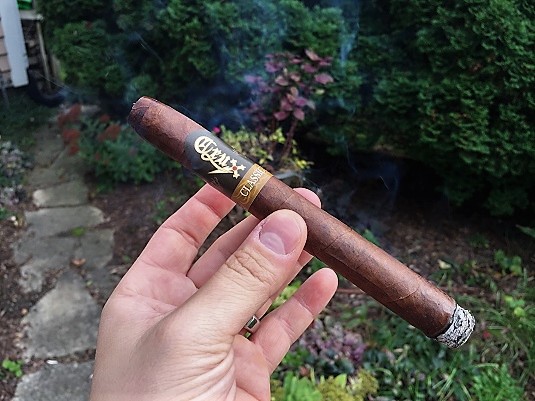
Quick Smoke: Crux Classic Corona Gorda

4 Nov

Each Saturday and Sunday we’ll post a Quick Smoke: not quite a full review, just our brief verdict on a single cigar of “buy,” “hold,” or “sell.”

My colleague George E has written favorably about quite a few Crux smokes, including Guild, Sports, Limitada PB5, Passport, du Connoisseur, and Ninfamaniac. My experience with the boutique operation—created by Jeff Haugen and Joel Rogers, owners of the Tobacco Grove shop in Minnesota—is very limited, though. So when my father recently handed me a Crux Classic Corona Gorda (5.375 x 46) and said it had become one of his favorite everyday smokes, I was intrigued. After smoking it, I was impressed. This blend features a Nicaraguan Habano wrapper around Nicaraguan binder and filler tobaccos. The flavor is a spice-forward, medium-bodied combination of leather, black pepper, bread, and sweet cream. The combustion qualities are superb. A great bang for the buck and an easy recommendation.

Verdict = Buy.

Patrick A

photo credit: Stogie Guys

Cigar Reviews: Fable Fourth Prime Mersenne

30 Oct

Like many of you, I’m sure, I’ve been a huge fan of RoMa Craft Tobac for years. In my estimation, the entire portfolio is well-made, expertly blended, and relatively easy on the wallet. What’s not to like? So when I came across a cache of smokes from Fable Cigars at my local tobacconist, I couldn’t pass up the opportunity to try a few.

For the uninitiated, Fable comes from the RoMa Craft’s home factory in Estelí, Nicaragua: Fabrica de Tabacos NicaSueño S.A. The brand debuted in early 2016 and is made for owners Sean Kremenetski and Mitul Shah.

Fourth Prime is Fable’s inaugural release. (There is only one other line listed on Fable’s website, Fourth Prime Limited Production; but, again, the brand has only been around for less than two years, and there’s absolutely nothing wrong with having a small portfolio if that portfolio is really solid.) The line “is the story of the number seven and the significance it holds in our world,” according to the Fable website.

Fourth Prime is described as “medium to full strength” with “full flavor” and “full aroma.” It is available in four sizes: Sapta (6.25 x 54), Mi (5.75 x 46), Doc (4.25 x 52), and Mersenne (5.25 x 56). The recipe includes a dark Pennsylvania Broadleaf wrapper, an Ecuadorian Habano Ligero binder, and filler tobaccos from Nicaragua and the Dominican Republic.

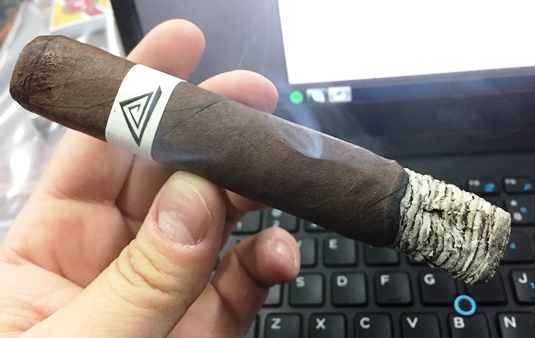
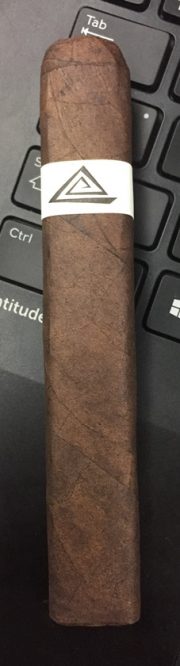
Mersenne (5.25 x 56) is named for Marin Mersenne, a French monk who lived in the 17th century and is known for his work on prime numbers. It is adorned by a simple white band with a curious black emblem. On the Fable website, you’ll find the following: “The triangle logo is a minimalist representation of the fourth prime number—seven. Seven lines that form the letter P when turned sideways.”

The cigar’s exterior leaf is toothy and textured yet devoid of anything but the slimmest of veins. It is rectangle-pressed and fairly firm to the touch. Despite that firmness, though, the flattened cap clips easily to reveal an ultra-smooth cold draw.

Once lit, the introductory profile is full-bodied, full-strength, and spice-forward with a meaty texture. Individual flavors include a sweet gassiness, espresso, cayenne heat, and cedar.

After an inch, the spiciness tones down considerably, but the flavor remains full. The retreat in spice makes way for some new notes, including caramel and dark chocolate. At this point, the core is a bold combination of earth, black coffee, dry oak, and burnt marshmallow.

As expected, the finale is characterized by a reprise of spice and strength from the outset, plus a grittiness that reminds me of San Andrés tobacco.

The combustion properties are impeccable, as one would expect from NicaSueño. The burn line is perfect, the white ash holds well off the foot, the draw is super-clear, and the smoke production is ridiculously voluminous.

To put it plainly, the Fable Fourth Prime Mersenne is an intense cigar that’s loaded with flavor. I paid about $10 per single, which seems entirely reasonable given the quality. I suggest you give it a try. In my book, it earns four stogies out of five.

[To read more StogieGuys.com cigar reviews, please click here.]

Patrick A

photo credit: Stogie Guys

Quick Smoke: Tatuaje Tattoo Caballero

29 Oct

Each Saturday and Sunday we’ll post a Quick Smoke: not quite a full review, just our brief verdict on a single cigar of “buy,” “hold,” or “sell.”

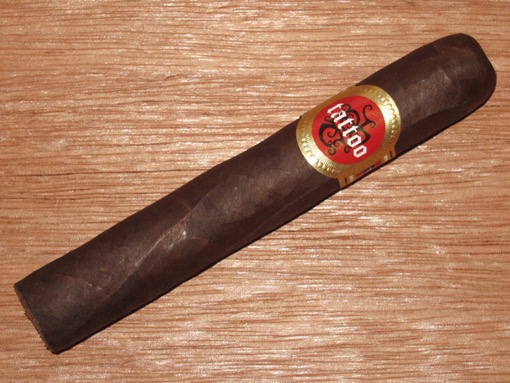
Tatuaje’s “Tattoo” cigar was originally conceived largely to defend Tatuaje’s trademark rights; Tatuaje being Spanish for Tattoo. However, eventually a re-blended expanded Tattoo line was introduced as a regularly-released, value-oriented, currently four vitola line. (The later release uses a red background behind the words Tattoo, while the earlier version had a white background.) The cigar – which costs just $5 for the robusto-sized “Caballero” – now utilizes a dark Ecuadorian Habano wrapper around Nicaraguan binder and filler and is made at the Pepin family’s TACUBA factory in Esteli. The medium-full bodied cigar features earth, oak, damp cardboard and pepper notes. The flavors aren’t elegant or particularly balanced, but the Tattoo certainly earns points for value.

Verdict = Hold.

– Patrick S

photo credit: Stogie Guys

Cigar Spirits: The Macallan Cask Strength and Aberlour A’Bunadh Single Malt Scotch Whiskies

25 Oct

One of the best things about single malt scotch is the variety in choice. Unlike straight bourbon or rye, the legal definition of single malt lends itself to starkly contrasting styles.

Sing malt can be peated or un-peated; aged in first fill, refill barrels, or a combination of each; and can use different barrel types (sherry, bourbon, port, etc.) for all or some of the aging. In addition, region, water source, and age can help make each whisky distinctive.

Personally, I tend towards the extremes of single malt styles. On one end are heavily peated styles (Ardbeg, Laphroaig, Lagavulin). On the other are sherry bombs (The Macallan and GlenDronach).

Within the heavily sherried style is the sub-category of cask strength whiskies. Today I look at two such single malts:

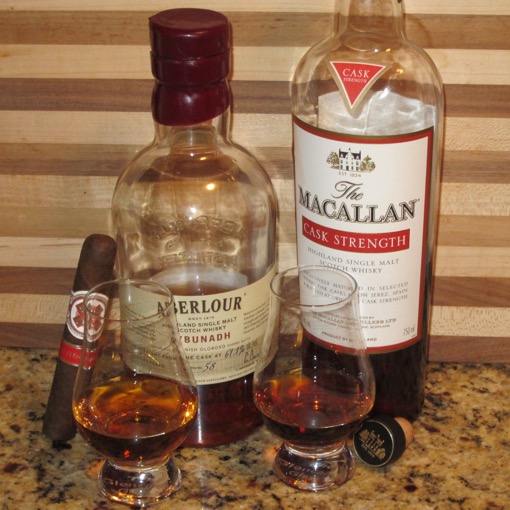
The Macallan Cask Strength

Macallan is the quintessential sherried single malt, and the Cask Strength offering shows off its mastery of the style. This particular bottle is 59% ABV and is a remarkably dark crimson color.

The nose features rich dried fruit, dates, and toffee. The flavors are intense with more dried fruit (raisins, dates, maraschino cherries), ginger, pralines, nutmeg, graphite, and chocolate. The finish lingers with oranges, more red fruit, baking spices, and brown sugar.

Macallan’s Cask Strength is a hedonistically rich single malt. Despite the high proof, it is easily enjoyed neat, though you should also try it with a drop or two of water.

Now for the bad news. While it once could be found for $99, this whiskey was discontinued a few years ago and has become nearly impossible to find. Macallan introduced a Classic Cut Limited Edition this year that uses a similar label and is high proof and aged in “oak casks seasoned with Oloroso sherry,” but reviews suggest it isn’t as intensely sherried as the discontinued Cask Strength.

Aberlour A’Bunadh

Aberlour uses sherry cask aged whisky in combination with bourbon casks in most of its offerings, but A’Bunadh (Scottish Gaelic for “of the origin”) is exclusively sherried whisky bottled at cask strength, in a style the distillery says it made a century ago. Each batch (I’ve tried multiple batches, but today I’m tasting Batch 58) is a blend of whiskies aged in first filled sherry casks of various ages.

Bottled at 61.1% ABV, Aberlour A’Bunadh Batch 58 is a light mahogany color. The nose features black cherry, apricot, and coffee grounds. The palate has some tannic notes with walnut, cinnamon, orange zest, nougat, and brown sugar. The finish is long with butterscotch, baking spices, and oak.

Unlike Macallan Cask Strength, Aberlour A’Bunadh isn’t difficult to find. And while prices can vary wildly, you can usually find it for around $80. It lacks the sherried intensity of the bold Macallan, but it is still a tasty, rich, lush, dram that’s brown sugar- and fruit-forward.

Cask strength sherried single malt pushes the style to its limit in a way that can be divisive. If you like sherry-forward whisky at a more traditional proof, you owe it to yourself to try Aberlour A’Bunadh and, if you can find it, Macallan Cask Strength. Other whiskies in the style include Highland Dark Origins, Glenlivet Oloroso Nadurra, and GlenDronach Cask Strength. For me, they represent the perfect after-dinner scotch whisky, cutting through a heavy meal and pairing perfectly with a medium- to full-bodied cigar.

–Patrick S

photo credit: Stogie Guys

Cigar Insider: Ernest Gocaj of General Cigar

23 Oct

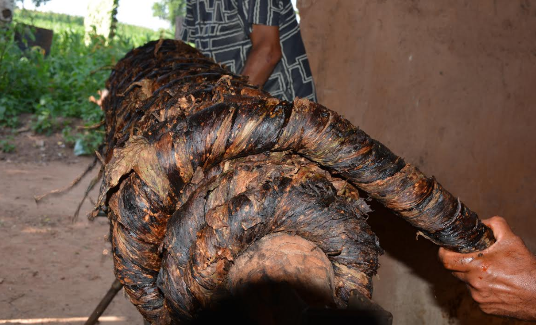
For anyone interested in cigars and tobacco, CAO’s Fuma Em Corda is a fascinating release. The sight of its Arapiraca ligero filler leaves fermenting in thick ropes resembling coiled anacondas is unlike any other.

I was, of course, curious about the cigar, the tobacco, and the process, so I reached out to Ernest Gocaj, General Cigar’s director of tobacco procurement who’s deeply involved in the company’s adoption of many exotic strains from around the world.

Gocaj said he came upon the special tobacco used in the Fuma Em Corda in Alagoas, a small Brazilian state on the eastern coast. The rope fermentation process is used only in Alagoas and only for ligero leaves—those at the top of the tobacco plant often characterized by spice and strength.
Tobacco farmers in Alagoas use more conventional methods of fermenting the lower leaves to allow moisture and ammonia to dissipate.

“The tobacco from Alagoas is Arapiraca, a native seed that’s only grown there,” Gocaj said in an email. “For CAO Fuma Em Corda, we use only ligero leaves which are harvested and sun-cured, and we use this tobacco as filler.”

“Once the tobacco turns brown, the natives make it into a rope and twist it regularly to expel the juices of the tobacco. At this time, ammonia is released and the flavor is softened. In other words, the harshness is removed from the leaf. Everything is done in sunlight. The tobacco becomes very pure and refined through this method.”

Gocaj has been with General Cigar for about 20 years after earning a degree in agriculture in his native Albania and moving to the U.S. He has worked at the company’s Connecticut farming operation and has been instrumental in developing General’s vast tobacco library.

For CAO’s Amazon Basin series, the blends include tobaccos from numerous countries in addition to Brazil. Fuma Em Corda, the second in a planned trilogy, features a Cameroon binder and a Honduran wrapper. It is a limited release with a Robusto (5 x 50, $8.99) for brick-and-mortar retailers and a Toro (6 x 58, $10.49) for online sales.

I’ve smoked several of the Robustos, and they definitely stand out. From the rich, leathery pre-light aroma to the spicy, cedar start, the cigar makes a statement. Along the way, I also encountered chocolate, coffee, and some nuttiness. Strength is medium, with a good burn and strong smoke production.

“Curing under the sun and rope fermentation in an open environment has many advantages,” Gocaj wrote. “The result is tobacco with subtle flavors that blends well with other tobaccos. These methods produce a tobacco that is very pleasant to smoke.”

Like a lot of cigars containing unusual tobaccos or using different production methods—fire-cured tobacco is one example that comes to mind—the smoking experience is distinctive. Some will find it to their liking. Others won’t. I doubt many will be neutral.

For me, Fuma Em Corda is a cigar I’d reach for when I want something different, not on a steady basis. That’s not a knock. I’ve enjoyed those I’ve smoked and would certainly recommend any experienced cigar smoker give it a try.

–George E

photo credit: General Cigar / Stogie Guys

Quick Smoke: MBombay Corojo Oscuro Gordo

22 Oct

Each Saturday and Sunday we’ll post a Quick Smoke: not quite a full review, just our brief verdict on a single cigar of “buy,” “hold,” or “sell.”

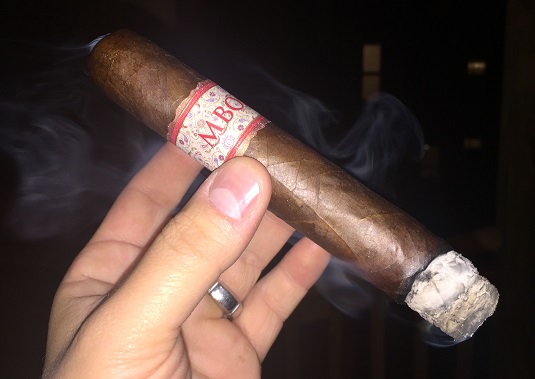
This MBombay creation was launched about three years ago and sports a beautiful, dark, oily Ecuadorian wrapper. The Gordo (6 x 60) is one of five vitolas in the Corojo Oscuro line. It retails for about $10. In addition to admirable construction properties, it has a dense, rich profile that’s medium- to full-bodied with hints of dark chocolate, espresso, cereals, dry wood, cayenne spice, and salted sunflower seeds. The finish is smooth and the texture is bready. I’m not a fan of this size in almost any blend, but the Gordo is balanced and interesting enough to keep my attention for the duration of the long, satisfying smoke.

Verdict = Buy.

Patrick A

photo credit: Stogie Guys

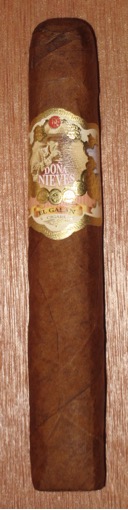
Cigar Review: El Galan Dona Nieves Negra Macha

18 Oct

Cuban cigarmaker Felix Mesa created El Galan Cigars in 2010 and makes the half dozen El Galan blends in his factory in Estelí, Nicaragua. In an interview last year, he explained why he left Cuba and started his own cigar company:

“I am Cuban, 41 years old, son and grandson of the third generation of a humble peasant family from the former province of Las Villas, today called Spiritus Santis in the Cabaiguan town where I was born and grew up in a field called the Purial, which is a tobacco region in Cuba. I left Cuba with a dream which could not realize there for the reasons that many know; there you can’t do registration marks, much less sell tobacco and to be able to pay tribute to a family who deserved it as many others to achieve experiences and wisdom in this beautiful tobacco industry.”

El Galan’s Dona Nieves cigar is named after Mesa’s grandmother, who worked in Cuban tobacco fields until she was 86 years old (and clearly remains a strong influence on Mesa). Even the three vitolas—including the box-pressed Negra Macha (5.5 x 54)—are all nicknames for Mesa’s grandma.

The cigar uses an Ecuadorian Habano wrapper around Nicaraguan binder and filler tobaccos. It isn’t easy to find, but you can locate it online for around $6.

The cigar features intense pre-light aromas, including barnyard with light fruit. It is densely packed with a light box press and a light brown, slightly splotchy wrapper.

Once lit, the Dona Nieves produces a complex array of flavors that include burnt toast, shortbread, cinnamon, nutmeg, white pepper, and cafe-au-lait. It’s full-flavored and medium-bodied. Construction is excellent with a sturdy ash despite a slightly wobbly burn line.

If I’m being honest, I picked up these cigars on a complete whim just because a Nicaraguan-heavy, Ecuadorian Habano-wrapped cigar made by a Cuban sounds a lot like some of the other cigars I’ve liked over the years (e.g., early Don Pepin and A.J. Fernandez).

I’m glad I did. This is a flavorful, complex, well-made, balanced smoke at a very fair price. If you’re looking for something new to try, check out El Galan Dona Nieves Negra Macha (since you probably haven’t smoked it yet). It was a pleasant surprise for me and earns four and a half stogies out of five.

[To read more StogieGuys.com cigar reviews, please click here.]

–Patrick S

photo credit: Stogie Guys