Search results: site-policy/images

Cigar Review: Foundry Time Flies 550

15 Feb
foundry-timeflies

When large companies find themselves under assault from smaller operations with innovative products, the response is often to try to replicate what’s leading the attack.

Time FliesThink of Ford’s Pinto to compete with smaller foreign imports, or MillerCoors’ Blue Moon reaction to craft beer brewers, or any one of many similar situations.

In the cigar world, a prime example is General Cigar’s Foundry Tobacco Co. The division was created in 2012 under the now-departed Michael Giannini, who’d come to General after Swedish Match bought Ernesto Perez-Carrillo’s successful boutique brand that made La Gloria Cubana.

Foundry has featured nearly every card in the boutique deck: exotic packaging, silly and obscure brand names, baroque themes, limited editions, elaborate back stories about the tobaccos, etc. Additionally, General Cigar has moved some of its historic, if under-appreciated, brands like Bolivar, Ramón Allones,  and Temple Hall under the Foundry umbrella.

With Time Flies, Foundry joined in the collaboration trend. This four-size line, introduced at the 2016 IPCPR Trade Show, was created by Giannini and A.J. Fernandez and rolled at Fernandez’s factory in Estelí, Nicaragua.

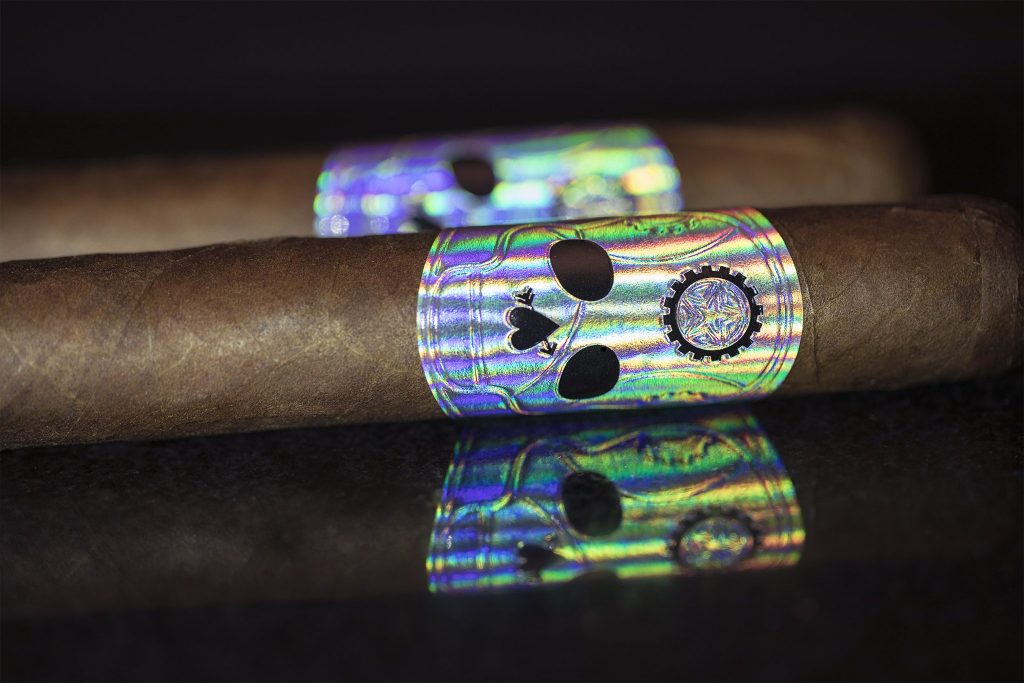
With all that surrounds Time Flies—skulls, wild colors, aphorisms on the band, a $35,000 humidor—you’d be forgiven for assuming the line is just another gimmicky creation. In this case, though, I believe you’d be wrong. The half-dozen Time Flies robustos I’ve smoked are strong, satisfying cigars.

The regular release Time Flies smokes feature an Ecuadorian Habano 2000 wrapper over Nicaraguan binder and filler. MSRP on the 550 robusto (5 x 50) is $7.50, and the most expensive in the line is the 660 at $9. (There’s also a limited edition with a Sumatra wrapper, which I haven’t tried.)

The opening notes of the cigar are hot pepper, which remind me of some of Don José “Pepin” Garcia’s early creations. The volume lowers about an inch in, which is where you begin to pick up woody notes and dark coffee.

At the halfway point, the pepper reemerges and mingles with some cedar. Toward the final third, there’s some sweetness as well.

I found the overall strength to be on the higher end of medium, though it ramps up a bit in the second half. The finish is fairly light. Construction, burn, and draw are excellent, as is the smoke production.

All in all, I enjoyed Time Flies and rate it four stogies out of five.

[To read more StogieGuys.com cigar reviews, please click here.]

–George E

photo credit: Foundry Cigars/Stogie Guys
Commentary: Older and (Somewhat) Wiser, At Least When it Comes to Cigars

13 Feb

20170213_053259148_iOS

Over the course of twelve years of serious cigar smoking, I’ve learned a thing or two. True, there’s still so much more cigar knowledge to absorb—that’s one of the beautiful things about this complex, engrossing hobby—but I’ve come a long, long way since my early days as a young brother of the leaf.

I was thinking about this a week ago today, on my 34th birthday. Birthdays are a natural time for reflection, a chance to take stock in what has been accomplished, what is yet to be achieved, and, of course, lessons learned.

My cigar development—and the development of any new cigar smoker, I think—can be broken down into a few different categories of knowledge. First is gaining an understanding of your own palate. What you like, what you don’t like, and which cigars tend to satisfy you the best under different circumstances. This category is incredibly personal. There are no right or wrong answers, and your palate’s preferences may be entirely unique to you. This is why the phrase, “The best cigar in the world is the cigar you like the best,” rings true.

The second category concerns learning how to properly evaluate and taste a cigar. While the outcome of any evaluation might be completely subjective (for reasons mentioned in the preceding paragraph), there are a few criteria that, more or less, are universally applied. Think broad standards for characteristics like appearance, flavor, aroma, balance, burn, draw, smoke production, etc. For any one of these—like flavor, for example—there might be a number of tools that can be employed to assist with a thorough examination, like a tasting wheel or prevailing cigar literature about flavors commonly found in cigars.

Finally, I tend to lump all other cigar knowledge into a catch-all category for cigar-related tips, ritual know-hows, cultural norms, and other miscellaneous items. Here, you’ll find stuff like how to properly cut a cigar, how to store/age cigars, cigar shop etiquette, etc. This final category, I think, is teeming with misinformation—tidbits that 22-year-old me read or heard, accepted at face value since I didn’t know any better, and have since learned were either incorrect or misleading.

Allow me to throw out a few examples. For instance, ever recall learning that only wooden matches or butane lighters were suitable for lighting a cigar? Something about lighter fluid tainting a cigar’s flavor? Well, I’m going to call bullshit on this one. Not only have I used lighter fluid to ignite a cigar many times without noticing any impact to taste, but I have personally witnessed many of the world’s foremost cigar authorities doing the same. If the occasional use of a gas station-bought Bic lighter is good enough for some of the most admired cigar makers/blenders, then it’s good enough for me.

Here’s another load of crap I was taught early on: “To fix an uneven burn, you can rotate the cigar so the slow-burning part is at the bottom of the cigar. Because a fire needs oxygen to burn, the bottom of the cigar will burn faster (as it has access to more oxygen) than the top. This is also why you should rotate your cigar as you smoke.” I’ve tried this technique thousands of times and can’t say I’ve ever seen it work. If your cigar starts to burn unevenly, just touch it up with your lighter and be done with it. Problem solved.

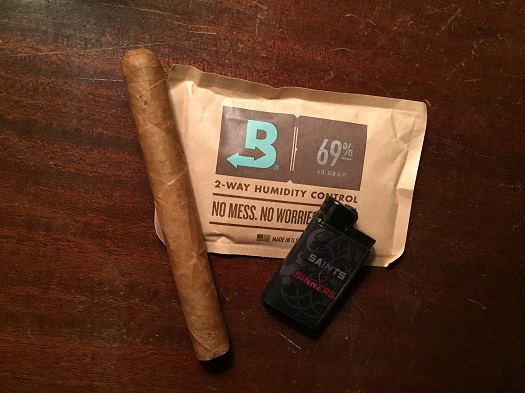
One last example for you. When I was younger, I used to obsess over monitoring the humidity inside my humidors. I had read 72 percent relative humidity was ideal, and I made every effort to achieve and maintain that level. Then I read 69 percent was best. Then I started to pay attention to a crowd that suggested certain types of cigars aged best at one humidity level, and others required different conditions. Enough already. After much trial and error, I don’t think it matters much. Somewhere between 65 and 72 percent is probably best. These days I just get the 69 percent Boveda packs, throw them in my humidors, and don’t even bother to worry about reading and calibrating the hygrometers anymore.

Am I starting to sound like a bitter old man? Maybe. But I think I’ve been around the block enough to form my own cigar-related opinions, however incorrect they may seem to some.

On that topic, if you disagree with anything above, or if you have other cigar myths you’d like to dispel, please let me know in the comments below. I am eager to continue to learn, and I am excited to see what knowledge I can attain over the next twelve years.

–Patrick A

photo credit: Stogie Guys

Quick Smoke: La Aurora 107 Cosecha 2006 Corona Gorda

11 Feb

Each Saturday and Sunday we’ll post a Quick Smoke: not quite a full review, just our brief verdict on a single cigar of “buy,” “hold,” or “sell.”

Cosecha

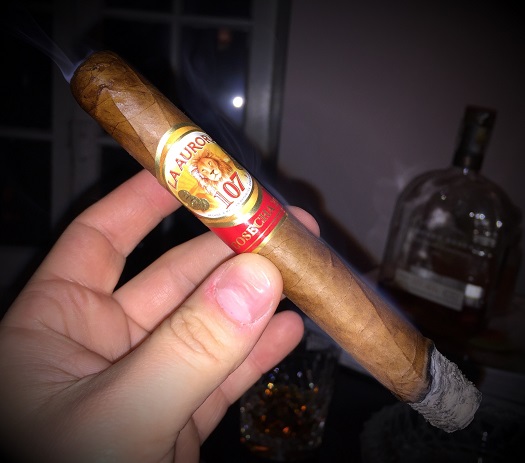
This limited edition, introduced last year, is a spinoff of the 107 line that debuted in 2010 to celebrate the storied history of the oldest cigar manufacturer in the Dominican Republic. It sports a Habana-seed wrapper grown in Ecuador around a Brazilian Mata Fina binder and filler tobaccos from Nicaragua and the Dominican Republic. The Corona Gorda (6 x 47, $10) is one of three sizes. In addition to solid construction, you’ll find a medium-bodied, well-balanced profile of dried fruit, citrus, sharp cedar spice, and coffee bean. My colleague recently reviewed this same cigar and liked it; I think I enjoyed it a little more.

Verdict = Buy.

Patrick A

photo credit: Stogie Guys

Photo Essay: Water, the Secret Ingredient to a Fine Cigar

8 Feb

Ask any cigar smoker what are the ingredients in a handmade cigar, and the answer will probably be something along the lines of this: 100% tobacco leaves (maybe they’ll also note vegetable glue, a small amount of which is used to attach the wrapper). This is without a doubt true, and let’s hope the FDA agrees, but when it comes to making cigars arguably the most critical ingredient is water, or more specifically moisture.

You don’t have to be an expert in cigars to know humidity matters. A cigar that is too dry loses flavor and burns too hot, while a cigar kept in too much humidity may be bitter, burn poorly, and risks mold in storage.

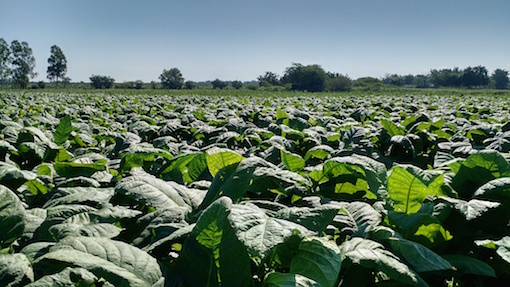
But the importance of water and moisture starts long before the cigar is rolled or ready to be smoked. Last week, I spent a few days visiting General Cigar’s facilities in the Dominican Republic. (Each of the photographs comes from the visit.)

IMG_20170130_104149482_HDR

I’ve visited cigar factories many times but, by starting this tour on the farm before going to the leaf processing facility and then finally the factory, it drove home the importance of controlling moisture to make an enjoyable final product. From seedling until harvest, of course, a tobacco plant needs water.

curingbarn-ext - 2

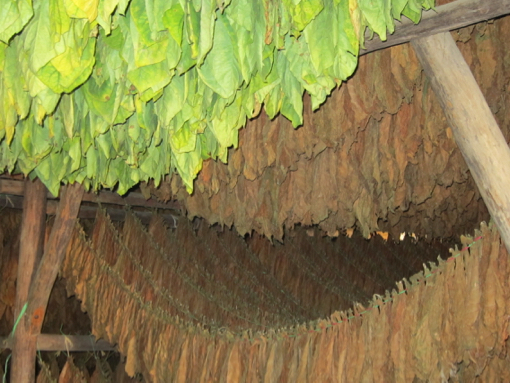
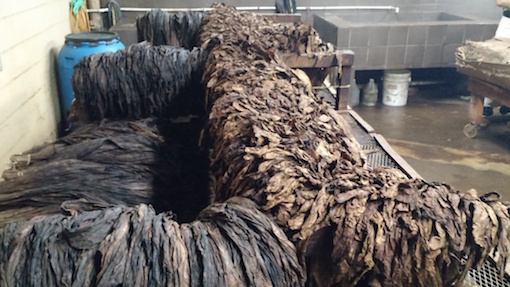
After leaves are primed (removed one leaf at a time, first from the bottom of the plant then, over time, upwards to the top) the work of preparing the tobacco begins. After harvest, green tobacco leaves go into curing barns where the the goal is removing the moisture, as well as the chlorophyll that makes leaves green. (Candela wrappers use a different curing process that locks in the green color.)

curingbarn-int - 1

When tobacco enters the curing barn, its moisture content is around 85%. After hanging upside down for four to six weeks (either sewn onto a rope or fastened to a wooden pole), the moisture level drops to around 30%. Some producers will use small fires in the barn to bring down humidity levels in what are generally high humidity tropical climates. At this point, the leaves are ready to be sorted and prepared for fermentation.

IMG_20170131_113029812

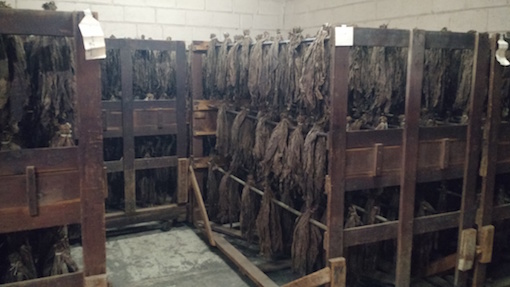
After curing, the tobacco leaves begin to look like the tobacco you’ll find in the cigars in your humidor. It isn’t ready to made into handmade cigars yet, though. The critical next step is fermentation, sometimes referred to as “sweating” the tobacco.

curingbarn-ext - 3

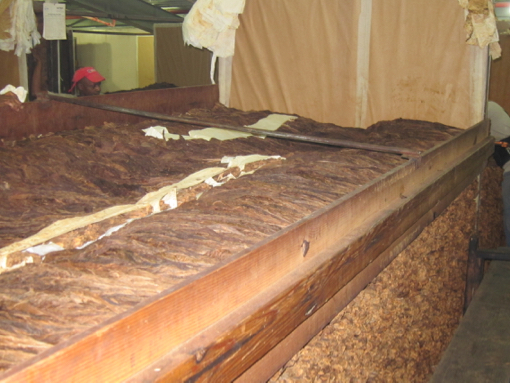
In fermentation, tobacco “cooks” by being stacked in a way that pressure, along with natural microbes, break down the tobacco and generate heat. Hands (a bunch of four to six leaves) of tobacco leaves are stacked in piles, often as high as six feet, where the middle particularly begins to rise in temperature.

IMG_20170131_110417993

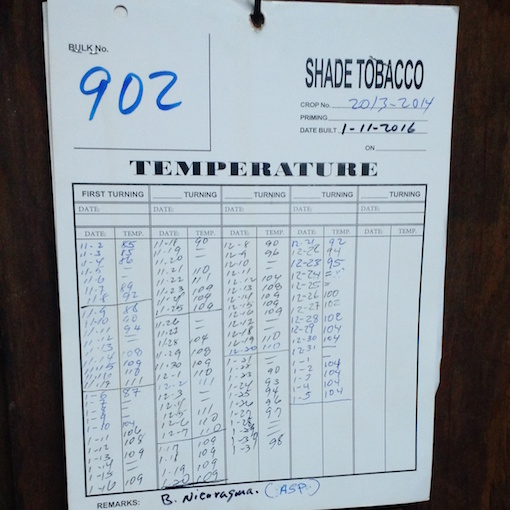
Temperature is closely monitored. If the tobacco gets too hot (140 °F, perhaps lower depending on the type of leaf) it will overcook. Over time, the tobacco is rotated to ensure even fermentation. By the time fermentation is completed, taste, aroma, and combustion are improved, while the harshness of nicotine, sugar, and ammonia are reduced as proteins breakdown.

IMG_20170201_102026656

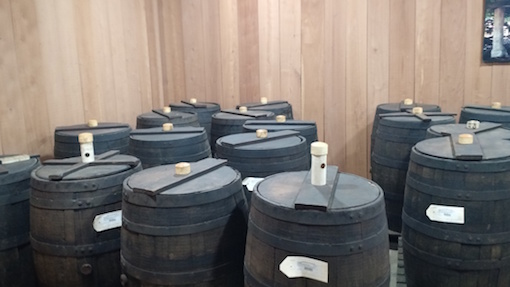
True maduro wrappers, as opposed to those that rely on artificial coloring, come from a longer, more intense fermentation process that creates a darker, richer color. At this point, the tobaccos are ready to be rolled into cigars. That said, some companies will age their tobaccos further (one to three years is not abnormal), the especially wrappers. This can be described as low level fermentation. For select tobaccos, aging in barrels (especially rum barrels) is another common technique to add even more complex and rich flavors.

IMG_20170131_121947704_TOP

Even as cigars are being rolled, proper moisture is key. Wrappers, in particular, are frequently moistened to make them more pliable and durable. Later, after the cigars are bunched and rolled, they go into aging rooms where moisture is again key. In the aging room, cigars release excess ammonia and equalize moisture levels between the filler, binder, and wrapper tobaccos.

IMG_20170131_140403358

After at least a few weeks in the aging room, cigars are ready to smoke. But, in order to remain ready to smoke weeks later, moisture content must remain stable between 65% and 70% relative humidity throughout shipping to your cigar shop and, eventually, to your home humidor, where Boveda packs or your humidification device of choice keeps humidity stable.

IMG_20170131_142302195

As you can see, controlling moisture from start to finish may be the single most important aspect to cigar production. The best tobacco without proper curing and fermentation will produce bad cigars. Only time, tobacco, and proper moisture control can produce a fine cigar.

–Patrick S

photo credits: Stogie Guys

Quick Smoke: Benji Menendez Partagas Master Series Prominentes

5 Feb

Each Saturday and Sunday we’ll post a Quick Smoke: not quite a full review, just our brief verdict on a single cigar of “buy,” “hold,” or “sell.”

Partagas-bmms-prominentes

Of all the many cigars made by General Cigar in Dominican Republic (think Cohiba, Partagas, Macanudo, most La Gloria Cubanas, and quite a few others), perhaps my favorite was the original Partagas Benji Master Series Majestuoso, something I mentioned last week while visiting General’s facilities in and around Santiago. No sooner than that evening, some of the 2013 release Partagas Benji Master Series Prominentes (7 x 49) were procured. The cigar features an oily wrapper (for a Cameroon) that came out of yellow-stained cellophane, paired with a Connecticut-grown Havana-seed binder, and Dominican and Nicaraguan filler tobacco. The Prominentes features light wood spice, coffee, and bread presented in a harmoniously-balanced, medium-bodied blend. The Majestuoso size (especially in the original 2009 edition) may still be better, but that’s no knock on the excellent 2013 Prominentes, which is definitely a cigar smoker’s cigar.

Verdict = Buy.

–Patrick S

photo credit: Stogie Guys

Cigar Review: Aguila Robusto

1 Feb

Aguila

In 2014, as part of President Obama’s efforts to normalize relations between Washington and Havana, the importation of Cuban cigars into the U.S. was partially legalized—only for officially licensed travelers to Cuba, and only if the value of the cigars (and rum) totaled $100 or less. Later, in March 2016, the $100 limit was eliminated, and the legalization was expanded to include the importation of Cuban cigars that were bought in Cuba or elsewhere overseas, as long as the cigars were for personal consumption. However, as we reported last fall, Cuban cigars still cannot be imported to the U.S. unless you are personally traveling with them. In other words, online sales of Cuban cigars to American residents are still illegal.

Aguila RobustoThat said, there a bevy of online retailers based overseas who claim to be able to ship authentic Cuban cigars directly to your door. Among them is iHavanas. “iHavanas operates out of a bonded warehouse located in Geneva, Switzerland, enabling us to offer our customers cigars with duty-free pricing,” reads the website. “All our cigars are purchased from authorized distributors, thereby ensuring authenticity.”

iHavanas is somewhat unique among overseas retailers in that it also has a house brand made in Nicaragua. The brand is called Aguila, which is Spanish for “eagle” (an eagle is prominently featured on the coat of arms and flag of Geneva). “We’ve noticed a growing interest in boutique brands of cigars and, although a few online retailers do offer custom-rolled cigars, we thought we’d go a step further and create a distinct brand,” said an iHavanas representative that, due to the nature of his business, wishes to be identified only as Bryan. “We had been in discussions with a number of factories in Nicaragua and the Dominican Republic, but eventually settled on this [undisclosed Nicaraguan] factory as we felt we were getting a high quality cigar that we could offer at exceptional value.”

Aguila was launched in October 2016 in three formats: Robusto (4.9 x 50, $47 per box of 10), Sublime (6.5 x 54, $49 per box of 10), and Torpedo (6.1 x 52, $48 per box of 10). The tobaccos include an Ecuadorian wrapper, a Jalapa binder, and long-filler from Estelí.

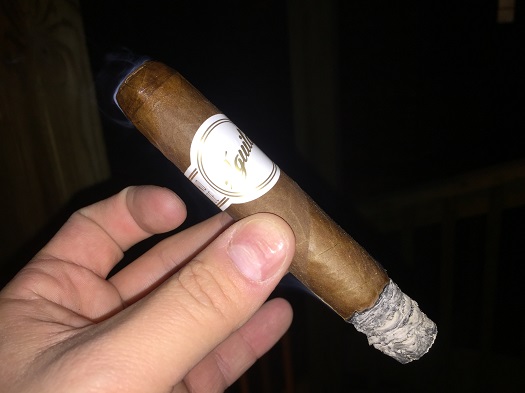
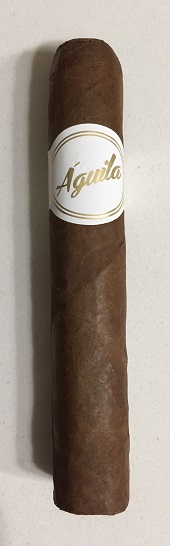
I smoked five Aguila Robustos for this review. The understated, elegant ring band of white and gold reminds me of another brand made by a company headquartered in Geneva: Davidoff. Beneath is a milk chocolate-colored wrapper that has only very thin veins, thick seams, and a moderate amount of oil and tooth. The feel is on the spongy side. Pre-light notes at the foot remind me of dried apricot, hay, and musty earth.

At the outset, a mild- to medium-bodied profile emerges with flavors of cinnamon, cedar, cream, and a cherry-like sweetness that, at times, verges on medicinal (think cherry cough drops). Cinnamon and cedar are sensations we all associate with spice, but in this case the spice is incredibly light. The texture of the smoke is somewhat sandy. After about an inch, a core of warm tobacco comes to the fore. Here, the sweetness is still playing a notable role. The finale is characterized by few flavor changes but a marginal increase in intensity.

The physical properties leave little to be desired. While the burn can get off to a poor start, it quickly self-corrects and then stays straight until the end. The draw is smooth and the smoke production is above average. The ash has a tendency to fall off a little prematurely.

For $4.70 per cigar when bought by the box of 10 (inclusive of shipping, mind you), the Aguila Robusto can be a nice little bargain for those who seek a low-cost, everyday cigar that packs considerable sweetness and feels at home in the garage, out on the yard, or on the golf course. It lacks complexity and balance, but I don’t think it was ever intended to be a special occasion masterpiece worthy of your undivided attention, either. In my book, this creation from iHavanas is worthy of three stogies out of five.

[To read more StogieGuys.com cigar reviews, please click here.]

–Patrick A

photo credit: Stogie Guys

News: Regulatory ‘Game Changer’ Creates New Opening to Repeal FDA Cigar Rules

30 Jan

FDA-cigars-large

Almost certainly, the timing of the FDA’s long-awaited deeming rule regulating cigars was influenced by a law passed two decades earlier called the Congressional Review Act. That legislation has long been interpreted to allow Congress to overturn agency rules and regulations within 60 legislative days of their enactment.

The Review Act works like this: If simple majorities of both the House and Senate vote in favor of a resolution to overturn an agency regulation, it then goes to the president’s desk. Unless the president vetoes the resolution, the regulation is not only overturned, but the agency is barred from enacting a similar rule again unless Congress specifically authorizes it to do so.

Because of the way the Congressional legislative calendar works, when the Food and Drug Administration (FDA) published the rule on May 10, 2016, the 60 legislative days were then guaranteed to pass in a way where even if Congress used the Congressional Review Act to attempt to overturn the regulation, such an action would land on President Obama’s desk. Given that the Obama Administration had initiated the new rule and that Obama had signed the Tobacco Control Act into law that authorized the cigar rules, a veto was guaranteed.

Had the FDA waited until later (June 13 turned out to be the cutoff, although the exact date wasn’t known until later), the Congressional Review Act action might have ended up on the next president’s desk. Thus, by getting the cigar deeming rule published in early May 2016, it appeared it was insulated from being overturned by the Congressional Review Act by a waiting Obama veto threat.

However, as detailed in a Wall Street Journal article published last week, one of the original drafters of the Congressional Review Act says that’s not how the 60-day clock was intended to work and, in fact, numerous regulations going back years could still be overturned using the Congressional Review Act:

Here’s how it works: It turns out that the first line of the CRA requires any federal agency promulgating a rule to submit a “report” on it to the House and Senate. The 60-day clock starts either when the rule is published or when Congress receives the report—whichever comes later.

“There was always intended to be consequences if agencies didn’t deliver these reports,” Mr. Gaziano [who was involved in drafting and passing the law] tells me. “And while some Obama agencies may have been better at sending reports, others, through incompetence or spite, likely didn’t.” Bottom line: There are rules for which there are no reports. And if the Trump administration were now to submit those reports—for rules implemented long ago—Congress would be free to vote the regulations down.

There’s more. It turns out the CRA has a expansive definition of what counts as a “rule”—and it isn’t limited to those published in the Federal Register. The CRA also applies to “guidance” that agencies issue.

If this interpretation of the Congressional Review Act is correct, could it be used to repeal the FDA’s cigar rules? Opponents of the regualtuons say they are looking into the possibility. Inquiries to the FDA’s media office were directed to the agency’s Freedom of Information Act contact, but the FDA’s Tobacco Products’ page listing reports to Congress shows no reports on implementation of the Tobacco Control Act since 2013. (Even if a timely report was submitted, guidance documents necessary for enforcing the FDA cigar rules could still be challenged under Gaziano’s interpretation.)

For opponents of the FDA’s cigar regulations, the benefits of this line of attack are two-fold. First, it would eliminate the Senate filibuster as a means of stopping Congress from sending the repeal to President Trump. And second, unlike new agency rule-making to undo the regulation, using the Congressional Review Act would bar the FDA from reissuing the rule (or something similar under a different administration).

Of course, it’s hardly a given that the Republicans in Congress will try this strategy, which even its proponents admit is “aggressive” and would require significant “intestinal fortitude.” Still, an alternative pathway to permanent repeal of the FDA cigar rules has presented itself, if those who say they oppose out-of-control regulation are willing to back up their words with actions.

–Patrick S

photo credits: Stogie Guys