Archive by Author

Stogie News: Play a Cigar Box Guitar

16 Dec 2010

And now for something completely different: puffing and picking.

Yes, that simple cigar box—like the ones you’ve got in the closet, the garage, and tucked who knows where—can make beautiful music beyond the joyous symphony of smoke the contents provide.

Just ask Steve Cinnamon. He’s a 64-year-old former ad exec living near Sarasota, Florida, who got involved in the old-time craft of cigar box guitars while recovering from a heart attack in 2009. He’s sold quite a few and been featured in newspapers and magazines.

Cigar box guitar history goes back at least to the Civil War. Pickers range from Lightnin’ Hopkins and Carl Perkins to Tom Waits and ZZ Top’s Billy Gibbons. You can hear numerous performances on YouTube and get lots of information, including DIY instructions, at the Cigar Box Guitars website.

Steve says his favorite boxes are Punch and Fuente. “Others work as well also,” he wrote me in an email, “but these seem to be some of the best sounds.”

His approach is a combination of traditional and contemporary. He favors the acoustic three-string model with frets over electric models. “I can make both,” he wrote. “However, I prefer not to make them electric, and it would lose the authenticity of the 150-year-old tradition.”

But he also utilizes resonators (sink drains) and modern designs, such as one that appears to be based loosely on the famous Gibson Flying V. He will build what a customer wants, though he said “most of the time my clients trust me to do the right thing.”

If you’re interested in one of Steve’s creations, he said he’s still working on his website but you can email him.

[View more photos of Steve’s cigar box guitars here.]

George E

photo credit: Stogie Guys

Stogie Reviews: La Aurora Corojo Gran Corona

15 Dec 2010

La Aurora cigars were among the first I smoked. I enjoyed them then and have since continued to look favorably on the Dominican firm’s products, though many of its releases in recent years have had fairly stratospheric prices.

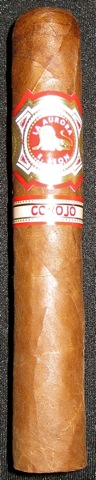
Not so with the new double-banded Corojo. Priced to appeal to bargain smokers, this line features substantial cigars for under $7. I paid about $6 for the 6.5-inch Gran Corona; the inch-longer Double Corona (both have a 50-ring gauge) is only 50 cents more, while the Robusto (pictured right) runs just under $6.

And what do you get for your money? Well, it’s not the prettiest cigar at the party. The reddish-brown Ecuadorian Corojo wrapper is a bit lumpy, sports quite a few veins, and has a cap that won’t win any prizes. But the wrapper’s pre-light bouquet is sweet and inviting. There’s not much aroma from the filler, which is a combination of Dominican Cubano and Olor along with Nicaraguan Habano.

Where it really counts—taste—is where the Corojo shines. It kicks off with a bit of the spice you expect from corojo tobacco. I used a cedar spill on one and, to me, that woody flavor mixed wonderfully for the first few puffs. The cigar generates a lot of smoke and features a good draw.

While not an overly complex smoke, the Corojo does create some variations along the way, including a little sweetness and leather, with a rich, full tobacco flavor predominating.

Negatives are only a few. The ash doesn’t hold. You need to be on alert to tap off frequently. The burn also isn’t particularly straight and can require an occasional touch-up.

Still, at the price, it’s difficult to complain. This well-balanced cigar would be a good deal at a couple of dollars more. Since its summer-time introduction, the La Aurora Corojo has garnered positive online buzz and quite a few favorable reviews. I think you’ll agree. I rate this three and a half stogies out of five.

[To read more StogieGuys.com cigar reviews, please click here.]

George E


photo credit: Stogie Guys

Stogie Tips: Dealing with Dreaded Tobacco Beetles

14 Dec 2010

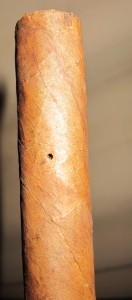
Recently, a single batch of cigars caused three different Stogie Guys’ humidors to show signs of the dreaded cigar beetle. The culprits were caught quickly, but the incident provides a good learning opportunity to talk about what to do when you notice beetle holes (pictured below) in your cigars.

Isolate

Immediately upon the discovery of signs of tobacco beetles, it is critical to stop them from spreading. This means not only removing cigars with beetle holes, but all others that may have beetle eggs in them. First you should inspect all your other cigars for similar holes.

If you see a beetle hole in one cigar, then that means the beetle has hatched and already moved on, likely to another cigar. In a small humidor, particularly where the cigars are not kept in cellophane, this means isolating the entire contents of the humidor. In a larger cabinet, if the infested cigar is in a closed box, I’d recommend isolating the cigars in that box, while keeping an eye on the other cigars in the humidor.

Decontaminate

Cigars with obvious holes should probably be tossed, because even though they may be dead after the decontamination process, smoking a cigar that has beetle eggs in it isn’t a pleasant experience. For all those cigars you are suspicious of, freeze them to make sure any eggs don’t hatch.

To do this, first put all the cigars in a ziplock freezer bag, then in a second ziplock, and carefully remove as much air from the bags as possible before sealing. Then place the bags into a refrigerator for 24 to 48 hours. Next, move them to the freezer for at least 48 hours, after which you again place the cigars into the refrigerator for two days. The stints in the fridge will make sure that the cigars don’t crack from too sudden of a temperature change or generate condensation, and the freezer will kill any beetle eggs.

Prevent

Once you’ve dealt with the contamination and made sure all your cigars are egg-free, it’s worth examining how they got there to begin with. High temperatures, particularly those above 75 degrees Fahrenheit, are conducive to eggs hatching, so keeping your humidors below 70 degrees is key. Personally, I find that 65 degrees and 65% humidity is ideal. But the real way to prevent beetles from wreaking havoc on your treasured cigars is make sure that cigar beetles aren’t present in your cigars before they go into your humidor.

Some manufacturers freeze their cigars, but others don’t. Getting information on who does and doesn’t can be hard to come by. (Plus, depending on how retailers keep their cigars, it is always possible for those that are frozen to become infested.) That means you have to be vigilant about what goes into your humidor. The best way to do this is to freeze every cigar before it goes into your humidor.

For those who feel this approach is overkill (including me), carefully monitor your existing collection and freeze new cigars that you may be suspicious of. Often, I keep new cigars separated for a month before they get mixed with my other cigars. And since high temperatures cause beetle outbreaks, I am far more likely to freeze cigars that have been shipped to me during the summer, when the temperature in a UPS truck is likely to be way above 75 degrees.

No matter what procedures you decide to put in place, knowing what causes cigar beetles and how you can minimize the risk of an outbreak is vital. Being vigilant will protect your cigars, and if a cigar beetle does sneak by, taking the steps above will minimize the damage they cause and protect your valuable cigars.

Patrick S

photo credit: Stogie Guys

Stogie Reviews: Indian Tabac Super Fuerte Robusto Natural

13 Dec 2010

Rocky Patel brings new meaning to the word “prolific.” The cigar superstar, almost always on the road, is known far and wide for his ever-expanding portfolio of cigars. Newly added lines include the 1961, Patel Bros., and 15th Anniversary.

Long before his Decade, Edge, Old World Reserve, Vintage blends, and many others, there was Indian Tabac—Rocky’s original brand made in Danlí, Honduras by Nestor Plasencia. “This cigar line was created in the 1990s with the true cigar aficionado in mind,” according to Rocky’s website.

The Super Fuerte is a box-pressed line made with Honduran corojo-seed wrappers, Nicaraguan binders, and filler tobaccos from Costa Rica, Nicaragua, and Honduras. Each vitola is priced to move. The Robusto (5 x 50), for instance, can easily be found for less than $3 per stick.

It looks more expensive than it costs. With a clean wrapper and a neat cap, this cigar—based on first impressions alone—could command a price twice its retail value. Subtle pre-light notes of coffee and syrup don’t hurt, either.

Still, I have to admit I had low expectations before I examined the two Robustos I smoked for this review. I’ve had subpar experiences with Indian Tabac in the past, and my colleague, George E, recently wrote that this cigar was “hot, dry, and harsh with a taste reminiscent of stale cigarettes.” That description doesn’t sound too appetizing.

Sadly, but not surprisingly, I can mostly confirm my colleague’s assessment. While the Super Fuerte brings intermittent flashes of cream and cashew, the base flavor is of salty spice and paper—a combination that’s simultaneously harsh and bland. There’s little transition from light to nub.

This profile makes the cigar’s excellent construction moot. After all, it’s hard to appreciate an even burn, a well-built ash, and a clear draw when the flavor doesn’t deliver.

No, the Indian Tabac Super Fuerte Natural isn’t much to write home about. But it isn’t quite a dog rocket either. I’m sure there are plenty of cigar enthusiasts out there who enjoy these as affordable everyday smokes. To them I say, “Smoke ’em if you got ’em.” For me, though, the Robusto is only worthy of two stogies out of five.

[To read more StogieGuys.com cigar reviews, please click here.]

Patrick A

photo credit: Stogie Guys

Quick Smoke: La Gloria Cubana Serie N JSB

12 Dec 2010

Each Saturday and Sunday we’ll post a Quick Smoke: not quite a full review, just our brief verdict on a single cigar of “buy,” “hold,” or “sell.”

We all know how different preferences can be among cigar enthusiasts. Sometimes, though, it’s amazing how they match just about perfectly. That’s what I kept thinking as I worked my way through this remarkably dark, oily stick. Check my colleague’s review from last month. The only thing I can add is that this fat, highly touted La Gloria Cubana offering is a major disappointment.

Verdict = Sell.

George E

photo credit: Stogie Guys

Quick Smoke: Paul Garmirian Soirée Belicoso

11 Dec 2010

Each Saturday and Sunday we’ll post a Quick Smoke: not quite a full review, just our brief verdict on a single cigar of “buy,” “hold,” or “sell.”

It has been close to a year since I wrote about Soirée, a Nicaraguan Colorado-wrapped blend launched in 2008 by Paul Garmirian. The Belicoso (6.25 x 52) may be the best of the line’s four vitolas. It displays outstanding construction with a well-balanced profile of dry wood, soft pepper, creamy caramel, and overall depth befitting a cigar that costs about$13.

Verdict = Buy.

Patrick A

photo credit: Stogie Guys

Stogie Guys Friday Sampler CCXVIII

10 Dec 2010

As we have since July 2006, each Friday we’ll post a mixed bag of quick cigar news and other items of interest. We call ‘em Friday Samplers. Enjoy.

1) U.S. Customs officials seized 30,000 Cuban cigars when the illegal smokes arrived at Chicago’s O’Hare airport this week. “The flood of the popular contraband is the biggest seen at the Customs and Border Protection’s Chicago field office, which typically seizes 10 to 12 cigars a week at the O’Hare international mail facility,” reports the Chicago Tribune. “Officials attribute the influx in the last two weeks to changes in U.S. Transportation Security Administration regulations…[which ban the] shipment of parcels weighing more than 16 ounces from passenger flights…Officials believe that because European shippers could no longer send packages via these flights, they stockpiled parcels until they could be put on cargo freighters, which fly less frequently.”

2) In order to help New York shops that are suffering under draconian state taxes, La Aurora is launching a cigar called “Broadway” that will only be available at Empire State tobacconists. The blend includes a double wrapper of Ecuadorian Sumatra and Nicaraguan leaves over a Dominican corojo binder and fillers from the Dominican Republic, Nicaragua, and Peru. The only size, Sumo Toro (5.75 x 54), retails for $12 (including taxes).

3) Inside the Industry: Rene Castañeda, vice president of Miami Cigar & Company, is turning over the organization’s national sales portfolio to Hector Paz to concentrate on international sales and product development. Davidoff named Hans-Kristian Hoejsgaard as their new CEO. Davidoff subsidiary Cusano Cigars will now distribute for Heavenly Cigars. With demand increasing, La Flor Dominicana has expanded production in its Dominican factory from five days  per week to six.

4) Around the Blogs: Epernay Le Ferme is curently rated a 94 at Cigar Ratings. Cigar Fan fires up the EP Carrillo. Smoking Stogie smokes the Dunhill Selección No. 50. Stogie Review reviews the Tatuaje Anarchy. Cigar Inspector inspects the Tatuaje Boris. Stogie Fresh lights up a La Aurora 107 Lancero.

5) Deal of the Week: This Hurricane Sampler includes a dozen smokes for just $40. Included are sought-after cigars from Diesel, Man O’ War, Gurkha, Padilla, and La Herencia. Use coupon code “JIMMY” and get free shipping if you buy two.

The Stogie Guys

photo credit: U.S. Customs