Archive | Cigar Reviews RSS feed for this section

Stogie Reviews: Mi Dominicana Corona

13 Oct 2009

Two months after the 77th annual International Premium Cigar and Pipe Retailers Association (IPCPR) Trade Show in New Orleans, the industry remains focused on the newest additions to the market. But many of us still have some catching up to do. The Mi Dominicana, introduced at last year’s IPCPR event in Las Vegas, is one blend that, until recently, never made it into my humidor.

Mi Dominicana CoronaMi Dominicana is the first Dominican puro made by tobacco giant Altadis. It is crafted by José Seijas, general manager of Tabacalera de Garcia, Ltd.—one of the biggest cigar factories in the world—and the man behind the Dominican versions of Montecristo, H. Upmann, and Romeo y Julieta.

Born in Santo Domingo, Seijas created this eight-vitola blend to honor his Dominican heritage. “Everything that is beautiful about the Dominican Republic has gone into this cigar,” he says on Altadis’ website. “Mi Dominicana is my personal tribute to our nation and our people…[It] truly captures the pride of my country.”

That pride is evident in the Corona’s promising appearance. This five and a half inch by 44 ring gauge cigar includes a carefully applied cap, a firm feel, and a toothy, oily wrapper. The sole aesthetic drawback is the network of thick veins that crisscross the cigar’s surface.

Pre-light, sweet floral notes shine though. A cold taste reveals honey on the lips and a slightly stiff draw, then the first lighted puff produces notes of sage, coconut, almond, and toast. The profile is fairly balanced and medium-bodied, and the aftertaste reminds me of yellow cake.

These flavors remain largely unaltered at the midway point. The only change, unfortunately, is a bitterness on the finish. That, and I find myself growing a bit bored of the once interesting taste—a boredom that carries through to the end of this 90-minute smoke.

While the flavor is neither completely dull nor utterly inspiring, Mi Dominicana’s physical properties are above average. The draw opens nicely, the white ash behaves well, and the burn only requires minimal touch-ups to stay even. These characteristics were apparent in both Corona’s that I smoked for this review.

Still, for a cigar that commands a price tag of about $7-8 apiece, José Seijas’ Mi Dominicana falls a bit short. I was left hoping for more from a highly anticipated blend that is intended to espouse the attributes of a great tobacco-growing nation. Ultimately, the Corona earns three stogies out of five.

[To read more StogieGuys.com cigar reviews, please click here.]

Patrick A

photo credit: Stogie Guys

Stogie Reviews: Arturo Fuente King T

8 Oct 2009

Tubed cigars are common in the cigar industry but, until the “King T,” Fuente hadn’t released one except for the limited God of Fire line. The King T has been in production for some time. Delays in creating the tube up to Fuente’s standards, though, reportedly held the cigar off the market until late September, when the cigars started appearing on B&M shelves.

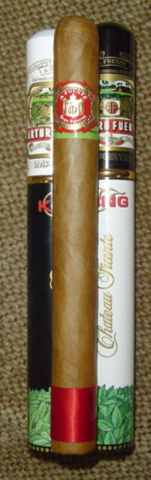
KingTMade by Tabacalera A. Fuente y Cia. in the Dominican Republic, the King T is a seven inch by 49 ring gauge Churchill featuring a Connecticut shade wrapper around Dominican binder and filler tobaccos.


Despite the name, the King T bears little in common with the King B, the big, tube-less, rosado-wrapped torpedo which was released in 2005. Check out the new Queen B (small belicoso) next to the King T if you’re looking for the latest Fuente rosado smoke.

The King T retails for around $10 per cigar, a price that no doubt reflects its special packaging. But you have to hand it to Fuente. When they make a tubo, they create an impressively ornate one.

The tube isn’t the only visually pleasing characteristic of the King T. The Connecticut wrapper is shiny, smooth, and vein-free. And as with most Fuente cigars, this Churchill is impressively firm.

The King T starts out with a combination of papery and peppery flavors. After it settles into a medium-bodied smoke with an oaky woodiness and bread flavors, the finish is long with a hint of cedar spice.

In both looks and flavor, the King T reminds me of the Fuente Double Chateau—but with a bit  more body and spice. Still, even with the spice, it’s well-balanced and mild- to medium-bodied.

The other main difference is that the King T costs nearly twice as much, which is really my biggest complaint. At $10 each, you feel like you’re paying quite a premium for the tubo.

That makes the King T a great gift, but not a cigar I’m likely to buy on a regular basis. With complex flavors, good looks, and flawless construction, though, the Arturo Fuente King T earns a rating of four stogies out of five.

[To read more StogieGuys.com cigar reviews, please click here.]

Patrick S

photo credit: Stogie Guys

Stogie Reviews: Tesa Havanitas Connecticut No. 1

7 Oct 2009

Tesa Havanitas Connecticut No. 1What do the Vintage Especial Rothchild and Gran Cru No. 2 have in common? Well, other than being produced by Tesa, they both rank among the best cigars I’ve reviewed in 2009. So it’s high time I check out “Havanitas,” another one of nine blends produced by this Chicago-based boutique manufacturer.

As you may recall from my previous reviews, Tesa is headquartered in a shop on the Near North Side of the Windy City. Their cigars are, according to the company’s website, “meticulously blended by Chicago area resident Chris Kelly and crafted in the Tesa Cigar factory in Estelí.” Tesa’s naked, tiger-endorsed blends make use of a variety of wrappers and filler tobaccos from Nicaragua.

The Havanitas line, available with a Connecticut shade or criollo ’98 maduro wrapper, comes in two slender sizes: No. 1 (7 x 36) and No. 2 (5.5 x 36). Only 90,000 per vitola are made annually.

With a sharp pigtail cap, a smooth and silky wrapper, and faint pre-light notes of honey and sawdust, the Connecticut No. 1 is as gorgeous as it is elegant. The only imperfection is a harmless “frog eyes” spot near the head.

The narrow foot is easy to light with a single wooden match. As the white ash begins to build, a crisp and satisfying profile develops that includes notes of dry wine, potato, toast, and cream. Mild, yet with plenty of flavor and some spice on the finish.

Warm honey, clove, and tea join in at the midway point to add depth. With each puff producing tons of aromatic smoke, it’s here where I start to appreciate this cigar’s easy draw—especially for a lancero—and razor-sharp burn. The last two inches are characterized by increased spice and notes of  meat and cereals.

As with the others in the Tesa lineup, this cigar’s main drawback is its limited availability and high cost. The only way to get your hands on one of these is to either visit the shop in person or purchase it from Tesa’s online store for $12.15 per single.

Notwithstanding those barriers, I still hope you decide to try at least one Havanitas Connecticut No. 1. You won’t be disappointed. For its complex flavor and high-quality physical properties, it earns four and a half stogies out of five.

[To read more StogieGuys.com cigar reviews, please click here.]

Patrick A

photo credit: Stogie Guys

Stogie Reviews: EO Cubao Maduro No. 5

5 Oct 2009

: EO Cubao Maduro No. 5 I have to admit I was a little disappointed when I smoked my first cigar from the new Cubao Maduro blend. Though I knew not to expect the spice of its natural sibling, I was unprepared for the difference the wrapper would make.
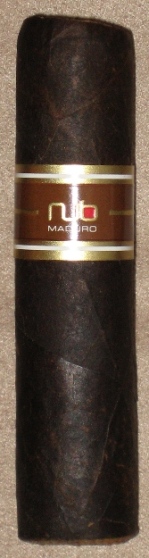
The Ecuadorian broadleaf maduro wrapper truly transforms the taste of the Nicaraguan binder and filler. My initial impression was that the Cubao Maduro was a little too bitter, too rough, and lacked the notes I typically associate with maduros.

Now, however, after quite a few more No. 5s (6.125 x 50), I’ve come to enjoy the cigar for what it is—not what it isn’t. And what it is, first and foremost, is its own cigar. Despite sharing names and innards with the original Cubao, they taste like completely different blends.

This Erik Espinosa, Eddie Ortega, and Don Pepin Garcia creation from EO Brands is a meaty, leathery, heavy-duty smoke not to be taken lightly. It requires attention, not only to appreciate its taste and aroma, but also for its practicalities as well.

The dark, thick wrapper, for example, can create a challenge keeping the cigar lit and burning evenly. Let it begin to burn down one side and you’ll experience a different cigar without the wrapper fully engaged. Yet the Cubao Maduro is also easy to overheat if you draw too frequently.

Rolled out at this summer’s IPCPR Trade Show, these cigars are not as widely available as the original Cubao blend or EO’s popular 601 line. I bought a box at an event in a local shop. The per-stick price appears to be around $6-8.

All in all, I have to say I prefer the original Cubao. I gave the No. 6 four and a half stogies when I reviewed it over a year ago. For me, this new blend isn’t quite at that level, so the EO Cubao Maduro No. 5 earns four stogies out of five.

[To read more StogieGuys.com cigar reviews, please click here.]

George E

photo credit: Stogie Guys

Stogie Reviews: Nub Maduro 460

30 Sep 2009

Sam Leccia was a popular guy at last month’s IPCPR Trade Show in New Orleans. That wasn’t surprising. He has an approachable personality, a sincere passion for cigar innovation, and a growing portfolio of tasty smokes—a portfolio that now includes Cain and a new maduro-wrapped version of his popular Nub series.

Oliva's Nub Maduro 460The concept for Nub was born of Leccia’s appreciation for the “dedication, passion, and manpower it takes to create a cigar.” It was during his time at Oliva, circa 2006, that he hatched the idea for “a high quality cigar that developed its optimum flavor extremely quickly.” He ultimately concluded that a short, stubby format provided for a cooler, tastier smoking experience.

So Leccia, a Pittsburgh native, left his position as a sales representative at the Oliva Cigar Company to found his aptly titled Nub brand. After getting his former employer on board (Leccia reportedly rolled the prototype himself), Nub launched as an Oliva product in early 2008 with three blends: Connecticut, Cameroon, and Habano.

Like the cigars in that original Nub lineup, the new Maduro features Nicaraguan binder and filler tobaccos. It is wrapped in an oily and toothy Brazilian maduro leaf that’s marked with some hefty veins and spotted with a sandy discoloration.

Packed tightly with tobacco, the four inch by 60 ring gauge “460” clips to reveal a slightly stiff draw and some sweetness on the lips. That sweetness is misleading, however, because the initial taste is anything but sugary. It includes notes of spicy black pepper and bitter coffee beans.

The draw opens up and the flavor evens out around the quarter inch mark. Leather, peanuts, and cream are added to the mix. Compared to the heavy-handed outset, this development enables more nuance and balance, which renders the Nub Maduro more interesting and less abrasive.

The slower I puff this stubby stick—I spent over 60 minutes with each of the two samples I smoked for this review—the better it performs. The medium-strength, full-bodied taste stays on an even keel if the tobacco is cooked at the right temperature. Impatient cigar enthusiasts might find the Maduro 460 to smoke too coarse, hot, and sour.

If you take your time, though, this cigar turns out to be rich and fairly multifaceted. And you’ll be hard-pressed to find a better constructed stick that sells for $4.50-6. While some age will likely help round off the Nub Maduro 460’s edge, for now it earns three and a half stogies out of five.

[To read more StogieGuys.com cigar reviews, please click here.]

Patrick A

photo credit: Stogie Guys

Stogie Reviews: Graycliff Double Espresso

29 Sep 2009

Graycliff Double EspressoEven harder to find than most of Enrico Garzaroli’s Graycliff Cigars, the Double Espresso is a limited edition, one-size extension of the Espresso line.
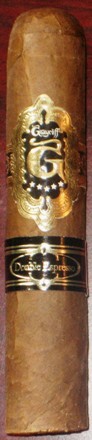
The four and a half inch by 54 ring gauge cigar features double the ligero found in the regular Espresso line. And like most of Garzaroli’s cigars, the it isn’t cheap, with a suggested retain price of $15 per stick.

The Double Espresso sports a milk chocolate-colored Costa Rican wrapper with a filler that is a mixture of Cuban-seed corojo and Ecuadorian ligero. It is slightly spongy, which I have found to be common for most Graycliffs.

Overall, the appearance is a little rugged with a cap that is less than perfect and a couple of knots in the wrapper near the head.

For a short cigar, it packs quite a punch in the taste department with a well-balanced core of coffee, chocolate, and spice. As a coffee lover I find the aroma of this stogie quite intoxicating, reminding me of a cup of nice French vanilla.

With its voluminous creamy smoke, this cigar really hits its stride about an inch in when the saltiness fades and the sweetness is amps up a bit. It is quite the treat with an even burn and fantastic balance.

Unfortunately, given the hefty price tag, an ash that was quite flaky, and some appearance issues, I can only give the Graycliff Double Espresso three and a half stogies out of five.

[To read more StogieGuys.com cigar reviews, please click here.]

Patrick M

photo credit: Stogie Guys

Stogie Reviews: Macanudo 1968 Trompeta

23 Sep 2009

Released last summer to commemorate the year Ramón Cifuentes began producing what is now America’s most popular premium cigar brand, Macanudo 1968 originally included four sizes. But last month, at the IPCPR Trade Show in New Orleans, General Cigar expanded the line with a fifth, less traditional vitola.

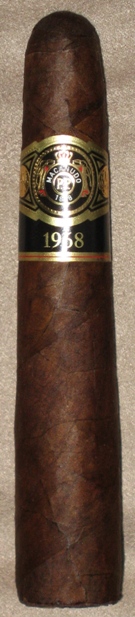
Macanudo 1968 TrompetaCalled “Trompeta,” it measures five inches long with a ring gauge of 60 at the foot and 40 at the head. According to a company press release, the idea is to “maximize the flavor of the critically-acclaimed blend while providing a quicker smoking experience.” It carries an MSRP of $6.99 and is intended for sale at brick and mortars only.

Like its Churchill, Gigante, Robusto, and Toro predecessors, Trompeta features a Dominican and Nicaraguan filler that includes tobacco grown on Ometepe, a volcanic island rising out of Lake Nicaragua. The binder is Connecticut habano and the wrapper is Havana-seed Honduran. As reported by the Macanudo 1968 website, the tobacco is “aged in tercios and charcoaled wooden barrels to further enrich its flavor.”

What strikes me about this cigar, other than its unusual shape, is its uniquely firm feel, pre-light notes of leather, and absence of obvious veins. The cap clips neatly to reveal a smooth draw.

Not surprisingly, it takes some work to establish an even light—especially if you’re using wooden matches. That effort is rewarded with a chalky flavor of firewood, black licorice, and spice. Tasty and interesting, but not particularly balanced or complex.

As the ring gauge narrows to 50, notes of steak, cocoa, and damp earth gain prominence. What was once a somewhat harsh and chewy profile settles into a lighter taste with nuance and cream. This subtler transformation is a welcome change that lasts until the final third when the smoke takes on a charred meat character.

The physical properties, typical of Macanudo, are exceptional. The gray, well-layered ash builds sturdily off the foot and the burn is straight and true.

I expect this cigar to strike a chord with those who enjoyed the first four 1968 vitolas and perhaps attract those who had previously ignored the blend. While the Trompeta is no masterpiece, you should consider picking one up when the frontmark hits retailer shelves in the coming week. For its good construction and flavor that flirts with both excellence and mediocrity, this new release earns three and a half stogies out of five.

[To read more StogieGuys.com cigar reviews, please click here.]

Patrick A

photo credit: Stogie Guys