
Book Review: Tobacco Sheds — Vanishing Treasurers in the Connecticut River Valley
17 Jun
To put it simply, this is a terrific book.
Whether you’re interested in history, cigars, preservation, tobacciana, or rural life, you’ll find yourself enchanted and enlightened as you move through this oversize volume just published by Schiffer Publishing for $24.99.
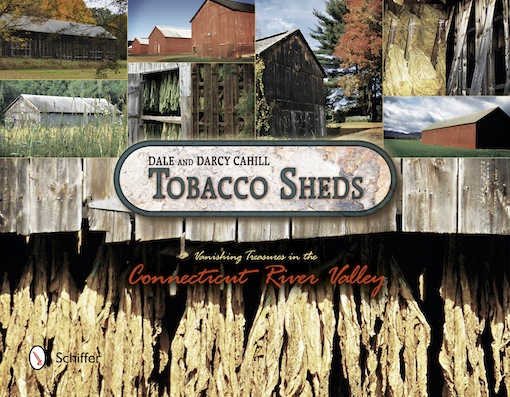
It will also likely sadden you a bit as you learn that these architectural treasures are rapidly vanishing from the landscape. Dale and Darcy Cahill, a pair of enthusiastic writers and photographers who have devoted themselves to documenting the sheds, estimate that more than 1,000 have been destroyed since their first volume on the subject was published in 2009.
This book uses a geographical theme to explore the sheds in words and roughly 250 photographs selected from about 7,000 frames. Beginning in Vermont and traveling the Connecticut River Valley south to Portland, Connecticut, the Cahills take readers on a marvelous journey.

In the book’s preface, cigar industry giant Carlito Fuente writes that “the tobacco barn stands tall, proud, and beautiful.†The Cahills describe it this way: “Whether standing inside or outside of a shed, a tobacco shed’s repetitive lines engage the eye†and the buildings themselves “evoke a sense of timelessness.â€
In addition to the structures, Tobacco Sheds provides fascinating introductions to people such as Mrs. Prout in South Windsor, Connecticut, who is said to be “the first person to roll a cigar in the United States,†and artist Erika H. Zekos, who lit a tobacco shed from inside as a public art project in 2009 to celebrate the 250th anniversary of Amherst, Massachusetts.
With the growing popularity of tourism to the cigar centers of Latin America, it seems an appropriate time to remember the reach and importance of cigar tobacco in the United States beyond Florida. And to do it not only with annual events, but by recognizing true artifacts.
This book is certainly a good way to do that. You should also check the Cahills’ website for other tobacco shed artwork, as well as their first book, Tobacco Sheds of the Connecticut River Valley. And StogieGuys.com will have more on the subject as well, with a interview of the Cahills and a contest you won’t want to miss.
photo credit: TobaccoSheds.com
 Antaño Dark Corojo is the line that first comes to mind when I think of Joya de Nicaragua. It was the first Joya I ever smoked and, for a while, it shaped my notion of what a Nicaraguan cigar should be. When I was just getting into cigars, I remember having a Joya on my lunch break after a light meal. I was not terribly productive for the rest of the afternoon.



 1) The

 The 1930 Collection, a six-vitola line introduced last year, is a big part of the maker. Using a Dominican wrapper and binder, with long-filler from Nicaragua and the Dominican Republic, it boasts a strength level—upper medium—beyond my image of most Nat Shermans.


 Sazerac, along with
 Patrick Ashby
Co-Founder & Editor in Chief
 Patrick Semmens
Co-Founder & Publisher
 George Edmonson
Tampa Bureau Chief