
Cigar Review: Para Ti Canonazos
8 Mar
Though you might not know it, Tatuaje creator Pete Johnson is a cigar distributor as well as a brand owner. And he doesn’t just distribute his own cigars, which are made in Miami and Nicaragua, but also those from a small cigar factory in the Dominican Republic.
 Para Ti is the project of Pete Johnson’s friend, Fred Schrader, maker of some of the most highly-regarded Napa Valley wines. A cigar enthusiast in addition to a vinter, Schrader has created two cigars at his small factory, both distributed exclusively by Pete Johnson’s Havana Cellars.
Says Pete of Para Ti: “I’m only doing the distribution, but it’s a trip for me because it’s a completely different country for me to be working with. This is their blend, I OK’ed it; I told them I’d be happy to sell it because the product is good. I don’t know a lot about the factory except that it’s called Para Ti and it’s very small. This is a way for me to help out a friend in the industry, but also, people have asked me to do this before and I never really wanted to do it and this one just seemed to fit right.”
With Johnson handling distribution, Schrader has created two cigars. Extremely hard to find, limited, and expensive ($25 each) is the Schrader Hispaniola Sparky Doco-Est MMIX, named after Schrader’s most exclusive wine. His other cigar, the subject of this review, is the Para Ti, a Dominican puro available in four sizes: Hermosos (4.5 x 52), Perlas (5 x 40), Prominentes (6 x 60) and Canonazos (6 x 48).
To evaluate the Para Ti, I smoked four of the toro-sized Canonazos, which retail for around $8 each. The cigar has as rough, rustic appearance with a medium brown wrapper that has both an oily sheen and many veins. It is firmly constructed, and produces an even burn and sturdy ash.
Para Ti (“for you” in Spanish) starts with forward and simple woody notes, but soon develops into a more complex medium-bodied cigar. It has a strong flavor of roast cashew that combines with dried fruit for a flavorful, balanced blend. Towards the final third it becomes more woody. It has a clean flavor profile with a soft finish.
Considering that I knew little about this Dominican before I smoked it, I found it to be an impressive creation. It’s one of those rare cigars where after smoking one, you’d consider lighting up another almost immediately. With bold, balanced favors and good construction, it earns a most impressive rating of four and a half stogies out of five.

[To read more StogieGuys.com cigar reviews, please click here.]
photo credit: Stogie Guys
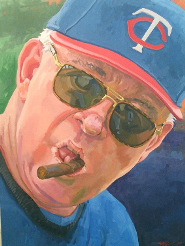 Kelly is having his number retired this year. After leading the team to two World Series titles and then sticking around to work in the Twins front office and occasionally moonlight as the color commentator on Twins TV broadcasts, it’s fitting that the franchise would retire #10. After all, he’s exalted in Minnesota baseball, the most successful manager in Twins history, and the only one to lead the Twinkies to a World Series title, which he did not once but twice.
 Lindstrom was
 The blends in the EO Brands portfolio—including 601, Cubao, Murcielago, and Mi Barrio—are all made at Don Pepin Garcia’s My Father Cigars factory in Nicaragua. So it comes as no surprise that the first line from the Ortega Cigar Company is also made by Pepin at My Father Cigars. Called “Serie D,†the blend boasts a Mexican maduro leaf from the San Andreas Valley surrounding Nicaraguan binder and filler tobaccos. “We are using some fillers from Jalapa and Estelà that are crazy good and help create a profile that is full-bodied with lots of spice, flavor, and aroma,†Ortega told us via email. “I know the consumer will love this one.â€


 1) The price of premium cigars increased by 25 cents per stick in Chicago yesterday. The president of the Cook County Board, Toni Preckwinkle (pictured), had originally proposed a 30-cent tax on cigars in November. When she did, Bill Spann, chief executive officer of the
 Patrick Ashby
Co-Founder & Editor in Chief
 Patrick Semmens
Co-Founder & Publisher
 George Edmonson
Tampa Bureau Chief