
Stogie Tips: How To Properly Cut A Cigar
23 Jul 2008
While enjoying a fine stogie is certainly more of an art than a science, there a few essential skills you should master in order to get the most out of the experience. While much of what makes cigars so great is the relaxed, ceremonial nature of smoking, when it comes to cutting your cigar, that artistry takes a back seat to function. The goal is simple: a cut that best allows you to enjoy the cigar.
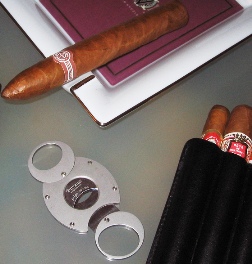
The cut that is best will enhance the flavors of the cigar by regulating the draw and appropriately focusing the flavors on your palette.
It’s worth pointing out that when it comes to cigar cutting, there are many different tools. Some people use specially-crafted cigar scissors, some use a sharp knife, a cigar punch, a V-cutter—some even use their teeth. But the most common tool, by far, is the guillotine-style cigar cutter, which comes in both the one blade (single) and two blade (double) varieties.
Here are a few general tips on deciding what tool to use:
- â— Cigar scissors are quite elegant, but tend to require a bit more skill and precision than other cutters. Also, while a dull blade hurts any cutter, scissors become particularly difficult if the blades aren’t ideally sharp and calibrated.
- â— Guillotines are the most popular cigar cutters with good reason. They are easy to use and are the most versatile. A double blade guillotine will usually prevent the pinching and tearing that can occur with a single blade cutter. Also remember to use firm, consistent pressure to get a clean cut.
- â— V-cutters can be perfect for cigars with small ring gauges, since they increase the surface area of the cut.
- â— Punch cutters are ideal for stogies with tightly-packed fillers because they can ease the draw, but a punch cutter is almost useless on a belicoso.
- â— If you find yourself without a cutting tool, skip your teeth and use your fingernail. A relatively precise cut can be made on non-torpedo cigars by using your nail to slice a circle in the wrapper and binder, which can then be lifted off to expose the filler.
- â— Knives are rarely a good idea, but if you are going to use one, use it to cut like you would your fingernail (see above).
Where to place your cut is another variable in the science of cigar cutting. With a guillotine cutter, take the head of the cigar (that’s the uncut end) and position it so the blade will enter the stogie just above the shoulder (where the cigar stops being round). If you’re planning to smoke a torpedo, a good rule of thumb is to slice off about half an inch, but it really depends on how much you want to focus the smoke with a smaller cut, versus how large you need the cut to have a draw that isn’t difficult.
Finally, remember to try out different cutters. While a cutter can’t actually improve a cigar, the cut can either bring out the best of a cigar or ruin it.
photo credit: Flickr
 Patrick Ashby
Co-Founder & Editor in Chief
Patrick Ashby
Co-Founder & Editor in Chief Patrick Semmens
Co-Founder & Publisher
Patrick Semmens
Co-Founder & Publisher George Edmonson
Tampa Bureau Chief
George Edmonson
Tampa Bureau Chief
A plus for the punch is that you can pretty easily attach one to most key rings so you have at least that tool available nearly all the time.
This is a pretty elementary post, but new smokers and longtime aficionados alike need to have a solid foundation in cigar basics. I encourage readers to share some of their own cutting tips so we can all benefit.
One tip from experience: if you get nicotine build-up on the head, just get out your guillotine and cut it again. Good reason to leave yourself a little room on the initial cut just in case. This works especially well if you used a punch initially (which seems to be more prone to the problem, in my experience).
Jeff: Smaller/narrower cuts in general — be they punch cuts or v-cuts — tend towards tar buildup after awhile, especially if you use such a small cut on a cigar with a large ring gauge. Good tip re: cutting again. That never would have occurred to me, but it makes sense. There's no rule against recutting an already-lit cigar, after all.
Best tip some of us learned at Casa Fuente: Don't let anyone else cut your cigar no matter how hot they are…LOL!
A strong word of caution re: cutting cigars with a knife: it's really not a good idea. I mean, you might be able to pull it off if you're very careful and use the methods outlined by Patrick in this article. But in my experience, knives just don't do the trick. There's a very real tendency to tear, split, or crush the end of the cigar — no matter how sharp the knife. One thing to keep in mind: never, under any circumstances, try to "cut" the end off of the cigar with a knife, the way you'd try to slice a carrot. You're going to ruin the stogie that way. Just take my word for it.
Ran across a nice alternative; bought one and love it. It's a 3-blade cutter; looks like scissors, but works like a guillotine. Available from Cuban Crafters:
http://www.cubancrafters.com/products.php/item_id…
Great tips! If you can give a video instroduction, that will be great.