
Archive | Tips RSS feed for this section

Stogie Tip: Try Before You Buy (A Box)

30 Aug 2006

We have recently received several emails from readers asking us to recommend a cigar for them to buy a box of. This brings me to a simple but important tip that we always follow…and you should, too.

Stogie Guys is about the “average guys’ search for the next great smoke” and Joe Sixpacks usually don’t waste money buying boxes of cigars on a whim. That’s why we suggest you always try a cigar multiple times before you buy a box. After all, if you wouldn’t buy a car without a test drive, why would you buy a box of cigars (something far more subjective) without a few test smokes?

The answer, of course, is that you shouldn’t. So drop by your local cigar shop and pick a few sticks of whatever you’re considering purchasing a box of. Consistency and construction are hard to evaluate with just one smoke, so get a few. Five packs from cigar auctions are a great way to evaluate quality.

Also, don’t neglect online resources. Be sure to check if we’ve done a review of the cigar, or feel free to send us a few sticks if you want our opinion on something we haven’t yet reviewed. And there are plenty of sites out there (some bad, some good) that have cigar reviews. One site I usually check is Top25 Cigar.

While the reviews at Top 25 often lack the detail we provide, the sheer number of cigars in their database (many popular lines and sizes have been reviewed dozens of times) allows you to learn quite a bit about a stogie by providing you with the combined knowledge of many smokers. Particularly, be on the lookout for cigars with poor construction ratings.

But because cigar smoking is a personal experience, and everyone has their own tastes and preferences, remember that reading all the reviews in the world is no substitute for trying a cigar yourself.

Now get out there and start smoking!

Patrick S

Tags:

Stogie Tip: Cigar Auctions

16 Aug 2006

In the past, we have directed our readers to great deals for quality cigars at bargain prices. Today, we’re going to share a few tips on finding bargain cigars on your own.

These days, instead of ordering cigars from catalogs with fixed prices, many people turn to cigar auctions to buy cigars in eBay-style markets. While not every item is going to offer you substantial savings, if you look patiently and don’t get caught up in bidding wars you can find some real bargains on good cigars.

While there are other auction sites, I’ve been using JR Auctions and CigarBid. Both work in mostly the same way.

JR Auctions is run by JR Cigars (obviously), while CigarBid is run by Cigar International. This is important because one of the first things you should do is check at what price they sell the item you are bidding on in their non-auction section. JR allows you to combine shipping between auction and non-auction items so there is never any reason to pay more. CigarBid orders cannot be combined with Cigar International orders, but the savings from combined shipping (usually just a few bucks) rarely justify spending more than CI’s retail price.

Despite this, cigar forums are filled with stories of people who get caught up trying to outbid someone for an auction item and end up paying too much. So I recommend deciding early how much you are willing to pay, setting auto-bid (where you enter the maximum amount and then allow the site to raise your bid as necessary) and then simply waiting…You may win, you may lose, but you’ll never overpay.

Finally, I highly recommend the 5 packs that CigarBid offers. If you have a cigar you really want to try, often a single stogie isn’t enough to decide if you really like it, but a full box is too large of an investment. Five packs let you really get to know a cigar, including determining its consistency. Just last week I grabbed two 5-packs (Rocky Patel Vintage 1990 and 1992) together for less than what Cigar International would have charged me for just one of them.

Now go out and fill up your humidor! Just don’t out-bid the Stogie Guys.

Patrick S

Tags:

Stogie Tip: Smoke Through The Nose

14 Aug 2006

On July 31, I told you about a private cigar tasting we attended with Mike Copperman at Bethesda Tobacco. In that post, I said it’s amazing how refined your palate can be if you (1) pay attention to the geography of your tongue, (2) smoke through the nose, and (3) have a human cigar encyclopedia at your disposal.

While you can revisit that post to study the geography of the human tongue and how it relates to cigar tasting, you most often won’t have a human stogie information bank at your side. But – in order to further your understanding and appreciation of cigars – I’d like to share with you how to smoke through the nose. It’s a relatively simple strategy to maximize the flavors you’ll get from each stick and, no, it’s not inhaling.

First, take a decent puff from a properly-lit stogie. Not surprisingly, your mouth will fill up with delicious smoke. Good. Next, slowly release about 80 to 90 percent of that smoke by gently blowing out.

After that, close your lips, trapping the remaining smoke in your mouth. This time, instead of releasing, literally swallow the smoke (as you would any food or beverage). Then, with your mouth still closed, blow out through your nose. If you see smoke, congratulations…you’ve just smoked through your nose.

Why go to all the trouble? Well, let me answer that question with a question: Ever notice you can’t taste food when you have a cold? That’s because flavor information can’t make it to the odor receptors in your nose.

Our noses can tell the difference between many different tastes, but our tongues can only detect a few flavors: bitter, sour, salty, and sweet. Only about 10 to 20 percent of flavor information comes from our tongue. Smoking through the nose, therefore, will allow you to detect flavors and aromas on the palate you otherwise wouldn’t be able to by just smelling cigar smoke.

Now you certainly shouldn’t do this on every puff – once or twice per cigar should do the trick. Just give it a try and I think you’ll be pleasantly surprised.

Happy smoking!

Note to our readers: As you probably already noticed, the picture to the right has no relation to this particular post. I just had some trouble finding a good image and thought a hot Asian chick smoking a cigar wouldn’t be a bad choice. Sue me.

-Patrick A

Tags:

Stogie Tip: Fixing an Uneven Burn

2 Aug 2006

So you’re enjoying a cigar, maybe a bit distracted, and suddenly you notice it has an uneven burn. This happens to everyone, but what’s a Stogie Guy to do?
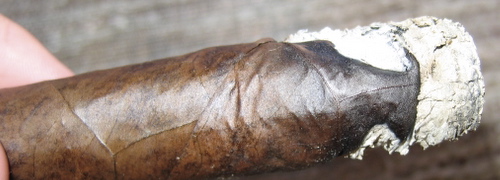
The following tips should help you fix an uneven burn (also called a canoe), but remember that the best thing to do is to avoid an uneven burn in the first place. A proper light is a good way to start an even burn. Also, in most cases, step one alone will be adequate if you catch an uneven burn soon enough:

First, you can start by rotating the cigar so the slow burning part is at the bottom of the cigar. Because a fire needs oxygen to burn, the bottom of the cigar will burn faster (as it has access to more oxygen) than the top. This is also why you should rotate your cigar as you smoke.

Second, if placing the long end on the bottom doesn’t work, we recommend touching up the fast burning part of the wrapper by applying moisture to the wrapper to slow down the burn. Usually saliva will get the job done, but remember you just want to add a little moisture to the wrapper…you don’t want a wet stogie.

If the aforementioned two techniques don’t work, you should get you lighter or matches back out and burn off the section(s) that’s burning too fast. However, don’t rush to quickly take a puff afterwards: the ash is likely unstable and may fall on you. Wait until the burnt wrapper turns black and then burns off completely.

Finally, once you’ve rid your stogie of the uneven burn, monitor it carefully to avoid further predicaments. Happy smoking!

[Thanks to Tristan and longashes from ClubStogie for the pictures.]

-Patrick S

Tags:

Stogie Tip: Sixty is the New Fifty-Four

25 Jul 2006

As any Stogie Guy should know, when it comes to cigars, thicker isn’t necessarily better. Each year, nonetheless, stogies get fatter and fatter…and this alarming trend towards quantity from quality is taking root in the cigar world with lightning speed.

Not a decade ago, a 60 ring gauge cigar (that’s 60/64 of an inch in diameter) was a tobacconist’s anomaly. Up until the cigar boom of the 1990s, America’s most popular size was the manageable and elegant 42 ring gauge lonsdale (or vitola). Wrote Jordan Russin of Cigar Aficionado in 2002:

American smokers moved away from traditionally popular sizes in search of thicker cigars with more complexity and cooler smoke. By the early 1990s, the robusto was the country’s most popular size, and thinner cigars had begun to be relegated to the back of the cigar-smoking consciousness.

Today, thick cigars are even more popular. Cigar Aficionado’s RTDA Blog Day 3 reports that this year’s convention is inundated with fat sticks. The Maxx by Alec Bradley has a new 60 ring smoke called The Freak. And CAO has one of the thickest ever made – a 96 ring Brazilia-Italia (they cut it down from a 137 ring gauge). That’s just obscene! Couple these introductions with Lars Tetens’ new 60 ring Gorilla Fingers, and you could argue 60 is the new 54.

But before we jump headfirst on the thicker-is-better bandwagon, let’s not forget some oft-overlooked vital facts. Fat cigars are awkward in the hand and tragically uncomfortable in the mouth. And these mammoths tend to burn so cool they are often difficult to keep lit. Finally, and perhaps most importantly, their behemoth size actually tempers most of their flavors.

Case in point: Remember that the best tobacco on any cigar is the wrapper. By choosing thinner cigars (like the 40-46 ring gauged coronas, lonsdales, and Cuban corona gordas), you get more wrapper in relation to filler. While these cigars typically burn a bit hotter than their fat counterparts, you get richer, fuller, and more pronounced flavors. Simply put, a smaller smoke can deliver a taste experience that is often lost in the girth of larger cigars. Also, thin cigars peak much quicker, delivering their flavor without the long wait that many thick stogies require.

So while the entire cigar world plunges into a trendy fascination with fatness, I’m encouraging Stogie Guys Nation to plunge with caution. Like Pogs, it’s only a phase. Much like women, thick ones can be a lot of fun from time to time, but let’s not forget how flavorful and classically-beautiful a thin one can be.

-Patrick A

Tags:

Stogie Tip: Proper Cigar Etiquette

19 Jul 2006

Just like any other fantastic hobby (it’s not a habit), cigar smoking should be more relaxing than cumbersome. But there are a few rules you should follow in order to respect your fellow man and, more importantly, get the most out of your experience. Since I’ve already shared with you my tips on cutting and lighting stogies, I think now is a great time to discuss proper cigar etiquette.

1) Where to smoke. It goes without saying that if you’re on your own property, smoke ‘em if you got ‘em. But – if you’re like me – most of your stogies are smoked outside your personal realm and in the presence of other Americans. If you’re at a friend’s place, it never hurts to ask. That’s the considerate thing to do, whether your outdoors enjoying a barbeque or indoors enjoying a game of Parcheesi. Nine times out of ten when you’re outside, cigar smoking will be OK (just make sure there’s an ash tray around so you’re not sullying your friend’s deck, patio, plants, etc.). Conversely, nine times out of ten when you’re inside, smoking will be off limits. Just make sure to abide by your gracious host’s wishes, whatever they may be.

Now if you happen to be out at an establishment – not covered by a Draconian smoking ban – and you witness patrons smoking cigarettes, but you’re not sure if cigars are allowed (say, at Grumpy’s in Baltimore with a bunch of your buddies on Saturday night after you violently and seriously stubbed your toe in a drunken stupor on the way to the bar) it’s best to ask one of the establishment’s employees. In my case, Grumpy’s had no policy against cigars – so I lit up a La Rosa Cubana. Some patrons may bitch and moan (even people smoking cigarettes, which I can’t understand), but too bad for them. You’re well within your rights to completely ignore their objections. Just like private residences, when you’re at a private establishment it’s necessary to abide by the owner’s policies.

2) When to ash. First off, let me once again reiterate that you must ash in an ashtray. I can’t tell you how many times I’ve seen cigar smokers ash on floors, in potted plants – even in toilets. Tisk, tisk.

That being said, when to ash is a much more convoluted topic. Any Stogie Guy will tell you that letting the ash build up at the foot of your cigar is a good thing – it cools the smoke thereby increasing the flavor of the stogie. But if you let the ash grow too long, it can fall at an unexpected and inconvenient time. My advice is this: If you’re somewhere falling ash won’t be a big problem (say, on a golf course), go ahead and let it accumulate for an inch or so. But if you’re at a fancy cocktail party standing on a $15,000 Persian rug, ash early and ash often.

3) When to take off the band. While some say it’s showy and impolite to leave the band on your cigar, I couldn’t disagree more. In my experience, leaving the band on is a great conversation starter that helps cigar aficionados meet one another.

If you do decide to remove the cigar band, make sure you let the cigar heat up before taking it off. The heat from the foot will help loosen the glue that holds the band on. It’s also important to note that taking the band off some brands of Cuban cigars (even after heating), like the Montecristo, is very difficult and can result in damage to the cigar wrapper. So in my personal opinion, keep the band on as long as you like – just don’t smoke it.

Follow these simple steps and your next stogie experience will be even more pleasant. If you have any additional tips of your own, please feel free to leave a comment. Happy smoking!

-Patrick A

Tags:

Stogie Tips: The Salt Calibration Test

7 Jul 2006

Even the most amateur enthusiast knows that cigars need humidity for proper storage. Since they are hydroscopic in nature, cigars will, over time, dry out in an arid climate or absorb moisture in a humid one. Dry cigars yield high combustion temperatures, leaving the smoke hot and acrid on the palate. And wet cigars tend to burn improperly and taste stale.

Therefore, we need to aim for a happy medium between too dry and too damp. For the most enjoyable smoke, this equates to 12 to 14 percent of the cigar’s total weight in moisture (or about 60 to 70 percent relative humidity). If you have a humidor, your hygrometer measures relative humidity. But hygrometers, whether mechanical or electronic, can be grossly imprecise and may require adjustment or replacement. So be sure to verify the accuracy of your hygrometer with the salt calibration test.

I’ll begin by mentioning that my degrees in political science and international commerce in no way qualify me to discuss the intricacies of chemistry. So I won’t try to explain why the salt calibration test works. Just please note that it does.

To perform the test on your own hygrometer, you’ll need a few basic items:

(1) Distilled water (purchased from any grocery store)
(2) Coffee stirrer (or other thin, clean object with which to stir)
(3) Bottle cap (Snapple bottle caps work perfectly)
(4) Empty wide-mouth jar with lid (like a clean mayonnaise jar)
(5) Tablespoon of plain table salt
(6) Your hygrometer

Place the tablespoon of salt within the bottle cap and slowly add distilled water to the salt while stirring with the coffee stirrer. Only add just enough water to moisten the salt so that it becomes a thick paste—do not add enough to dissolve the salt.

Next, place the bottle cap with salt/water mixture gently into your wide-mouth jar and add your hygrometer. Make certain the sensor is exposed and is not blocked by the sides of the jar. Seal the jar so there are no leaks, and put it in a place out of direct sunlight and with a stable, cool temperature (like your closet).

Leave the setup undisturbed for a minimum of eight hours. After that, check the reading on the hygrometer through the glass jar. It should read on or near 75 percent relative humidity. Most inexpensive hygrometers are only accurate to within 3 percent, so do not be surprised if yours reads 72 or 78 percent. Whatever it reads plus or minus our 75 percent benchmark is the amount of error.

If your hygrometer has an adjustment meter then, by all means, try to tweak it to exactly 75 percent relative humidity. You should repeat the salt calibration test after making any adjustments. If your hygrometer can’t be adjusted but the reading is close, then my advice is to not worry about it; just remember that your hygrometer is X percent off—either high or low. If the reading is grossly in error and you are unable to adjust it, you need to replace it.

Once you confirm your hygrometer’s accuracy and maintain a relative humidity of about 65 percent in your humidor, your cigars will age properly and be in peak condition when you’re ready to fire them up.

Patrick A