
Cigar Review: Viaje Fifty Fifty Black Label No. 1
7 Jun 2011
Viaje is a brand I’ve never fully gotten acquainted with. Maybe that’s because none of my regular shops seem to carry it, or because buying this brand is a significant investment (especially by the box), or because with, so many limited releases, it’s difficult enough to keep track of Viahe, let alone track it down.
Still, there’s a lot going for Viaje, not the least of which is a small but growing group of loyal fans. Further, Viaje is made by the same people behind Casa Fernandez, who, addition to their own cigars, make such highly regarded smokes as Illusione, Padilla (1932 & Miami), and Alec Bradley (Tempus and Prensado) at their Raices Cubana factory. Fernandez is also the original partner of Don Pepin Garcia with whom he co-owns the El Rey de Los Habanos factory in Miami (though that is the subject of a current legal dispute).
 The Fifty-Fifty concept is a unique idea, with the premise being that one cigar contains two distinct blends, which transitions from one to the other at the halfway mark. According to Viaje creator Andre Farkas, “Each cigar is carefully crafted taking triple the amount of time a normal cigar takes to roll. The cigar comes wrapped in a dark, oily Nicaraguan cover leaf with two binders holding the filler in place.”
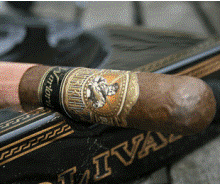
The Black Label aims to transition from full to fuller, while the Red Label aims to be a more balanced transition from medium to full body. Like the Red Label, the Black comes in three sizes selling for around $9-10 per cigar and upwards of $200 for a box of 25. For this review I smoked several No. 1s (5.6 x 46). The Nicaraguan puro features a oily wrapper with a small pigtail cap. It has a slight give when you give it a squeeze, but no exterior indication that inside there is a change in blend.
When I finally lit this corona extra I found a medium- to full-bodied blend (though I can certainly see how some would consider it full-bodied). I was struck by the sweetness that this cigar displayed in the first half. Cafe au lait, semi-sweet chocolate, vanilla bean, and subtle leather notes were all apparent. However, when I got to the second half (and presumably second blend), that sweetness disappeared entirely. Here the cigar is a truly full-bodied smoke. It’s leathery, earthy, and heavy with significant “mouth feel.” In addition, there’s some charred notes and a subtle peppery spice on the retro-hale.
One of the four samples I smoked required a few touch-ups to counteract an uneven burn, but the construction was mostly maintenance-free. That’s impressive given the two separate blends. And while some have criticized the transition from the first blend to the second as too abrupt, I didn’t find that to be the case. I may have liked the profile of the first half better than the second, but the transition was smooth enough to make it a largely seamless and enjoyable smoke. That, combined with good construction and the successful execution of a unique concept, earns the Viaje Fifty Fifty Black Label No. 1 a rating of four and a half stogies out of five.

[To read more StogieGuys.com cigar reviews, please click here.]
photo credit: Stogie Guys

 1) The generosity of the cigar community knows no bounds, and that charitable spirit is in fine display in the wake of the deadliest tornado season in 50 years. The Montecristo Relief Organization, established in 1999 by Altadis after devastating hurricanes swept through the Caribbean, is donating $25,000 in vital aid to the victims of last month’s tornado in Joplin, Missouri. It is also matching the first $75,000 donated by Altadis employees, vendors, and customers. If you’d like to contribute, you can send a check to: Montecristo Relief Organization, Joplin Tornado Relief, c/o Altadis U.S.A., PO Box 407179, Ft. Lauderdale, FL, 33340.
 The website is called
  Angel Cuesta and Peregrino Rey, both in their thirties when they started the famous cigar company in 1896, were just a pair of entrepreneurs in a city with dozens of cigar factories. In fact, the Tampa Tribune thought so little of them that the newspaper didn’t even bother to check the spelling of their names and with little fanfare, announced that Cuesta Ray [sic] had formed in Ybor City, Florida, employing 100 workers. The paper would have never expected this pair of young Spaniards to create a revolutionary cigar company that would set industry standards for quality and marketing and become one of the most recognized brands in the world.
 Patrick Ashby
Co-Founder & Editor in Chief
Patrick Ashby
Co-Founder & Editor in Chief Patrick Semmens
Co-Founder & Publisher
Patrick Semmens
Co-Founder & Publisher George Edmonson
Tampa Bureau Chief
George Edmonson
Tampa Bureau Chief