Search results: index.php

Commentary: The New Fuente Nicaraguan Cigar Factory is a Big Deal

23 May

When it comes to classic, old-school cigars, few brands come to mind more than Arturo Fuente. In an era of so many brands bringing new cigars to market constantly, Fuente has never given in to that pressure of the new release treadmill, or the need to chase trends. All of which makes their recent announcement particularly noteworthy.

Yes, Fuente had a presence in Nicaragua in the 1970s prior to the Sandinista revolution that wiped out many international investors. But now it is back in a big way. Using land the Fuentes have used to grow Nicaraguan tobacco for a while, the Domincan cigar giant announced recently it is building a new cigar factory in the heart of Estelí with the name “Gran Fabrica de Tabacos La Bella y La Bestia.”

I, for one, am very excited to see what the new Nicaraguan factory can create. Fuente makes cigars that stack up well at every price point, from the bargain bin mixed-filler Curly Head to the ultra-premium limited edition Opus X releases. Fundamentally, though, they’ve always been characterized by Dominican tobaccos, especially fillers.

The prospect of an abundance of Nicaraguan tobacco in new Fuente blends sounds good to me. That Fuente brought in Felix Mesa of El Galan Cigars (maker of the Doña Nieves) to run the Nicaraguan operations is especially promising.

The announcement is also a sign of the emergence of Nicaraguan cigars.

Not that long ago, Nicaragua was third among countries when it came to importing handmade cigars into the United States, behind Honduras and far behind the Dominican Republic. Today, for the second straight year, Nicaragua has edged out the Dominican Republic, with Honduras a distant third.

Put simply: If you were starting a new cigar company today, the most obvious place to build your factory would be Nicaragua. Yes, labor costs that are lower than the Dominican Republic. But the biggest reason would be the access to Nicaraguan tobaccos.

In many ways, Fuente’s announcement is the culmination of Nicaragua’s ascendance. In short, it’s a big deal, and a sign of the where the U.S. cigar market is now.

–Patrick S

photo credit: Fuente
Weekly Cigar News Sampler: Royal Agio Ends U.S. Distribution Agreement with Drew Estate, H. Upmann Robustos Añejados Announced, and More

8 Dec

As we have since July 2006, each Friday we’ll post our sampling of cigar news and other items of interest from the week. Below is our latest, which is the 558th in the series.

1) Royal Agio Cigars and Drew Estate are expected to terminate part of their distribution agreement on Monday, December 18. “The two companies joined forces globally on April 1, 2014 with Drew Estate distributing Royal Agio Cigars’ products in the United States, and Royal Agio distributing Drew Estate products in key European markets, such as Holland, France, Belgium and Germany,” reads a press release. Going forward, while Royal Agio will continue to distribute Drew Estate in Europe, Drew Estate will no longer distribute Royal Agio in the U.S.—Royal Agio will now manage its own U.S. distribution. The move signals Royal Agio’s “strengthening commitment to the U.S. market,” which is underscored by the opening of its new U.S headquarters in Bradenton, Florida. “We are grateful for the enthusiastic support and significant contributions made on behalf of the Drew Estate organization that have helped improve distribution and awareness for our premium cigar brands over the past three and a half years,” said George Margioukla, President of Royal Agio U.S.A. “Thanks in large part to these efforts, Royal Agio Cigars is now in a position to strengthen our U.S. presence and enhance direct support for our highly-valued trade partners and consumers.” The Royal Agio portfolio includes the premium handmade Balmoral brand, as well as two cigarillo brands: Mehari’s and Panter.

2) Habanos, S.A. has announced H. Upmann Robustos Añejados (4.9 x 50)—a new Cuban cigar that has been aged for five to eight years—will be available at international retailers in the coming weeks. It “does not exist in the standard portfolio of the [H. Upmann] brand,” but instead joins four other Cuban cigars in the Añejados portfolio: Romeo y Julieta Pirámides Añejados, Montecristo Churchill, Partagás Corona Gorda Añejados, and the Hoyo de Monterrey Hermosos No. 4.

3) Inside the Industry: The cigar industry lost a legend this week when José Orlando Padrón passed away. If you’re looking for more information about his life, his memoir is for sale with proceeds going to the Padrón’s charitable foundation. Also, check out this 2006 New York Times profile and this interview from 1998.

4) From the Archives: One of the first cigars we ever gave a top rating to (way back in 2006) was the Padrón Serie 1926 No. 6.

5) Deal of the Week: Here are 100 deals, including cigars from Ashton, Oliva, CAO, My Father, Tatuaje, Rocky Patel, Padrón, Drew Estate, and more. Free shipping is included on any purchase. If you really want to stock up, add promo code “GBP20D” at checkout to knock $20 off an order of $150 or more.

–The Stogie Guys

photo credit: Royal Agio Cigars

Cigar Review: Diamond Crown Julius Caeser Toro

23 Aug

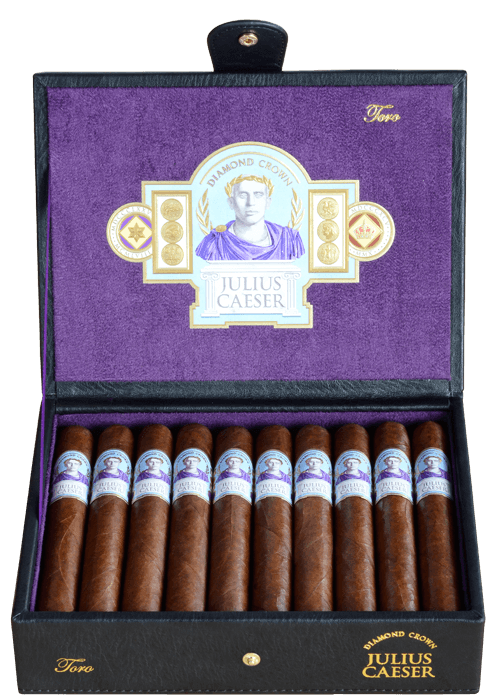
This Diamond Crown extension was introduced some years back to celebrate the founder of J.C. Newman Cigar Co., which calls itself “America’s oldest family-owned premium cigar makers.”

Newman promotes Julius Caeser as a high-end premium, packaged in fancy boxes and originally available only at Diamond Crown lounges. In 2014, the robusto was named No. 14 on Cigar Aficionado’s Top 25 list.


But to me it seems the line has never really garnered the cachet of some other top-tier smokes rolled by Fuente, such as Opus X or God of Fire. My belief was reinforced recently when I was able to buy 10 of the toros online for around $50, roughly a third of the normal retail price listing.

The tobacco composition of Julius Caeser is a bit muddled. Newman’s website refers to an Ecuadorian Havana-seed wrapper over a rather vague “robust blend of Central American tobaccos.” That CA rating has it as an all Dominican stick, while others generally list Dominican binder and filler.

The Toro (6 x 52) has a lovely pre-light chocolate aroma from the wrapper. The cap is excellently applied and easy to clip. Performance, as you’d expect, was excellent in all of those I’ve smoked. Straight burn, fine draw, and good smoke production.

I found it to be a little stronger than my colleague when he reviewed the Julius Caeser Pyramid in 2011. I’d call it near the low end of medium. We did agree on the lack of complexity, with little in the way of changes from start to finish, especially after the first inch or so.

But what Julius Caeser produced was pleasant. I got light spice, a touch of cedar, and some deep, woody notes.

If you’re looking for a cigar you can enjoy any time of the day, this could be one to try. At the regular retail price, though, most experienced cigar smokers can probably find other sticks that stand out more. But when it’s marked down, Julius Caeser is well worth picking up. I rate the Toro three and a half stogies out of five.

[To read more StogieGuys.com cigar reviews, please click here.]

–George E

photo credit: Diamond Crown/Stogie Guys

Weekly Cigar News Sampler: Bumper Tobacco Crop in Cuba, FDA Legal Updates, and More

4 Aug

As we have since July 2006, each Friday we’ll post our sampling of cigar news and other items of interest from the week. Below is our latest, which is the 541st in the series.

1) Cuban farmers in the storied Pinar del Río province are harvesting a bumper tobacco crop, and they expect to increase acreage even more next year, according to news reports. Much of the country is struggling with drought, so additional wells are being drilled and irrigation systems expanded to accommodate the additional planting. Exported premium cigars are said to generate about $450 million a year for Cuba.

2) With the override of a gubernatorial veto, Maine this week became the latest state to raise the minimum age for tobacco purchases to 21. (Others that have approved the change are California, Hawaii, Oregon, and New Jersey.) Voting for the increase in both legislative chambers crossed the required two-thirds majority. Gov. Paul LePage, in opposing the change, had referred to raising the age as “social engineering.”

3) Inside the Industry: A lawsuit filed last year by Frank Herrera’s law firm on behalf of several cigar makers challenging FDA cigar regulations has been suspended. Herrera posted the document to stay the case on Facebook. He wrote that the FDA’s three-year extension for implementation of the substantial equivalence provision regarding cigars “provides relief for issues that were raised” in the lawsuit. Either party is allowed to reopen the case in the future. Meanwhile, Judge Amit Mehta of the U.S. District Court for the District of Columbia has granted a 30-day delay in the lawsuit brought by Cigar Rights of America, IPCPR, and the Cigar Association of America against the FDA. It is assumed the extension is intended to buy time for the Department of Justice, the agency that is representing the FDA, to determine how FDA Commissioner Dr. Scott Gottlieb’s new tobacco regulation plan impacts premium cigars.

4) From the Archives: San Andrés wrapper is seemingly everywhere these days, including on many of the cigars that were introduced at the recent IPCPR Trade Show. Back in May 2015, we published our thoughts on Mexican tobacco. You can revisit that piece here.

5) Deal of the Week: StogieGuys.com recommends Bespoke Post, a monthly collection of awesome items (think fine bar accessories, shaving kits, wine, workout gear, coffee kits, and more) delivered for just $45. You can skip or purchase every month. Sign up here.

–The Stogie Guys

photo credit: Stogie Guys

Cigar Spirits: Compass Box Hedonism Quindecimus

14 Sep

cb-hedonism-quindecimus

If you know anything about scotch grain whiskey, you probably know the lack of grain whiskey is what makes single malts so sought-after.

Put another way: Grain whiskey is the less flavorful filler that is blended with single malt to make blended whiskies like Dewar’s, Bells, Johnnie Walker, Cutty Sark, and Chivas Regal, which make up 90 percent of all scotch whiskey sold.

For the most part, that characterization is correct, as most grain whiskey is aged only a few years and then blended with single malt to make blended whiskey. And yet, what if instead grain whiskey was left to age properly, perhaps even for decades? How would it taste?

The answer is found in Compass Box’s Hedonism Quindecimus, which is certainly one of the most unique whiskeys I’ve ever tasted. To celebrate the company’s 15th anniverary, they created a blend of grain whiskies, all of which are at least 20 years old.

The Compass Box website can no longer legally disclose the components of this blend due to some ridiculous rules. But, fortunately, we know what makes up this unique blend:

  • 17.6% North British 20-year-old from first-fill American standard barrels
  • 36.6% Port Dundas 25-year-old from rejuvenated hogsheads
  • 8.4% Dumbarton 28-year-old from American standard barrels
  • 19.4% Port Dundas 20-year-old from first-fill American standard barrels
  • 18% 32-year-old Loch Lomond mystery blended grain from American standard barrels

The resulting whiskey is bottled at 92-proof, with just 5,689 bottles made. Expect to pay $125 to $180, if you can find it.

The nose is quite light with hay, honey, shortbread, and floral notes. On the palate, the immense depth and complexity reveals itself with lemon cake, creaminess, tea, custard, light oak, and citrus. It’s the kind of flavor you want to let linger as long as possible. The finish is clean and elegant with more creaminess, cake batter, and light spice.

Considering the price, this isn’t a whisky for everyone. But I don’t think it was ever meant to be for most people. It’s an extraordinary experiment in what a grain whiskey can be in the right hands. Single malt fans should jump at the opportunity to try a glass if they find it on the menu.

The complex flavors go well with a cigar, but it takes a milder smoke to not overwhelm the Hedonism Quindecimus. Try an Ashton Classic, Davidoff Grand Cru, Illusione Epernay, or Paul Garmirian Gourmet.

–Patrick S

photo credit: Stogie Guys

Cigar Review: Drew Estate Herrera Estelí TAA Exclusive

30 May

Herrera 1

In early March, it was announced Drew Estate would be expanding its popular Herrera Estelí line by launching the Herrera Estelí TAA Exclusive, which began shipping to Tobacconists’ Association of America (TAA) members in April. (TAA works to “maximize professionalism and success” among its 80 associated retailers through training and the sharing of best practices; you can find a TAA shop near you here.)

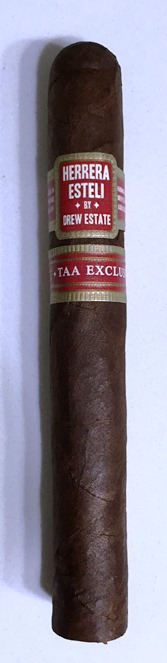
Herrera 2The Drew Estate Herrera Estelí TAA Exclusive is presented in a single vitola, a toro (6 x 52) that retails for $144 per 12-count box, or $12 per cigar. Whereas the original Herrera Estelí features an Ecuadorian Habano wrapper around a Honduran binder and filler tobaccos from Nicaragua, the TAA Exclusive—also blended by Willy Herrera—sports a Connecticut Broadleaf wrapper, Brazilian Mata Fina binder, and Nicaraguan fillers.

“This is my first blend since joining Drew Estate that utilizes Connecticut Broadleaf tobacco,” said Herrera in a press release. “Drew Estate fans know that we’re famous for our use of Connecticut Broadleaf tobaccos, especially in our Liga Privada No. 9 and Nica Rustica lines. I’ve been experimenting with blends that incorporate this incredible wrapper since coming on board and finally have a blend I’m really excited about.”

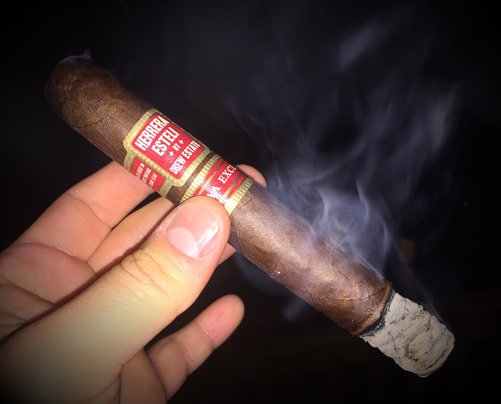
The Herrera Estelí TAA Exclusive is handsomely appointed with dual bands of red and gold that make this extension easily differentiated from the original Herrera Estelí blend. Even without the bands, though, you’d never confuse the two. The Ecuadorian Habano wrapper on the core line is light and golden, whereas the TAA Exclusive is dark. In typical Drew Estate fashion, the cold draw is ultra-easy. The pre-light notes remind me of chocolate and cedar.

Once underway, I find cocoa with black pepper spice and abundant leather. The texture is coarse and gritty. The potent vegetal notes that are so common among Connecticut Broadleaf smokes from Drew Estate are also apparent, especially in the plentiful resting smoke. Other noticeable flavors include damp earth, vanilla, cream, and a dash of cinnamon. At the midway point and beyond, I start to notice some sour, meaty notes from time to time—nothing terribly concerning, but certainly worth pointing out.

As far as the physical properties are concerned, this cigar is expertly rolled and a complete joy to smoke. The burn line is straight and true throughout, the smoke production well above average, the draw smooth, and the gray ash holds very firmly off the foot.

If Willy Herrera’s objective was to blend a full-bodied cigar that smokes cool with plentiful flavor, I’d consider the Herrera Estelí TAA Exclusive a job well done. I especially appreciate the fleeting tastes I uniquely associate with Drew Estate Connecticut Broadleaf tobaccos, and how they are coupled with an overall profile that’s differentiated from the likes of Liga Privada No. 9 or Nica Rustica. This well-crafted cigar is worth seeking out—even with its lofty price tag—and deserving of an admirable rating of four stogies out of five.

[To read more StogieGuys.com cigar reviews, please click here.]

–Patrick A

photo credit: Stogie Guys

Stogie Guys Friday Sampler No. 478 (FDA Cigar Regulation Edition)

6 May

As we have since July 2006, each Friday we’ll post a mixed bag of quick cigar news and other items of interest. Below is our latest Friday Sampler.

unnamed

1) Yesterday the FDA issued a 499-page final rule subjecting cigars to FDA regulation. The regulation will officially be published on May 10 and will take legal effect on August 8 with various requirements being phased in thereafter. Notably, the FDA rejected an option that would have created an exemption for premium handmade cigars that met certain criteria, which the handmade cigar industry had made the focus of lobbying efforts. Because the regulation doesn’t alter the 2007 grandfather date (cigars introduced after that date will have to go through the FDA approval process), the regulation means that, should Cuban cigars ever become legal, they would not be exempt from the approval process. FDA officials admit that process could cost hundreds of thousands of dollars per each size of each blend.

2) Cigar Rights of America blasted he rule in a press release: “Unfortunately, the FDA and the Obama Administration have rejected and cast aside any rationally objective approach to developing this regulation. When Congress gave FDA the authority to regulate tobacco products in 2009, they did so specifically with the stipulation that in order to subject a product to regulation FDA must demonstrate that the specific product(s) possess issues of underage consumption and health and mortality impact through addiction, both which have never been associated with premium cigars… As a result of today’s announcement by FDA, the board of Cigar Rights of America will be convening an emergency meeting to evaluate all legal and legislative options moving forward.”

3) The International Premium Cigar and Pipe Retailers Association (IPCPR) also slammed the devastating impact of the rule in a statement: “The FDA’s regulation of premium cigars, if left unchecked, would have a devastating impact on retailers and manufacturers alike. Consumers will have less choice. Youth access is simply not an issue in the premium cigar space where 35,000 Americans earn their living along with over 300,000 employees in the Caribbean Basin.”

4) From the Archives: Since 2007, StogieGuys.com has covered the issue of FDA regulation of cigars. In 2009, after the FDA tobacco regulation bill was signed into law, we reported on the potential impact, noting it was “a major threat to cigar manufacturers and the choices available to cigar smokers.” Later, in the same article, we reported on the reaction from various cigar makers. One comment was particularly striking: “Jaime Garcia, son of famed cigar-maker Don José ‘Pepin’ Garcia, and a top maker in his own right, told me through a translator that coming from Cuba, he couldn’t believe that in America so much power would be given to the government to control his business.”

5) Deal of the Week: If you’re not already a member, the events of yesterday should motivate you to join Cigar Rights of America. Joining not only supports professional lobbyists who fight for cigar freedom, but also affords discounts at cigar shops, free cigars, and more. One great way to join is by purchasing a Cigar Rights of America sampler. Each sampler includes CRA membership, plus ten exclusive cigars. Buy one at your CRA-supporting local cigar retailer or purchase one online here.

–The Stogie Guys

photo credit: CRA