Search results: site-policy/images

News: FDA Regulations Could Wipe Out Every Cigar Introduced in the Past Eight Years

2 Jun

February 15, 2007 could turn out to be the most important date in the history of the premium cigar industry. Why, you ask? Because every cigar introduced after that date could soon be made illegal by the Food & Drug Administration (FDA).

FDA-cigars-large

While the so-called Family Smoking Prevention and Tobacco Control Act (FSPTC)—the bill giving the FDA the power to regulate cigars—didn’t pass until June 2009, the legislation sets February 15, 2007 as the cutoff date for tobacco products to be grandfathered in as exempt from needing FDA approval before being sold or marketed in the United States.

Tobacco products introduced after that date (which comes from the text of the legislation and probably cannot be altered by the FDA, even if the agency wanted to) must receive the FDA’s approval before they can be marketed for sale. For a period from passage of the FSPTC until March 22, 2011, new tobacco products could be marketed while an application was pending but, as the FDA reiterated recently, any new product that didn’t have an application submitted by that date cannot be marketed until the FDA takes action to approve it. This would apply to cigars when they are subject to FDA regulation, despite the fact the FDA hadn’t even taken the first step towards regulating cigars in March 2011, and so no cigar applications would have been submitted.

Theoretically, new cigars should get approved as “substantially equivalent” to products that were already on the market in 2007 since the basic components of handmade cigars haven’t changed in at least a century. But the process is surprisingly complicated, likely very expensive, and includes an “Environmental Assessment” and a “Health Information Summary” along with a requirement for scientific studies about how the product would be used in comparison to the product it is being claimed as substantially equivalent to. In other words, you’d probably need deep pockets, lawyers, and scientists to have a chance.

Plus, so far the FDA hasn’t shown any ability to handle existing applications. As we observed when the Deeming Rule was first proposed, only a few dozen of the 4,000 pending applications were ruled on as of April last year, with just 17 being approved over the period of multiple years. As of now, the FDA site says it has approved only 132 products as “Substantially Equivalent” since 2011, while an untold amount remain waiting for a ruling.

The FDA did propose in its rules one option for an exemption for premium cigars with a retail price of $10 or more, but even if the agency adopts that option it would leave the vast majority of cigars (85%, according to one analysis) to be banished from the market and forced to wait for an approval that may be nearly impossible to get.

February 15, 2007 is a long time ago, so allow me to set the stage: On that date we published a Quick Smoke of the Gispert Lonsdale (remember that cigar?), and you couldn’t yet buy an Apple iPhone because the first one didn’t go on sale until later that summer.

As far as cigars go, here are just a few introduced in 2007, but after the February cutoff date: Oliva Serie V, San Cristobal, Padrón Serie 1926 80 Years, CAO America, Te-Amo World Selection Series, Santa Rosa (an Altadis cigar I forgot ever existed), Rocky Patel Sumatra Edge, Cabaiguan Guapo, La Aurora Corojo Oscuro Barrel Aged, and the Cuban Cohiba Maduro (which, if the embargo ever ends, would also be subject to the regulations).

To say the industry has changed since then would be a gross understatement, as evidenced by the fact that multiple cigars listed above are no longer being made. For most cigar smokers I talk with, the vast majority of cigars they smoke were introduced well after 2007.

Cigar rights groups are now looking to push legislation that would amend the date for new cigars to be grandfathered in. This seems extremely reasonable. After all, how can cigars have complied with a regulation two years before passage of the bill authorizing the FDA to regulate cigars, and five years before the agency took any steps towards exercising its power to regulate cigars?

The problem is that reasonable doesn’t buy you much when it comes to passing federal laws. And considering the difficulty in getting support for the Traditional Cigar Manufacturing and Small Business Jobs Preservation Act in Congress, there isn’t much indication that there are majorities in Congress that want to treat cigars reasonably, nor that President Obama would sign such legislation if it somehow made it to his desk.

–Patrick S

photo credits: Stogie Guys

Cigar Review: 1502 Ruby Lancero

1 Jun

Back in 2012, I wrote a less-than-flattering review of the 1502 Emerald Torpedo, calling the cigar slightly bitter and underwhelming in the flavor department. Not only have I not tried another Emerald since, but—up until recently—I also haven’t smoked any of the other blends from 1502. Apparently that was a mistake.

1502 Ruby LanceroThe House of Emilio-distributed 1502 brand, which is owned by Enrique Sánchez Icaza’s Global Premium Cigars, has several other lines worthy of consideration. Among them are 1502 Black Gold, 1502 Nicaragua, and 1502 Ruby. Each pays homage to the year Christopher Columbus discovered Nicaragua.

The 1502 Ruby is marketed as a medium-plus creation that ranks between the Emerald and Black Gold in terms of power. It features an Ecuadorian wrapper around tobaccos from the Jalapa and Estelí. Seven box-pressed sizes are available, each made at the Plasencia Cigars S.A. factory: Robusto (5 x 50), Toro (6 x 50), Torpedo (6.5 x 52), Perfecto (6.1 x 50), Conquistador (6 x 56), Lancero (7 x 38), and Corona (5.5 x 42).

The Lancero costs about $8 and has a dry, slightly lumpy exterior with only the thinnest veins and tight seams. The handsome specimen is adorned with a traditional band, a well-executed cap, and a semi-closed foot. Pre-light notes include sweet hay and cocoa. A simple V-cut is all that’s needed to reveal a cold draw that’s easy, especially for a lancero.

Right out of the gate the 1502 Ruby boasts a well-balanced, tasty profile with hints of dry wood, red pepper, sweet cream, and mixed nuts. The texture is a combination of leather and bread. At times, hints of lightly roasted coffee come and go. Body and strength are both decidedly medium. As the Lancero progresses, the intensity gradually ramps up while the flavors remain mostly consistent. I’d describe the finale as medium- to full-bodied. Any potential bitterness or heat can be controlled by taking your time and not smoking too quickly.

The physical properties are excellent from light to nub. Across several samples I witnessed straight burn lines, solid gray ashes, good smoke production, and moderate draws. While crafting a well-constructed lancero is no easy task, the Plasencias have succeeded here.

I’m not sure what the 1502 Black Gold or 1502 Nicaragua have in store, but I mean to find out. The 1502 Emerald may not have been up my alley—perhaps it’s time for a revisit?—but the 1502 Ruby Lancero is really speaking my language. For interesting flavors, especially ample red pepper spice offset by sweetness, this cigar earns an admirable rating of four stogies out of five.

[To read more StogieGuys.com cigar reviews, please click here.]

–Patrick A

photo credit: Stogie Guys

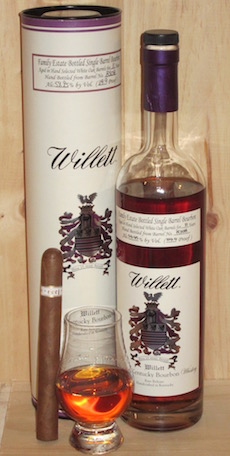
Cigar Spirits: Willett Family Estate Bottled Single Barrel Bourbon (11 Year)

28 May

Lately the book Bourbon Empire has been cited by more than a few articles I’ve read as debunking some of the bourbon mystique. “By the year 2000 you have 8 companies, 13 plants, and they make about 99 percent of all the whiskey in America,” the author Reid Mitenbuler told an astonished public radio reporter.

willett-febourbonThat may be true (today the number is slightly less at around 95%) but it’s hardly new information to many informed drinkers that the overwhelming amount of bourbon is distilled by a handful of companies. In fact, with full knowledge of that, Willett Family Estate Bourbon is very sought-after by many extremely knowledgeable whiskey drinkers.

Willett doesn’t currently sell any bourbon it distilled itself, but instead picks barrels distilled elsewhere which it then resells. Some are blended together in bourbons like Rowan’s Creek, Noah’s Mill, and Willett Pot Still Bourbon; others are selected for the Willett Family Estate Bottled Single Barrel program. (Willett recently restarted its stills but, as of this writing, only a very young rye is for sale.)

The Family Estate bourbons are all single-barrel and bottled at barrel-proof. Ages vary from 7 to 20+ years (along with price). For this write-up I tasted an 11 year bourbon purchased by a friend at the Willett Gift Shop for $110. (My barrel is number 8308 and is bottled at 119.9-proof.)

The nose features vanilla and caramel, with a hint of clove spice. On the palate this bourbon is rich and complex with oak, dried fruit, toffee, buttery pie crust, banana, and fudge. The finish is surprisingly short with caramel and clove spice, although a tiny splash of water smooths out the dry spice. Willett Estate Bottled Single Barrel Bourbon is a testament to the fact that barrel management and selection are often more important than who distilled the whiskey. It’s an exceptionally rich and complex bourbon, which lets it live up to its expensive price.

Still, the price leads me to recommend getting acquainted with better value bourbons before jumping up to this one.

As for cigars, strangely, I don’t have any specific recommendations. This bourbon has complexity and strength, and also enough subtleties to go well with any good balanced cigar.

–Patrick S

photo credit: Stogie Guys

Cigar Review: Bandolero Bravos

27 May

So far this year I’ve reviewed three interesting smokes from United Cigar: the Atabey Ritos, an expensive cigar that’s complex and nuanced; the Garofalo Robusto, a mild-mannered smoke that’s affordable, flavorful, and satisfying; and the Byron Serie Siglo XX Londinenses, a handsome $30 stick that’s memorable and harmonious.

Bandolero BravosAll three creations are impressive, not only in their performance but also in their packaging. So I’ve made it a point to try and smoke my way through the rest of the United Cigar portfolio, which includes Fleur de la Reine, La Gianna, and Bandolero.


Here’s the origin of the Bandolero name from United Cigar: “Between 1717 and 1817, the Spanish Crown prohibited cigar production in the Caribbean and the rest of the American colonies, and although its precious leaves continued growing on the other side of the ocean, the ‘puro’ cigar rolling that we all know today could only be done at the Sevilla Royal Factory… [This] led to the rising prices of tobacco and the birth of the Bandolero, an intrepid figure that hid on mysterious roads with tobacco leaves rolled in other countries…”

The Bandolero Bravos is part of the so-called Premium selection of five vitolas that are packaged in humidified tubes (tubes that, by the way, make excellent reusable single-stick travel humidors). This size measures 5.25 inches long with a ring gauge of 52. It is only available in a special gift pack that includes five Bandolero cigars and costs $159.99. (A similar size, the Picaros (5.5 x 54), runs $12.79 for a single.) The Bandolero blend makeup is not disclosed.

Once out of the tube, the Bravos is certainly dressed like a super-premium with its banded cedar sleeve foot, and another two bands near the head with glossy, raised fonts and graphics of gold, silver, black, and red. Beneath is an oily, milk chocolate-colored cigar with thin veins, virtually invisible seams, and a well-executed cap. The feel is consistently spongy throughout, but the foot shows a cross-section of tightly packed tobaccos. The cold draw has just a little resistance.

Once lit, pre-light notes of hay and coffee give way to a medium-bodied profile of coffee, leather, oak, and some faint citrus. The core is natural tobacco and the texture is bready. Spice and nicotine strength are both minimal. The resting smoke is an enticing blend of roasted nuts and cream.

Construction—as I’ve grown to expect from United Cigar—is consistent with the characteristics you should demand from a stick priced in the super-premium range. The burn is straight, the ash holds firm, the draw is smooth, and the smoke production is slightly higher than average. Put plainly, the Bravos is a beauty to watch burn.

Given the cost, I was hoping for a memorable, complex experience that would make me reach for this cigar to celebrate special occasions. The Bandolero Bravos falls a little short of those lofty expectations. While I enjoy the flavors, I think the complexity isn’t quite there, and that results in a rating of three and a half stogies out of five.

[To read more StogieGuys.com cigar reviews, please click here.]

–Patrick A

photo credit: Stogie Guys

Commentary: Don’t Underestimate the Enemies of Cigar Freedom

26 May

FDA-cigars-large

As a whole, cigar smokers are an amiable bunch that, with the exception of a few curmudgeons, tend to assume good intentions of others. That’s a good way to deal with most people, and exactly how you’d have most people treat you.

But when it comes to politics, it can be very dangerous to underestimate you opponents. This is very much true with the opponents of cigar freedoms.

There are lots of people with various views on how our laws should deal with tobacco products. When it comes to where smoking is banned or permitted, at what level cigars should be taxed, and to what extent cigars should be treated the same as other tobacco products, there a wide variety of views. A proud, freedom-loving cigar smoker should welcome informed debate.

That said, we shouldn’t lose sight of the fact there is a well-funded group of professional anti-tobacco activists for whom any adult choosing to use any tobacco product anywhere is a problem that needs to be solved by a law. Attempts to reason or negotiate with these people are not only a useless; any energy expended on them is counterproductive.

These “tobacco control” activists, as they call themselves, are funded to the tune of billions of dollars a year (much of it by our taxes) and extremely politically connected. Look no further than the U.S. Senate, where a small group of anti-tobacco senators continue to push for more aggressive anti-smoking measures, no matter how hypocritical or illogical.

Earlier this month, Senator Blumenthal of Connecticut called for the FDA to accelerate the rulemaking process to, among other things, regulate cigars. The senator even said if the FDA doesn’t issue a final rule soon enough, he would introduce a law demanding that it rush the final rule. Never mind that anti-smoking activists have called for the FDA process to proceed uninterrupted and without the influence of legislation like the Traditional Cigar Manufacturing and Small Business Jobs Preservation Act. Suddenly, when the supposedly independent rulemaking process isn’t proceeding fast enough, here is a senator moving to intervene.

Similarly, Blumenthal is one of four senators who recently introduced a bill to increase taxes on most tobacco products, including almost doubling most tobacco taxes. That may be unsurprising, but their reasoning strains reality. According to a press release issued by Senator Dick Durbin, the bill is necessary to stop smuggling and black market tobacco products. Of course, anyone with a basic understanding of how taxes create black markets realizes this bill would be counterproductive to its supposed goal.

But pointing out to Senator Blumenthal and his ilk that it is hypocritical for them to interfere with the FDA process, or that excessive taxes only encourage smuggling, would be a waste of time because their real goal is removing tobacco as a choice that informed adults can make for themselves.

So I’d like to suggest the following: Instead of just focusing narrowly on the text of whatever legislation the anti-tobacco forces are championing next, lets also remind Americans (who I still think are mostly reasonable on these issues) that every time they cast their lot with politicians and professional activists who just want one more tobacco tax or regulation or smoking ban, they are siding with folks who reject the basic American premise that adults can make choices for themselves.

Cigar smokers, and all adults who choose to use tobacco, don’t want children smoking, nor do we demand the right to smoke everywhere whenever we want. Mostly, we just want to be left alone and not picked on for our choices by a powerful special interest group that seeks to control a centuries-old behavior by consenting adults.

Maybe I’m too optimistic about Americans. But I think enough people agree with those basic principles for the underdog (and that’s exactly what we are) to ultimately prevail.

–Patrick S

photo credits: Stogie Guys

Quick Smoke: Emilio AF2 BMF

24 May

Each Saturday and Sunday we’ll post a Quick Smoke: not quite a full review, just our brief verdict on a single cigar of “buy,” “hold,” or “sell.”

emilioaf2

Habano leaf has a very distinctive flavor, and perhaps the purest Habano-tasting cigar I’ve come across is the AF2 made by A.J. Fernandez for Emilio Cigars. It’s not a flavor I want all the time, but sometimes it really hits the spot. The BMF (I’ll let you guess what that stands for) is the large gordo (6 x 58) version of the blend. It features dry bready flavors, mild coffee, and very light wood spice. While the size makes it an over two-hour cigar (I was driving to visit family while I smoked it; I lit it in Washington and didn’t finish it until New Jersey) it also loses a lot of the finesse in the massive size.

Verdict = Hold.

–Patrick S

photo credit: Stogie Guys

Quick Smoke: Drew Estate Nica Rustica El Brujito

23 May

Each Saturday and Sunday we’ll post a Quick Smoke: not quite a full review, just our brief verdict on a single cigar of “buy,” “hold,” or “sell.”

Nica Rustica

As we reported yesterday, Drew Estate has announced a new Nica Rustica size called Belly (7.5 x 54, $7.95) that will be available nationally in September. For now, the only size in the blend is El Brujito (6 x 52), a toro that boasts a rich, full-bodied profile of black pepper, coffee, and leather with some vegetal notes and excellent construction. This Connecticut Broadleaf-wrapped smoke is an excellent way to help satiate that Liga No. 9 craving at a fraction of the price. Of course, Nica Rustica isn’t quite the cigar Liga No. 9 is, but it’s nice to get some similar flavors and textures without worrying about cost or scarcity.

Verdict = Buy.

–Patrick A

photo credit: Stogie Guys