Search results: site-policy/images

Cigar Review: Punch Rare Corojo Rare Salomones

24 Mar

There are two ways to get your hands on this new limited edition smoke. You can either buy one for the suggested retail price of $7.99, or you can enter to win one of 13 boxes General Cigar is giving away between now and May 31.

Rare SalomonesEither way, if you want to try the new Rare Salomones vitola (7.25 x 57), you’ll need to act pretty quickly. While the Rare Corojo line is released every March—and has been since 2001, the year it was reintroduced after a wrapper shortage caused a hiatus—Rare Salomones is a 2014-only size. Once the figurado is gone, it’s gone.

While supplies last, Rare Salomones is joining the portfolio of seven other Rare Corojo vitolas, all of which are made in Honduras: Champion (4.5 x 60), Double Corona (6.75 x 48), El Doble (6 x 60), Magnum (5.25 x 54), Pita (6.1 x 50), Rothschild (4.5 x 50), and Elite (5.25 x 55).

Unlike its predecessors, which have the familiar double bands of bright red and gold, the Rare Salomones has cream-colored bands that impart a subtler, more exclusive look. Beneath are Nicaraguan, Honduran, and Dominican tobaccos, bound with a Connecticut Broadleaf binder, and wrapped in a reddish Sumatra leaf from Ecuador.

Truthfully, the Rare Salomones is one of the more beautiful cigars on the entire General Cigar roster. The difficult-to-roll shape is executed very well, and the wrapper has an oily sheen with minimal veins. Notes of earth and black cherry are apparent off the foot. The sharply pointed cap clips easily to reveal a smooth draw.

Even before the figurado gets to its widest point, the smoke production is solid and the flavor is well-developed. The profile includes dried fruit, hay, cocoa, and a little cedar spice. The texture is leathery, and it isn’t uncommon for the aftertaste to linger on the palate for a noticeably long time between puffs.

Towards the midway point, a black coffee flavor emerges. This can be misconstrued as a bitter component by those who smoke too quickly; but I find slowing the pace of my puffs (as I so often recommend) results in a much better experience.

With outstanding construction—this wouldn’t be a bad choice for a long ash competition, considering the fortitude of the ash and the remarkably straight burn—the Punch Rare Corojo Rare Salomones is a good value at $8. I fired up four for this review. If I get my hands on more, I’ll be saving them for the warmer months to accompany me to the golf course. Overall, this limited, medium-bodied smoke is worth seeking out and worthy of a solid rating of three and a half stogies out of five.

[To read more StogieGuys.com cigar reviews, please click here.]

–Patrick A

photo credit: Stogie Guys

Quick Smoke: Oliva Serie V Maduro Especial 2010

23 Mar

Each Saturday and Sunday we’ll post a Quick Smoke: not quite a full review, just our brief verdict on a single cigar of “buy,” “hold,” or “sell.”

OlivaSerieV-Maduro

Yet another reason to patronize your local B&Ms: Who knows what you might run across. The other day, I was trolling through the humidor and spotted a just-opened box of Oliva Serie V Maduro Especial 2010. How often do you get to smoke an aged, limited edition stick for MSRP ($10 in this case)? If my humidor wasn’t nearly overflowing and my wallet nearly under water, I’d have bought them all. The stick, highly sought at each annual release, lived up to its stellar reputation, though draw and smoke production dropped off in the final third. But if you stumble across these, don’t hesitate to pick up one.

Verdict = Buy.

–George E

photo credit: Stogie Guys

Cigar Review: Quesada Heisenberg Robusto

18 Mar

This dark, attractive cigar is something of a gimmick, with Quesada concealing nearly all details about the line and promoting it with a fundamental principle of quantum mechanics. I was eager to try the Heisenberg, not because of any of that, but because I’ve enjoyed several earlier Quesada smokes.

HeisenbergBut after going through a five-pack of Robustos—each five inches long with a ring gauge of 48—I’m not uncertain about my reactions. The Heisenberg is not for me. (My colleague had a similar reaction.)

First, let me deal with Quesada’s intention to, as it says, “dispel the stereotypes that limit our ability to enjoy a cigar and remind aficionados that sometimes it’s best to sit back, relax, and just enjoy a smoke without overanalyzing it.”

To that end, they turned to Werner Heisenberg’s Uncertainty Principle, a scientific principle that, like déjà vu, has been greatly altered in popular use. For Quesada, it’s more or less reduced to “embrace uncertainty.”

I think, perhaps, Quesada should name its next cigar after Robert K. Merton, who popularized the concept of unintended consequences. I’m sure many Heisenberg smokers spend a lot of time trying to guess what the tobaccos are, rather than get lost in smoke-filled wonder.

These days, with so many tobacco strains being cultivated all over, I think it’s impossible for most of us to pinpoint the origin or leaf. The only guess I’d hazard is that I’d be surprised if there’s much, if any, typical Nicaraguan in the Heisenberg.

I say that because there’s very little pepper or spice and a fairly prominent grassy taste often found in Dominican tobacco. The other prominent tastes I noted were floral notes and heavy wood.

Overall, the draw was good, as was the burn and smoke production. The ash was flaky. I paid $6.75 each, and they come in boxes of 10.

As I said upfront, the medium-strength Quesada Heisenberg Robusto isn’t my kind of smoke. But that doesn’t mean it’s not a well-made, quality stick and worth a try. I give it three stogies out of five.

[To read more StogieGuys.com cigar reviews, please click here.]

–George E

photo credit: Stogie Guys

Cigar Review: Emilio Cigars Series H Maduro Robusto

17 Mar

These days, Emilio Cigars is a brand that seems to be flourishing—thanks in no small part, I believe, to the warm welcome the outfit has received from the online cigar community.

Emilio Series H RobustoIn addition to the growing blends in the Emilio portfolio, brand owner Gary Griffith also controls distribution for several other companies under is House of Emilio umbrella. It’s hard to imagine Emilio Cigars is just a few years old.

The cigar that started it all was the Series H Maduro. It was the first cigar Gary Griffith created after he sold his construction business, started working at a cigar shop, and then bought and expanded the tobacconist franchise to over 20 locations. According to Griffith, he blended the Series H Maduro on his first trip to Central America. Shortly thereafter, he started to visit various cigar factories and speak with different cigar makers, A.J. Fernandez chief among them.

Griffith, who takes a chemistry-oriented approach to blending, chose to pair a Maduro Ligero wrapper from Jamastran with Nicaraguan and Costa Rican tobaccos for the Series H Maduro. It is made for him in Danlí, Honduras. Three sizes are available: Robusto, Toro, and Torpedo.

The Robusto measures 5.5 inches long with a ring gauge of 50 (kudos for making a robusto that’s slightly longer than the traditional 5-inch format without upping the ring gauge). It has pre-light notes of nut, red pepper, and chocolate. While the feel is noticeably firmer than most cigars, the cold draw is smooth. The wrapper is dark, oily, and clean with pronounced shine.

After setting an even light, the Series H Maduro starts with a medium-bodied profile of black coffee, creamy nut, cocoa, and leather. Smoking quicker will impart more of a dry, woody spice on the center of the tongue. This peppery finish couples really well with what I’d characterize as a typical Maduro sweetness. The smoke production is above average, and as it fills the room it leaves a sweet, creamy aroma. The final third of the Robusto tends to straddle the line between medium- and full-bodied.

I smoked several samples for this review—all of which I had been aging for about 18 months—and each displayed very good combustion qualities. Expect no problems with the burn line, ash, or draw. This is a set-it-and-forget-it smoke.

In addition to the Series H Maduro, Griffith also makes a Series H Sumatra. I honestly don’t think there’s much of a comparison. The Maduro is the far better, more balanced, more interesting choice, and the Robusto is worthy of a very fine rating of four stogies out of five.

[To read more StogieGuys.com cigar reviews, please click here.]

–Patrick A

photo credit: Stogie Guys

Quick Smoke: Añoranzas Toro

16 Mar

Each Saturday and Sunday we’ll post a Quick Smoke: not quite a full review, just our brief verdict on a single cigar of “buy,” “hold,” or “sell.”anoranzas-sq

anoranzas-toro

This Nicaraguan puro is made for Miami Cigar & Co. by My Father Cigars. With a very dark, oily Oscuro Habano wrapper and a slight box-press, it’s a handsome smoke. The Añoranza continues to be one of the most full-bodied cigars in my regular smoking rotation. It features a powerful combination of dark earth, charred oak, unsweetened cocoa, and a bit of spice. There’s not a lot of nuance here, but plenty of intense flavor, which is why I enjoy it.

Verdict = Buy.

–Patrick S

photo credit: Stogie Guys

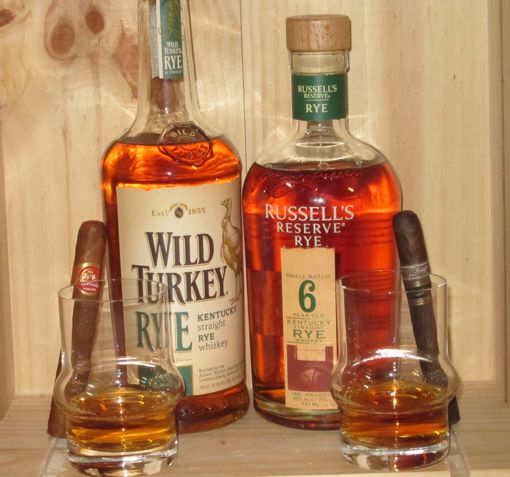
Cigar Spirits: Wild Turkey 81-Proof Rye & Russell’s Reserve Small Batch 6-Year Rye

13 Mar

I’m in the middle of a series of Cigar Spirits articles about rye, with the intention being a guide to rye along the lines of our A-Z Guide to Bourbon (part 1 and part 2). Today I’m tackling two ryes from Wild Turkey: the standard 81-proof variety, and the Russell’s Reserve Small Batch 6-Year-Old Rye.

WildTurkey81-WTRR-rye

Russell’s Reserve Small Batch 6-Year Rye ($30-38) is named after Jimmy Russell (and his son Eddie), the longtime master distiller at Wild Turkey. According to the back of the bottle, it “has a crisp, lively taste that they believe to be the perfect 6-year-old rye.” The $25 81-proof standard Wild Turkey Rye is the most basic version of the Wild Turkey rye recipe, which has a mash bill of 23% corn, 65% rye, and 12% malt barley.

The two represent the two easiest-to-find rye whiskeys made by Wild Turkey. Wild Turkey also sells a 101-proof rye, but it’s limited in quantity, available only in certain states, and reportedly only comes in 1-liter bottles. Along with the 101 Rye, they make for an interesting case study in the difference age and proof can make.

Wild Turkey Rye 81 is a light golden color with a muted nose of floral and oak notes. On the palate it has buttery smoothness with hints of wood spice, pine, and honey. The finish is soft and short. Overall, it suffers from its diluted low-proof nature, but nevertheless is a pleasant, easy-drinking, value-priced rye.

The 90-proof Russell’s Reserve Small Batch Rye has a darker copper color and an inviting nose with baking spices and wood. On the palate it’s a rounded combination of oily intensity, floral notes, and spice with hints of dried fruit. The finish is long and spicy. It’s miles more complex and interesting than it’s 81-proof cousin, a fine ribeye steak to the regular Wild Turkey 81’s burger.

Both are solid pairings for a cigar, but Russell’s Reserve can stand up to a wide variety of mild, medium, or full-bodied cigars, while the standard variety is likely to be overwhelmed by a cigar that’s full-bodied. Both are good rye whiskeys, but the Small Batch variety is particularly noteworthy as a classic rye to enjoy neat.

–Patrick S

photo credit: Stogie Guys

Cigar Review: La Dueña Petit Lancero

12 Mar

I doubt it would be controversial at this point to say that the Pepín family will go down as one of the greatest and most important cigar families the industry has had. Don Pepín García has his huge legacy, which was followed by his son’s fantastic cigars, and now with La Dueña, his daughter Janny is releasing her first cigar. To add to all of that tobacco star-power, the blending for this cigar was done by Pete Johnson, of Tatuaje fame.

Petit LanceroThis blend is a Connecticut Broadleaf wrapper billed as medium-full strength, with Nicaraguan origins. I smoked the “Petite Lancero” vitola (6 x 42) for this review. The construction was immaculate, and the wrapper had a great color to it. Personally, I think that a 42 ring gauge is a bit much for a lancero, but that’s not really a negative.

The aroma off of this cigar is great, with a nice core tobacco aroma complimented by a subtle sweetness in the background. The cigar lights really well, with that typical Pepín spice kicking off the experience. Quickly into the cigar, though, a ton of flavors emerge.

The smoke is very smooth, almost syrupy in its consistency, and earth, leather, black pepper, and a natural tobacco sweetness dominate the first half. Once this cigar hits the mid-point the pepper dies down a lot, and a leathery core takes over, with earth and cocoa notes making slight reappearances until the nub.

While I am writing this review to let everyone know how much I enjoyed this cigar, I’d like to take a quick moment to make another secondary point. When I first tried this cigar a while back (right upon its release), I was actually really disappointed and I gave away three of the five cigars I purchased. I am not sure why, and I don’t know if I ran into a bad batch, or if this cigar needs a little age on it, but the argument I’m making here is this: Do yourself a favor, and re-visit cigars.

We all know that tobacco is a fickle product, and everything from weather, storage, your complimentary drink or meal, or whatever is on your palate, etc. can affect how a certain cigar tastes to you at a particular time. If I would not have given up my preconceptions that this cigar was bad, I would have missed out on a smoke that I think is truly great, and a cigar that I am now considering purchasing a box of.

Anyway, with that small rant out of the way, the La Dueña Petite Lancero is a great addition to an already fantastic line-up of smokes related to the Pepín /Johnson portfolio. This cigar deserves a very respectable rating of four stogies out of five.

[To read more StogieGuys.com cigar reviews, please click here.]

–Joey J

photo credit: Stogie Guys