Search results: site-policy/images

Cigar Review: Flor de las Antillas MAM-13

7 Nov

A little over a month ago, My Father Cigars began shipping a limited size of it’s Flor de las Antillas blend to select retailers. The cigar (6 x 48) will be offered in a round format, unlike the standard Flor de las Antillas slightly box-pressed vitolas. (You can see the difference in shapes in this photo.)

LfdlAntillas-MMFDubbed the MAM-13, the cigar is limited to 500 boxes of 20, all exclusive to five retailers located in Virginia, North Carolina, Tennessee, and Alabama. I received three samples from Emerson’s Cigars (one of the five retailers) which sells five-packs for $36 and boxes of 20 for $130.

Except for the shape and size, there’s no difference between the MAM-13 and the rest of the Flor de las Antillas Sun Grown line, which features a Nicaraguan sun-grown wrapper around Nicaraguan binder and filler tobaccos. (It’s the second Flor de las Antillas size that isn’t a box-press.)

The wrapper is dark brown and a bit rustic. It’s framed by the classic, old-school Flor de las Antillas band and burgundy-colored foot ribbon. Pre-light the foot features a pungent earthy aroma.

Once lit, the MAM-13 reveals wood, leather, baking spices, and a little dryness on the roof of the mouth. It starts out a little rough around the edges but smooths out after the first third. There’s also a bit of pepper spice that really shows up on the retrohale.

It’s very well-constructed, which is hardly a surprise for a Pepin-made cigar. Each of the three samples I smoked burned perfectly and drew flawlessly.

The change in size and shape didn’t alter the flavor very much so, if you’re fan of Flor de las Antillas, you’ll like the MAM-13. Personally, MAM-13 is more my size than the box-pressed Toro, which has a ring gauge of 52, but that’s more a function of ring gauge than box-press.

More fundamentally, the three samples I smoked confirmed my thoughts about Flor de las Antillas, which received plenty of attention after being named Cigar Aficionado’s Cigar of the Year for 2012. It’s a solid, enjoyable smoke, but not extraordinary. In fact, there are at least a half-dozen blends made by My Father Cigars that I enjoy more.

You may, as I do, slightly prefer the MAM-13 to the rest of the line because you prefer smaller ring gauges. But it’s not a significant change from the original line, which is medium- to full-bodied, well-made, flavorful, but not particularly complex. That earns the Flor de las Antillas MAM-13 a rating of three and a half stogies out of five.

[To read more StogieGuys.com cigar reviews, please click here.]

–Patrick S

photo credit: Stogie Guys

Cigar Review: Montecristo Monte Jacopo No. 2

6 Nov

Released earlier this year by Altadis USA, Monte is the newest blend in the storied Montecristo portfolio, which includes Classic, Platinum, Epic, and White, among others. It is being sold as the strongest Montecristo to date.

MonteIn addition to its strength, Altadis is also drawing attention to Monte’s dual binders. “The Monte’s signature feature is the inclusion of two binders: a spicy Dominican Olor combined with a strong and aromatic Nicaraguan Corojo, which adds strength, firmness, and complexity,” reads the Montecristo website. “This brand new offering from the Grupo de Maestros is the most robust Montecristo yet, putting a revolutionary twist on a revered classic.”

Paired up with those dual binders are aged Dominican filler tobaccos and an Ecuadorian Habano wrapper that’s dark, oily, and virtually veinless. Three vitolas are made in the Dominican Rebublic: Conde (5.5 x 48), which retails for $8.95 and features a pigtail cap; Monte (6 x 60), an extra-large smoke that runs $9.50; and Jacopo No.2 (6.1 x 54), a “square-pressed” torpedo that costs $9.25.

I smoked several Jacopo No. 2s for this review, each provided to me by Altadis. This is a unique-looking smoke in that the box-press has four equal sides (as opposed to the traditional box-press that creates more of a rectangular effect). The recognizable brown and gold Montecristo band is complemented by a second Monte band of black and red. With its symmetry, relatively sharp corners, perfectly pointed cap, and extremely clean wrapper, the Jacopo No. 2 makes a good first impression.

While lighting the cigar, I notice the torpedo cap and the square-press significantly concentrate the draw on the tip of the tongue. This leads me to hypothesize that the other Monte vitolas might have a very different taste.  As far as the Jacopo No. 2 is concerned, though, the initial profile is one of dried berries, white pepper, and oak. The texture is bready and the strength is medium-bodied. The resting smoke is toasty and sweet.

As the cigar progresses, the dried berry flavor really comes to the fore, and I find myself constantly reminded of strawberry—a taste that’s very unique in the world of non-flavored premium cigars. I also find the draw, which is a tad stiff at the outset, opens nicely after the first third, yielding much better smoke production. Throughout, the body remains medium with a short finish, and the burn stays wonderfully straight.

While I don’t agree Monte is “the most robust Montecristo yet” (I recall the Cabinet Selección was much more intense), I have to say it is a complex smoke with flavors that aren’t easily found elsewhere in the premium cigar market. That, combined with good construction and great presentation, earn the Jacopo No. 2 an excellent rating of four stogies out of five.

[To read more StogieGuys.com cigar reviews, please click here.]

–Patrick A

photo credit: Stogie Guys

Commentary: Flavors, Cigars, and Reports

4 Nov

A recent report on youth smoking and flavored tobacco generated headlines and is likely to become ammunition in the efforts to bring cigars under the Food & Drug Administration.

Cigar Store IndianNow, there’s a lot to look at in the article, but I want to bring out a couple of points that I think could be useful in making the case to exempt premium, hand-rolled cigars from FDA oversight.

First, the cigar component of the study deals largely with what are known as little cigars. These are more or less the same as cigarettes, the biggest distinction usually being the composition of the wrapper. In most places, little cigars are considerably cheaper than cigarettes because of the tax structure and offer a ready substitute for cigarette smokers looking to save money. Little cigars have almost nothing in common with premium, hand-rolled cigars.

Next, I think there’s a big hole in the study: no mention or exploration of young people using cigars to smoke marijuana. A spokeswoman for the Centers for Disease Control told me the agency “does not have data on cigar use in relation to marijuana use.” I’m no expert on kids and grass, but I think it’s reasonable to assume that a fair percentage of the kids who said they smoked cigars did so after replacing tobacco with marijuana. Again, nothing to do with premium cigars.

Then there’s the whole question of “flavored.” The report is based on the National Youth Tobacco Survey, in which students in grades 6 through 12 note their own activity. Cigarettes flavored with anything other than menthol have been outlawed since September 2009. So how, in a 2011 survey, did more than a third of the youth smokers report using flavored cigarettes? Among the authors’ conjectures: The kids could have confused cigarettes with little cigars, or they could have been referring to menthol cigarettes as flavored. Have you ever smoked, or seen, a menthol premium cigar?

Finally, I think it’s a good idea to keep all this in perspective. The National Institute on Drug Abuse reported in December that “while 17.1 percent of 12th graders were current (past month) cigarette smokers—the lowest it has been in the history of the survey—22.9 percent were current marijuana smokers.”

I’d be the last to argue that smoking doesn’t have inherent risks, and I see nothing wrong in the public health sector pointing them out. I also believe keeping tobacco away from under-age boys and girls is worth considerable effort. But it’s also important to recognize the difference between premium, hand-rolled cigars and other forms of tobacco, and not simply lump everything under a single umbrella.

By the way, if you’re looking for more on this topic, check the latest Cigar Aficionado. I was flipping through it about an hour after I wrote this and found that the Editors’ Note addresses many of the same points.

–George E

photo credit: Flickr

Quick Smoke: Tatuaje Cohete (2013)

3 Nov

Each Saturday and Sunday we’ll post a Quick Smoke: not quite a full review, just our brief verdict on a single cigar of “buy,” “hold,” or “sell.”

tatuaje-cohete-13

A store-exclusive release that also appeared in the recent Saints & Sinners club membership pack, the Cohete (4 x 50) is based on the Tatuaje Brown Label blend that’s made at My Father Cigars in Nicaragua. Previous versions from 2009 and 2006 were made in Miami. The cigar features lots of dark cocoa and earth, backed by oak, a hint of creaminess, and subtle leather and spice. While generally I consider the Brown Label to be medium-full, this is more straight full-bodied, and that’s a good thing. (Although it does take its foot off the gas slightly after the first third.) With excellent combustion it easily earns a recommendation.

Verdict = Buy.

–Patrick S

photo credit: Stogie Guys

Cigar Spirits: Abraham Bowman Limited Edition Gingerbread Beer Finished Bourbon

31 Oct

I remember having my first pumpkin beer in college, Shipyard Punpkinhead. Back then, it was a Halloween novelty. There weren’t that many and there were only (it seemed) far fewer that could be found at any given beer store.

bowman-gingerbreadToday pumpkin beers have exploded. My local grocery store has half a dozen in stock, and there are no fewer than a few dozen at my local beer and wine shop. Pumpkin pie (which more adequately describes most pumpkin beers than just “pumpkin”) is a perfect flavor for beer for autumn nights, when the temperature is crisp and we celebrate Halloween and Thanksgiving.

Abraham Bowman Limited Edition Gingerbread Beer Finished Bourbon, however, is the first such attempt I’ve seen to take the concept into bourbon. No, gingerbread and pumpkin aren’t exactly the same thing, but they share many similar characteristics: sweetness, cinnamon spice, nutmeg, and an association with autumn.

Founded in 1935, Bowman is Virginia’s preeminent bourbon distillery. Now based in Fredericksburg, the distillery is owned by Sazerac, which also owns the world-renowned Bufallo Trace Distilery in Kentucky. Reportedly, much (if not all) of what Bowman makes is distilled twice, first at Buffalo Trace before being shipped to Bowman where it is then distilled a second time on-site before being aged in Fredericksburg.

Bowman makes a number of different lines including Virginia Gentleman, Bowman Brothers (small batch, 90-proof), John J. Bowman (single barrel, 100-proof), and Abraham Bowman, which is released in small batches of limited edition whiskey, the latest being its Gingerbread Beer Finished Bourbon.

To make this unique bourbon, Bowman sent used bourbon barrels to the Hardywood Brewery in Richmond, Virginia, where they were used to age the brewery’s Gingerbread Stout. After that the barrels were sent back to Bowman, who used it to finish bourbon that had already been aged for eight years. After three months in the used gingerbread beer barrels, Abraham Bowman Limited Edition Gingerbread Beer Finished Bourbon was bottled at 90-proof.

The result is a bright, copper-colored spirit not dissimilar to the their small batch variety. On the nose you pick up slight hints of the gingerbread beer finish with clove and vanilla.

On the palate, the special finish becomes more apparent. It features a lush mouthfeel with classic vanilla and oak, combined with dashes of nutmeg, bread, and fall spices. The finish is notably short, though the spices linger a bit longer.

I can’t help but wonder if this wouldn’t be even better at a slightly higher proof (100 or even a bit higher?) as it’s a touch thin. Still, it’s an enjoyable spirit that subtlety shows off just enough of its unique finish. It’s perfect for this time of year, though—like pumpkin beer—I’m not sure I’d want to drink it year-round.

I’d recommend a medium-bodied cigar with plenty of Honduran tobacco as a pairing; something that has both spice and balance. Try the Room 101 Namakubi Ecuador, Sencillo Platinum, or Camacho Connecticut.

–Patrick S

photo credit: Stogie Guys

Cigar Review: Ventura Psyko Seven Robusto

30 Oct

Talk about an attention-grabbing presentation. Psyko Seven from the Ventura Cigar Co. comes enveloped in a white prescription form enticing you to “medicate your mind” with this six-country blend of tobaccos. It’s signed by “El Diablo Blanco.”

Psyko Seven RobustoListed on the form are the tobaccos that comprise Psyko Seven: Dominican Hybrid, Nicaraguan Ligero, Mexican Sumatra, Peruvian Pelo de Oro Viso, Honduran Holancha Seca, and Pennsylvanian Ligero. Underneath is a smaller, traditionally sized white band with Ventura’s trademark “V” cutout.

Like Project 805, Psyko Seven was launched at last summer’s IPCPR Trade Show in Las Vegas and is aimed at serving “the new generation of cigar smoker out there.” It bills itself as a mild- to medium-bodied experience “with distinct transitions.” Four vitolas are available, all made by Henke Kelner in the Dominican Republic: Robusto (5.5 x 50), Toro (6.25 x 48), Gordito (4 x 58), and Gordo (6 x 60).

Beneath its two white bands, the Robusto has a beautiful, moderately oily Cuban-seed Dominican wrapper that has a yellowish hue to it. You have to pay close attention to see the seams in the exterior leaf. The foot gives off only faint notes of hay, syrup, and cinnamon.

After a single wooden match, a bready profile emerges with notes of cream, almond, and oak. The body leans toward the mild end of the spectrum. What the Psyko Seven lacks in power it makes up in balance and uniqueness. The Robusto is captivating enough to maintain my attention throughout its duration, and it does so with depth and a toasty texture that isn’t too common. But I do not find any distinct transitions.

The cigar’s physical properties are superb. Expect an even burn, a stable ash, a smooth draw, and good smoke production with each puff. The resting smoke has a sweet gingerbread-like aroma that enhances the overall experience.

This is the best cigar I’ve had from the Ventura Cigar Co. to date, and one I’d like to try in other sizes. The asking price of $7 for the Robusto is more than fair. Whether you like the marketing angle or not, the quality of Psyko Seven can’t be denied. It earns an excellent rating of four stogies out of five.

[To read more StogieGuys.com cigar reviews, please click here.]

–Patrick A

photo credit: Stogie Guys

Cigar Tip: Cigar Halloween Costumes

29 Oct

Like it or not, Halloween is just two days away. Looking to pull together a last-minute costume? Want to smoke a cigar while you hand out candy to trick-or-treaters? (This is acceptable if you offer their dad a cigar.) We’re here to help. In an effort to make trick-or-treating a lot more tolerable, we’ve updated a list we first put out in 2007 of costume ideas, each that will let you smoke a cigar as part of the costume:

1. Winston Churchill. One time when informed by his host, the King of Saudi Arabia, that drinks would not be offered because of his religion, Churchill responded: “My religion prescribed as an absolute sacred ritual smoking cigars and drinking alcohol before, after, and, if need be, during all meals and the intervals between them.” Plus he beat the Nazis in World War II.

2. Arnold Schwarzenegger. He’s no longer The Governator, but his movie characters always made better costumes anyway, and many of his famous characters smoked cigars. (Major Alan “Dutch” Schaefer of Predator is highly recommended if you have the guns to pull it off.)

3. Groucho Marx. Sure, it’s a little dated, but this American comedy icon loved his stogies.

4. Mark Twain. America’s cigar-smoking author.

5. Scarface. Say hello to my little friend.

6. Bill Clinton. The president who got into trouble with cigars.

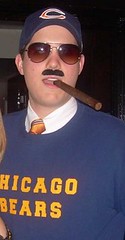
7. Mike Ditka. Da Coach. See photo of Patrick A from a few years ago. (Also, Grill Class doesn’t exist on any airline yet… Why?)

8. Ernest Hemingway. The famous author loved his cigars. And his rum. (No doubt he’s a world famous boozer.)

9. A cigar-chomping communist Cuban. Fidel Castro or his murderous sidekick Che Guevara will do.

12. Al Capone. Capone was known for his enjoyment of cigars, booze, and women. Just don’t get syphilis.

Got a costume idea that we missed? Let us know in the comments.

–The Stogie Guys

photo credit: Stogie Guys