
Stogie Tips: How To Properly Cut A Cigar
23 Jul 2008
While enjoying a fine stogie is certainly more of an art than a science, there a few essential skills you should master in order to get the most out of the experience. While much of what makes cigars so great is the relaxed, ceremonial nature of smoking, when it comes to cutting your cigar, that artistry takes a back seat to function. The goal is simple: a cut that best allows you to enjoy the cigar.
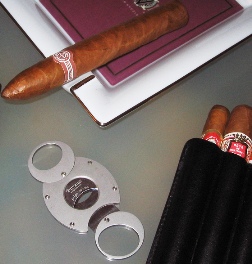
The cut that is best will enhance the flavors of the cigar by regulating the draw and appropriately focusing the flavors on your palette.
It’s worth pointing out that when it comes to cigar cutting, there are many different tools. Some people use specially-crafted cigar scissors, some use a sharp knife, a cigar punch, a V-cutter—some even use their teeth. But the most common tool, by far, is the guillotine-style cigar cutter, which comes in both the one blade (single) and two blade (double) varieties.
Here are a few general tips on deciding what tool to use:
- â— Cigar scissors are quite elegant, but tend to require a bit more skill and precision than other cutters. Also, while a dull blade hurts any cutter, scissors become particularly difficult if the blades aren’t ideally sharp and calibrated.
- â— Guillotines are the most popular cigar cutters with good reason. They are easy to use and are the most versatile. A double blade guillotine will usually prevent the pinching and tearing that can occur with a single blade cutter. Also remember to use firm, consistent pressure to get a clean cut.
- â— V-cutters can be perfect for cigars with small ring gauges, since they increase the surface area of the cut.
- â— Punch cutters are ideal for stogies with tightly-packed fillers because they can ease the draw, but a punch cutter is almost useless on a belicoso.
- â— If you find yourself without a cutting tool, skip your teeth and use your fingernail. A relatively precise cut can be made on non-torpedo cigars by using your nail to slice a circle in the wrapper and binder, which can then be lifted off to expose the filler.
- â— Knives are rarely a good idea, but if you are going to use one, use it to cut like you would your fingernail (see above).
Where to place your cut is another variable in the science of cigar cutting. With a guillotine cutter, take the head of the cigar (that’s the uncut end) and position it so the blade will enter the stogie just above the shoulder (where the cigar stops being round). If you’re planning to smoke a torpedo, a good rule of thumb is to slice off about half an inch, but it really depends on how much you want to focus the smoke with a smaller cut, versus how large you need the cut to have a draw that isn’t difficult.
Finally, remember to try out different cutters. While a cutter can’t actually improve a cigar, the cut can either bring out the best of a cigar or ruin it.
photo credit: Flickr
 Limited production and the luster of being Pete Johnson’s “
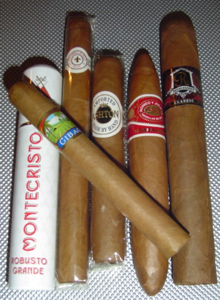 It’s true that many of the finest cigars available happen to be full-bodied cigars. It’s also true, however, that many are medium- or even mild-bodied sticks. Davidoff, for instance, has long been one of the finest cigar brands available, and the company specializes in milder stogies. You’d be hard-pressed to argue that a milder Davidoff is inferior to a fuller cigar of lesser craftsmanship and flavor.
 1) Winston Churchill may be the all-time most towering individual in the world of cigars, but he’s got nothing on
  My antennae always go up when I see references to polls or surveys with no accompanying information. Years of editing news stories made me quite skeptical about polling. Of course there are legitimate polls, but there are many, many more completely useless reports that attempt to gain credibility by artfully disguising their lack of any objectivity or scientific validity.
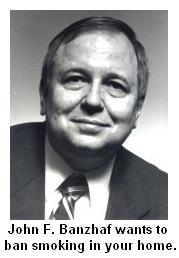 First, though, I e-mailed Professor John F. Bazhaf, ASH executive director, to see if he could direct me to a copy of the survey. He sent me the email address for the Vhi release. When I told him I’d seen that and was seeking the full data, he responded that “you have all of the information I have on this particular study. For more information, I suggest you contact the authors and/or sponsors.†He also suggested I call with any other questions.
 Patrick Ashby
Co-Founder & Editor in Chief
Patrick Ashby
Co-Founder & Editor in Chief Patrick Semmens
Co-Founder & Publisher
Patrick Semmens
Co-Founder & Publisher George Edmonson
Tampa Bureau Chief
George Edmonson
Tampa Bureau Chief