Search results: 2006/05/stogie-guys.html

Quick Smoke: Dissident Bloc B_A

20 Oct

Each Saturday and Sunday we’ll post a Quick Smoke: not quite a full review, just our brief verdict on a single cigar of “buy,” “hold,” or “sell.”

bloc

A highly unique band takes for its inspiration an old 8-bit color video game complete with names that I’m not even going to try to describe. Made in Nicaragua, the cigar has a medium brown Nicaraguan Habano wrapper from the Jalapa region that surrounds dual Nicaraguan binders and filler from Mexico and Nicaragua. It features lots of cedar, a tannic tingle on the tongue, and hints of coffee and black pepper spice. Construction is notably flawless and the balance is excellent.

Verdict = Buy.

–Patrick S

photo credit: Stogie Guys

Quick Smoke: Padrón 2000 Maduro

19 Oct

Each Saturday and Sunday we’ll post a Quick Smoke: not quite a full review, just our brief verdict on a single cigar of “buy,” “hold,” or “sell.”

Padron-2000-Maduro

Pondering my colleague’s recent article about what he calls “Classic Rock Cigars,” I couldn’t help but recall how much I enjoy the Padrón 2000 Maduro (5 x 50)—and how long it had been since I fired one up. No, this cigar isn’t the latest, the greatest, or the most hyped. But it does offer a fantastic, peppery profile of espresso, cocoa, raisin, and dark chocolate, all for less than $6. Like some of my favorite old rock songs, it’s classic and always reliable.

Verdict = Buy.

–Patrick A

photo credit: Stogie Guys

Stogie Guys Friday Sampler No. 354

18 Oct

As we have since July 2006, each Friday we’ll post a mixed bag of quick cigar news and other items of interest. Below is our latest Friday Sampler.

Duke Riley1) In a bizarre article appearing in the New York Times on Wednesday, it was reported that Brooklyn-based artist Duke Riley recently trained homing pigeons to fly him Cuban cigars. “Mr. Riley trained a flock of homing pigeons to fly one way from Havana to Key West,” reads the article. “Half the birds were flat-out smugglers, running Cuban cigars to the United States. The others were documentarians, outfitted with special cameras to record their 100-mile journey across the Straits of Florida.” Carefully not divulging too much information about his methods, Riley says, “If a bird ends up in my pigeon lofts, that happens to have a cigar from Cuba, and there also happens to be a pigeon that has a video camera on it, that shows footage of birds flying from Havana to Key West with cigars—yeah, I can’t really say how that happened.”

2) Billing itself as “The World’s Largest Cigar Celebration,” the Tampa Cigar Festival is scheduled for downtown Nov. 23 from 10 a.m. to 4 p.m., with two evening parties—one a $100 dinner at the J.C. Newman factory—beforehand. Admission to the festival, which features cigar manufacturers, a beer and wine garden, and Cigar Dave broadcasting, is $10.

3) The New York State Supreme Court has struck down an outdoor smoking ban for state parks. According to the Wall Street Journal: “The February rules establishing no-smoking areas at various parks, including popular beaches and all nine state parks within New York City, aren’t supported by any policy set by the Legislature, state Supreme Court Justice George Ceresia said. The city has a separate outdoor smoking ban for its parks and beaches that wasn’t challenged in this lawsuit.”

4) Inside the Industry: Joya de Nicaragua has announced a new cigar called “Cuatro Cinco” to celebrate 45 years since the company was founded in 1968. Cuatro Cinco will be available in a single semi-box-pressed vitola (6 x 54) in 10-count boxes. As a Limited Edition, only 4,500 boxes of Cuatro Cinco are being produced, each individually numbered to guarantee exclusivity. The initial batch will start shipping the first week of November.

5) Around the Blogs: Stogie Review reviews a Sencillo Black. The Tiki Bar kicks back with an Oktberfest Dunkel by Quesada. Stogie Fresh smokes the Partagas 1495. Cigar Inspector inspects La Flor Dominicana Double Ligero Natural. Half Wheel fires up a Cain F 543.

6) Deal of the Week: Famous Smoke Shop has this 5-cigar 601 sampler on sale. The deal is notable because, for $25, in addition to a 601 Blue (maduro) and two 601 Red (Habano) cigars, it includes two of the now discontinued 601 Black Connecticut cigars.

–The Stogie Guys

photo credit: New York Times

Cigar Spirits: E.H. Taylor Single Barrel Bourbon

17 Oct

Buffalo Trace makes plenty of great bourbons: Blanton’s, George T. Stagg, Elmer T. Lee, W.L. Weller, Eagle Rare, Buffalo Trace, and a little bourbon called Pappy Van Winkle. (Pappy has become excruciatingly difficult and expensive to acquire in the past few years.)
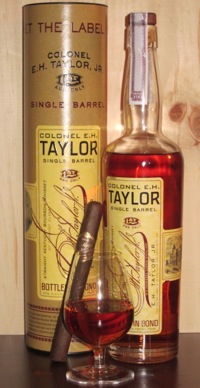
eh-taylor-single-barrelThat’s why I was enthusiastic about trying one of Buffalo Trace’s newer offerings: E.H. Taylor, named after Colonel Edmund Haynes Taylor, Jr., one of the founding fathers of the bourbon industry and one-time owner of what is now called Buffalo Trace Distillery. Taylor was a proponent of the Bottled-in-Bond Act of 1897, which ensured quality standards for “bottled-in-bond” bourbon (back then lots of bourbon was mixed with things like tobacco, turpentine, or other horrible additives to appear more aged than they were). The Act also ensured that the federal government could more easily collect taxes.

Naturally, the many styles of E.H. Taylor are all “Bottled-in-Bond” in compliance with the 1897 law, most of which is still in effect. In order to meet that standard, a bourbon must be 100-proof straight whiskey, must be made at one distillery and distilled in one season, and must be at least four years old. Up until the 1980s bottled-in-bond whiskey was guarded by federal treasury agents in special warehouses where taxes were collected only when whiskey was bottled for sale and departed the warehouse.

The E.H. Taylor line currently includes six whiskeys. The single barrel bourbon variety sells for $60-70 a bottle. And it’s a handsome bottle that comes in a matching tube. It also belongs on my top shelf, along with George T. Stagg, Smooth Ambler, and Zaya Rum, if only because, like those, the bottle is too tall to fit on any of my other shelves.

I’ve seen the age listed at 11 years and 7 months, but the bottle doesn’t have a formal age statement, so take that with a grain of salt. The resulting 100-proof spirit is a dark amber color with a rather muted nose of caramel notes.

On the palate, E.H. Taylor Single Barrel demonstrates fudge, nut, dried fruit, winter spices, and just a bit of oak. It has a rum-like mouthfeel. The finish is medium-length and smooth with more dried fruit and fudge.

There’s a fair bit of nuance to the Taylor Single Barrel, so you’ll want to go with a mild or medium-bodied smoke with lots of balance. Think Tesa Vintage Especial, Ashton Classic, Arturo Fuente King T Rosado Sun Grown, Cabaiguan, or the Cuban Cohiba Siglo.

Overall, I enjoyed E.H. Taylor Single Barrel, but for the price I’d expect something a bit more exceptional. It’s only a bit better than Elmer T. Lee or Eagle Rare 10 Year (and at least double the price) and not nearly what George T. Stagg is (if you can find it) for not too much more money. Connoisseurs may want to seek this out, but if you’re just getting acquainted with bourbon there are better options that provide more value.

–Patrick S

photo credit: Stogie Guys

Commentary: When Enough Cigar is Enough

16 Oct

While smoking cigars is more of an art than a science, over the years we’ve tried to provide you with dozens of Tips to enhance your enjoyment. I hope you’ll take a moment to peruse our archives for everything from fixing an uneven burn and cigar auctions to winning the war on mold and establishing a good light. Many of these lessons are part of our Cigar University.

Cigar ToothpickMy quick observations today are far more subjective than the sort of info we usually provide in our tips. I don’t claim to have the answer because, more than likely, there is no one good solution. If anything, I’m hoping to open a dialogue in which I would encourage you all to participate.

The topic, simply stated, is as follows: At what point do you stop smoking a cigar?

I realize this may sound like a silly question. But I ask because I’ve heard and witnessed a variety of different answers. For example, a number of enthusiasts set down a cigar before it reaches the band. Still others practice the polar opposite, resolutely smoking each stick down to the nub. Smokers from the latter school know the best time to quit is a few minutes after your fingers start burning because they’re too close to the encroaching flame.

I, like most cigar enthusiasts, fall somewhere between these two camps, allowing the cigar and the situation to dictate when it’s best for me to set down my cigar. Some cigars, namely those that perform poorly or develop an unpleasant taste in the final third, deserve a premature death. Others merit a long, drawn-out goodbye, especially those that improve as they progress. Obviously, though, if I’m smoking a cigar for a full review or Quick Smoke—rather than for my own pure enjoyment—I’ll burn it down to the end.

While the “play it by year” approach works well for me, only you can determine what’s best for you. So please share your strategy with fellow StogieGuys.com readers and tell us: How low do you go?

–Patrick A

photo credit: Flickr

Cigar Tip: Five Tips for Tasting Cigars

15 Oct

We often get questions from people who read our reviews and say something along the lines of, “But I can’t taste flavor X, Y, or Z; my palate isn’t developed enough.” And they’re probably right, most people just smoke and enjoy cigars, and there’s nothing wrong with that.

cigarmouthThere’s obviously a good deal of personal preference when it comes to reviewing cigars, but when reviewers frequently notice the same flavors in the same cigars, it’s evidence that there’s also quite a bit of science to tasting cigars. In my experience, it’s mostly a question of training yourself to observe all the complexities that a cigar can demonstrate. To that end, for those who want to develop their palate and become better at cigar tasting, here are five suggestions:

Take Notes – If observation is step one then documentation is 1A. Not only will writing down your observations help you remember what you noticed while smoking a particular cigar, but putting pen to paper will force you to think about the descriptions you use and make sure they are evocative and precise so they will be useful later.

Re-taste – There’s a good reason why we make a point of sampling multiple cigars (usually at least three) before writing a full review. Not only can one particular cigar be off, or just different, but the situation in which it is smoked can make all the difference. Taste the same cigar more than once and you’ll start to realize what is the cigar and what is you, and the more you taste a cigar the more easily you’ll be able to pinpoint the defining characteristics.

Clean Your Palate – While I love pairing cigars with a fine spirit or a good cup of coffee, I find the best way to really focus on the cigar is absent a flavorful pairing. Spring water is good. The best is room temperature or slightly-chilled club soda. The bubbles clean the palate while making sure it isn’t too cold will prevent your taste buds from being dulled.

Smoke Two – I’ve written before that one of the best ways to develop your palate is to smoke two cigars at once. It’s like that game you did at a kid where you had to pick out the differences between two seemingly identical pictures. If you smoke two similar cigars side-by-side, you’ll be forced to notice the contrasts and complexities that you wouldn’t smoking one alone. (Not to mention, most people smoke cigars too quickly, so alternating between the two will force you to slow down.)

Retrohale – It’s said that 90% of what you taste is smell, or more precisely that only 10-20% of taste is through the tongue. That’s why smoking through the nose, also known as retrohaling, is an excellent way to observe flavors you’d otherwise miss. My colleague wrote an excellent description of how to retrohale here.

–Patrick S

photo credit: Stogie Guys

Cigar Review: Flor de las Antillas Toro Grande

14 Oct

The fact that Illinois, unlike Virginia, doesn’t have a state-controlled monopoly on the sale of liquor didn’t factor into my decision to move back home to Chicago in 2011. But it certainly didn’t hurt. Liquor store competition generally results in better selection, lower prices, and an overall superior experience. The absence of a state liquor stores was a welcome change.

FdlA Toro GrandeOur home in the Lakeview neighborhood is a short walk from a Binny’s Beverage Depot, a chain of nearly 30 liquor stores in the Chicagoland area—most of which have a walk-in humidor. While one might expect a liquor store to have a paltry stock of smokes, I’ve consistently found my local Binny’s to have excellent prices and a selection that would be the envy of many stand-alone cigar shops. I can’t go in there to buy libations without perusing the humidor to see what’s new. The whole arrangement is downright dangerous.

One new noteworthy display is the Flor de las Antillas Toro Grande, a cigar that’s crafted exclusively for Binny’s by My Father Cigars. Binny’s is the third tobacco retailer to get its own exclusive Flor de las Antillas vitola, the others being Texas-based Up in Smoke (Lancero) and Philadelphia-based Holt’s Cigar Company (Short Churchill). The formats may be different, but all adhere to the same recipe: a Nicaraguan sun-grown wrapper around Nicaraguan tobaccos.

The box-pressed Toro Grande (6 x 60) retails for $9.70 per cigar, or $174.95 for a box of 20. Only 500 boxes will ever be made for a total run of 10,000 cigars. I sampled four for this review. Each came equipped with a maroon band across the foot, a triple-cap, a firm packing of tobaccos, and pre-light notes of sweet cocoa and earth.

Slightly less awkward in the mouth than a normal 60-ring gauge smoke because of the box press, the Toro Grande starts with a delightful profile of cream, pepper, vanilla, and a spice that reminds me of nutmeg. The texture is bready and a little airy. The midway point witnesses no increase in the medium-bodied profile and more of a focus on coffee and dry wood. The finish is characterized by less sweetness and more bitter notes.

With damn near perfect combustion qualities, the Flor de las Antillas Toro Grande is a solid buy for less than $10—even if its large format means the cigar overstays its welcome a bit. While I’ve never been a big fan of large, thick cigars, I can see myself keeping a few of these on hand for those times that call for extra-long smokes. That results in a rating of three and a half stogies out of five.

[To read more StogieGuys.com cigar reviews, please click here.]

–Patrick A

photo credit: Stogie Guys