Search results: site-policy/images

Cigar Review: Mi Querida Fino Largo

3 Oct
mi-querida

This summer, cigar makers, brand owners, blenders, and factories scrambled in an effort to rush as many new brands and vitolas to market as possible before the August 8 deadline. (Regular StogieGuys.com readers will recall that cigars introduced after August 8, 2016, will have to go through the FDA approval process before they can be sold or marketed.)
fino-largoThis mad dash was best personified by Steve Saka of Dunbarton Tobacco & Trust. If you follow him on Facebook—where he is quite prolific—you’ll recall his rapid succession of posts proclaiming new cigars like Umbagog, Maestro de Saka, and Mi Querida. These announcements drew considerable attention among cigar faithful which, of course, was a predictable outcome given the success of Dunbarton’s inaugural line, Sobremesa.

“It has been an incredibly grueling 90 days,” Saka wrote on Facebook on July 7. “I have finalized five marca designs and over 15 ligas between 46 vitolas. Thankfully, I had been buying leaf and working on all of these blends over the past year. While there are some packaging tweaks required, none of any of these cigars are half-baked.”

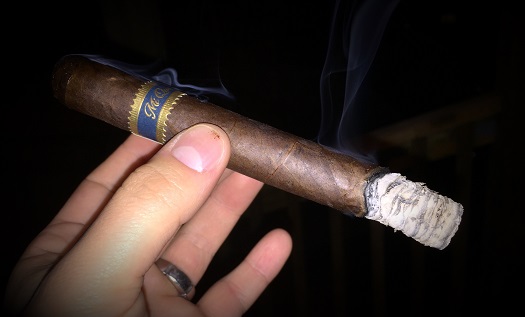
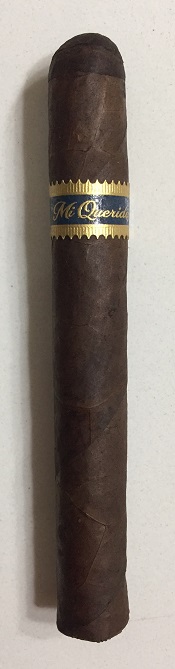
NACSA is the site of production for Mi Querida, a blend of Nicaraguan tobaccos surrounded by a Connecticut Broadleaf wrapper that’s crafted by Raul Disla under direction from Saka. Nine vitolas are available, including the Fino Largo (6 x 48), which retails for about $9. I smoked several for this review, each provided by CigarsCity.com.

Mi Querida sports an understated yet attractive band of blue and gold with corrugated edges. The exterior leaf is dark, oily, mottled, and rustic with plenty of tooth, thick seams, and the occasional splotch of out-of-place color. The rough-looking cap clips cleanly to reveal an easy cold draw. Off the foot, the pre-light notes are rich, sweet, and damp with hints of chocolate and musty earth.

The Fino Largo tastes the way, I believe, many expected Sobremesa to taste given Saka’s history with Drew Estate. It has a moist, full-bodied profile with a grainy texture and ample spice. Notes of espresso, cinnamon, damp wood, and leather are front-and-center from the get-go. After an inch, the cigar is at its best with hints of roasted nut and nougat sweetness adding complexity. Here, there’s still plenty of power, but that power is more refined, balanced, and harmonious. The final third brings a reprise of the intensity found at the outset.

Mi Querida is Spanish for “my dearest,” but in Nicaragua the phrase is most often used to describe a mistress. Kind of fitting, since I almost feel like I’m cheating on Sobremesa when I smoke one. Sobremesa came first, after all, and while it hasn’t been around terribly long, I’ve burned through more than my fair share. We have a history. That said, I foresee a long and meaningful relationship with the dirtier, cheaper Mi Querida. It’s highly satisfying if you’re seeking something musty, earthy, rich, well-constructed, and—in the case of the Fino Largo, especially—strong. My expectations are high whenever I light up a Saka creation, and this one does not disappoint. I award it four and a half stogies out of five.

[To read more StogieGuys.com cigar reviews, please click here.]

–Patrick A

photo credit: Stogie Guys
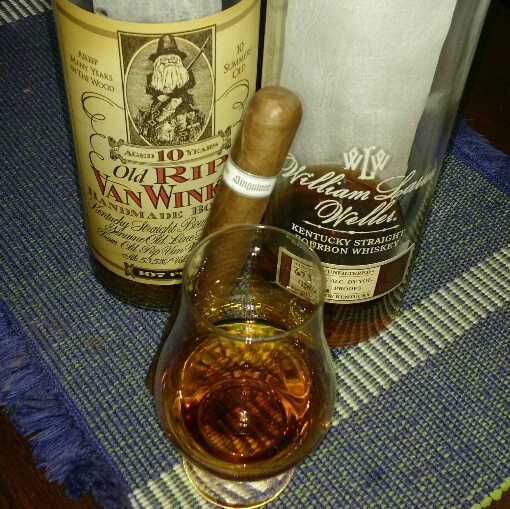
Quick Smoke: : Illusione Singulare Phantom LE 2010

2 Oct

Each Saturday and Sunday we’ll post a Quick Smoke: not quite a full review, just our brief verdict on a single cigar of “buy,” “hold,” or “sell.”

singulare2010-weller-ripvanwinkle

To celebrate a recent birthday, I fired up one of my favorite cigars: Illusione’s first Singulare release from 2010. More than half a decade since its release, “Phantom” continues to deliver. Medium-bodied with wood and earth along with hints of both sweetness and spice, the cigar is immaculately balanced. Of the 1,000 boxes made, I personally smoked through four or five, but I’m unfortunately down to my last few. At this year’s IPCPR trade show, Illusione announced the Singulare Phantom was being brought back as a regular production cigar. Needless to say, I’m very interested to see if they can successfully reproduce this masterpiece.

Verdict = Buy.

–Patrick S

photo credit: Stogie Guys

Quick Smoke: E.P. Carrillo Dusk Solidos

1 Oct

Each Saturday and Sunday we’ll post a Quick Smoke: not quite a full review, just our brief verdict on a single cigar of “buy,” “hold,” or “sell.”

ep-carrillo-dusk

Introduced a few months ago at the industry’s annual trade show, Dusk is a four-vitola line from E.P. Carrillo that resides in “The Classics” level of the company’s recently revamped portfolio. It sports a dark, undisclosed wrapper from the United States, an Ecuadorian binder, and filler tobaccos from Nicaragua. Dusk is crafted at Tabacalera La Alianza in the Dominican Republic. The Solidos format (6 x 60) retails in the $8 to $9 range and delivers a medium- to full-bodied profile that’s moderate on spice yet heavy on damp earth, cocoa powder, raisin, nut, and cream. The resting smoke is particularly sweet and mightily enticing. Construction is a bit lacking, though, with a burn line that tends to meander and a draw that’s a tad too tight for my liking. Still, this is a good cigar, and I suspect I will like it considerably more in one of the thinner vitolas.

Verdict = Hold.

Patrick A

photo credit: Stogie Guys

Stogie Guys Friday Sampler No. 499

30 Sep

As we have since July 2006, each Friday we’ll post a mixed bag of quick cigar news and other items of interest. Below is our latest Friday Sampler.

FDA-cigars-large

1) In a scathing—though perhaps unsurprising—story from Scientific American, it was revealed the FDA “has been arm-twisting journalists into relinquishing their reportorial independence” with a tactic known as the “close-hold embargo.” The entire article is well worth a read, but the gist of the unnerving scheme is that the FDA is offering certain media outlets briefings about upcoming announcements before those announcements are provided to their competition in exchange for the FDA’s ability to determine who the journalists can and cannot interview. “Documents obtained by Scientific American through Freedom of Information Act requests now paint a disturbing picture of the tactics that are used to control the science press,” reads the article. “For example, the FDA assures the public that it is committed to transparency, but the documents show that, privately, the agency denies many reporters access—including ones from major outlets such as Fox News—and even deceives them with half-truths to handicap them in their pursuit of a story. At the same time, the FDA cultivates a coterie of journalists whom it keeps in line with threats. And the agency has made it a practice to demand total control over whom reporters can and can’t talk to until after the news has broken, deaf to protests by journalistic associations and media ethicists and in violation of its own written policies.” This hardly seems like the behavior of an agency that works in the best interest of the public it supposedly serves. The revelation—which one observer described as “journalists become stenographers”—also may explain how so many supposedly reputable mainstream media outlets repeated many misleading FDA claims about the agency’s cigar regulations.

2) Major League Baseball may be officially anti-tobacco, but the players have no doubt what marks a special occasion. Before David Ortiz’s last game Sunday at Tropicana Field, the Tampa Bay Rays presented the Boston Red Sox slugger with gifts that included 34 cigars (his number) from local cigar company J.C. Newman. Reports referred to 34 Diamond Crown Maximus sticks, but a photo of the event (held off-field because of the death of José Fernández earlier that day) shows Rays’ star Evan Longoria with a box of Diamond Crown Julius Caeser and Big Papi holding the Maximus box. It’s not the first time cigars have figured in Ortiz’s retirement-tour celebration. The White Sox gave him a large cigar-filled humidor built by former Sox slugger-turned-woodworker Ron Kittle.

3) Inside the Industry:  A trio of products that pay tribute to the company’s history highlight La Aurora’s new offerings this year. La Aurora has long been known for using tobacco aged in rum barrels, but the new La Aurora 1903 Edition Double Barrel Aged doubles, by one year, the rum barrel aging period for the filler. The blend uses Ecuadorian wrapper, a Brazilian binder, and filler from the Dominican Republic, Brazil, and Nicaragua. The company is also introducing new formats of its flagship La Aurora Preferidos line, with non-tubo Corona, Robusto, and Toro sizes. Also new this year is the La Aurora 107 Cosecha 2006, which has tobacco from the 2006 harvest in three sizes: Churchill (7 x 50), Corona Gorda (6 x 47), and Robusto (5 x 50).

4) From the Archives: Picking a cigar to smoke is hard enough, but sometimes picking a tobacconist to buy it from can be equally frustrating. Based on lots of travel and visits to many cigar shops, this examination of “How to Spot an Excellent Tobacconist” will help you evaluate any shop.

5) Deal of the Week: Just $27 will land you this Lucky 7 Sampler. Included are three each of the Alec Bradley American Sun Grown and Oliva Serie O, plus a Punch Gran Puro, and a free cutter thrown in for good measure. Be sure to add the coupon code “stogie” for 10% off.

–The Stogie Guys

photo credit: Stogie Guys

Commentary: Cigar Country Power Rankings (5-1)

28 Sep

flag-top-10

While cigars are commonly associated with few countries, at least a dozen countries make significant contributions to handmade cigars. This week, we rank the top ten countries by their importance to the industry. The production of handmade cigars is truly global, as evidenced by the fact that Belgium, Costa Rica, Panama, Colombia, Peru, Jamaica, and the Bahamas—each of which grow cigar tobacco or make cigars—missed the top ten.

On Monday we counted down from ten to six. Today we reveal the rest of the top ten.

5) Ecuador — Wrapper, wrapper, and more wrapper. That’s why Ecuador is so high on this list. Blessed with powdery, nutrient-rich soil and natural cloud cover, odds are good some of your favorite cigars introduced in recent years use Ecuadorian wrapper, likely grown by the Oliva tobacco family. Not only is Ecuadorian-grown Connecticut (where cloud cover makes netting unnecessary) an alternative to U.S.-Connecticut Shade wrapper, but the country also produces the increasingly popular Ecuadorian Habano leaf, as well as significant amounts of Sumatra-seed wrapper.

4) Honduras — Not too long ago, Honduras surpassed Nicaragua when it came to cigar exports to the United States. That’s no longer the case, and it isn’t all that close but the country is still in a tier of its own above all but the top three on this list. Known for bold, flavorful tobaccos, Honduran tobacco continues to be a staple for cigars rolled in Honduras (especially in the country’s cigar epicenter of Danlí) and elsewhere.

3) Dominican Republic — Long the number one handmade cigar country for cigars imported into the United States, today the Dominican Republic has a strong claim to our number three spot. Many victims of Cuban revolution ended up in the Dominican Republic, where iconic brands continue to be produced today. Add such classic brands as Davidoff and La Aurora, plus many upstart boutique brands, and it is easy to see why the Dominican Republic continues to be a juggernaut.

2) Nicaragua — Both Nicaragua and the Dominican Republic have a strong case to make for second place, but in recent years Nicaragua has surpassed the Dominican Republic in many ways, especially as the social and political instability of the war in the 1980s moved into the rear-view mirror. In terms of handmade cigar output, Nicaragua, with its rich soil, has pulled even with the Dominican Republic in terms of imports to the U.S. in recent years, even though as recently as 2005 the Dominican Republic outproduced Nicaragua almost four to one. Today, many traditionally Dominican blends are coming out with cigars that include Nicaraguan tobacco, a fact that ultimately pulls Nicaragua ahead.

1) Cuba — Although held back because Cuba’s cigar industry is state-controlled, Cuba still has some of the best tobacco-growing regions in the world, which results in many of the finest cigars. Plus, no country is as closely identified with cigars as Cuba. If ever we could see some of the top-grade Cuban tobacco used in combination with that from other countries, I would expect the result to be spectacular.

There you have it, our top ten. Agree or disagree? Let us know.

–Patrick S

photo credit: Stogie Guys

Commentary: Cigar Country Power Rankings (10-6)

26 Sep

flag-top-10

While cigars are commonly associated with few countries, at least a dozen countries make significant contributions to handmade cigars. This week, we rank the top ten countries by their importance to the industry. The production of handmade cigars is truly global, as evidenced by the fact that Belgium, Costa Rica, Panama, Colombia, Peru, Jamaica, and the Bahamas—each of which grow cigar tobacco or make cigars—missed the top ten.

Today, we count down from ten to six, with the top five being revealed Wednesday.

10) Indonesia — Indonesian cigar tobacco doesn’t get a lot of respect from many cigar connoisseurs, but it is a workhorse. Sumatra wrapper is known for its mild spice, and Indonesian tobacco is frequently used as binder due to its excellent combustion qualities and neutral flavors that play well with more flavorful tobaccos. Take a look at any cigar catalog and you may be surprised at how many premium cigars use some Indonesian tobacco.

9) Brazil — Although rich in history with a diversity of cigar tobaccos grown—including Mata Fina, Mata Norte, and Arapiraca—Brazil flies under the radar. After the Menendez family, which created Cuba’s famed Montecristo cigar, had their Cuban-based holdings seized by the Castro regime, the family spread out in search of other opportunities to grow tobacco and make cigars, including Felix Menendez, who became a pioneer in Brazilian tobacco. While few Brazilian puros are made, Brazilian tobacco is primarily used in combination with other tobaccos.

8) Cameroon — Cameroon wrapper has a special place in the cigar industry. Put simply, there is nothing else like it. Grown predominately by the Meerapfel family in Cameroon and the Central African Republic, Cameroon wrapper features a mild spice that so far hasn’t been replicated. That’s why, even though quality Cameroon wrapper is expensive and sometimes delicate, more than one cigar maker has told me as long as it is available they plan on keeping a Cameroon-wrapped cigar in their profile, if for no other reason than because they enjoy the leaf so much.

7) Mexico — For a long time, Mexican tobacco had a reputation as rough and course, but that has changed in recent years as Mexican puros have decreased but Mexican San Andrés Maduro wrapper has become an increasingly popular. With high quality Broadleaf Maduro wrapper hard to find, the industry has turned to Mexican leaf in large numbers, and consumers have welcomed the addition.

6) United States — A century ago, cigars were rolled in every major U.S. city. Today, with the exception of a few boutique factories in Miami, almost no handmade cigars are made in the United States. Still, the country is important to handmade cigars because of the high quality wrapper grown in the Connecticut River Valley, especially Connecticut Shade and Broadleaf wrapper. As demand for Broadleaf has increased, tobacco—Broadleaf especially—is also being grown in Pennsylvania. Although minute in terms of volume, an interesting experiment has also seen cigar tobacco grown in Florida for the first time in decades.

Check back Wednesday for the top five.

–Patrick S

photo credit: Stogie Guys

Quick Smoke: Viaje Oro Reserva VOR No. 5 (2010)

25 Sep

Each Saturday and Sunday we’ll post a Quick Smoke: not quite a full review, just our brief verdict on a single cigar of “buy,” “hold,” or “sell.”

viaje-vor-no-5

This Viaje Oro Reserva VOR No. 5 is the cigar that put Viaje on the map for many people when it landed at number two on the Cigar Aficionado best-of list for 2010. Today, I’m re-tasting the six-year-old cigar to see how it has aged. (The VOR No. 5 was reissued in 2012 and 2013, but those can be differentiated because they featured a secondary band marked “Oro” and the Reserva band on the foot.) The cigar features wood, earth, and leather along with light cocoa and mild spice (cinnamon and nutmeg). The result is a cigar that, over the years, has become even more perfectly balanced, but still flavorful. Six years later you can still see why this was so sought-after.

Verdict = Buy.

–Patrick S

photo credit: Stogie Guys