Archive | Cigar Reviews RSS feed for this section

Stogie Reviews: Padilla 1932 Churchill

4 May 2009

Over a year ago, Don Pepin Garcia and Ernesto Padilla announced they would no longer be collaborating to make Padilla cigars. The partnership had produced some of Padilla’s most popular and highly acclaimed smokes, including the Padilla Miami, the Padilla 1948, and 1932.

Padilla 1932All three cigars were blended by Pepin and produced at his Miami or Nicaragua factory, but are now are made completely by Padilla. After the split, Padilla moved forward with a plan to open a small cigar factory in Miami’s Little Havana. But despite the separation—which came about because Pepin was focusing on his many other clients, including Tatuaje, 601, San Cristobal, and Pepin’s own Don Pepin Garcia brand—many of the Pepin-made Padilla cigars are still popping up.

The handful of Padilla 1932s that I sampled for this review are from the Pepin-era. This series of photos demonstrates the differences, of which the most notable is the font used in the word Padilla: in the Pepin-era smoke, Padilla is in bold capitals; the newer band features Padilla in script. Given the timing of the split, I can conclude that my Pepin-made 1932s have at least one year of age.

Underneath the ornate band, the Padilla 1932 features a nearly flawless, deep brown Nicaraguan corojo wrapper that surrounds Nicaraguan criollo binder and Nicaraguan Cuban-seed filler. The seven inch by 50 ring gauge Churchill is firm to the touch, and has a well-made triple cap. Pre-light, the foot gives off an aroma of earth.

Once lit, I was greeted by a complex smoke of licorice, spicy cedar, roasted cashews, and bittersweet chocolate. The full-bodied taste is complex and balanced with a long, dry finish. As it progressed to the midway point, it became slightly milder, developing a bit of toffee sweetness. Some of Pepin’s characteristic peppery spice also came to the forefront. The construction was also impressive: no touch-ups were needed, the draw was deliberate but not difficult, and the ash held admirably.

The 1932 is fuller-flavored than the Padilla Miami and more complex than the 1968 blend. Once the toffee and pepper kicked in in the second half, it particularly reminded me of a combination of two of my favorite smokes: the Coronado by La Flor and the Pepin-made EO Cubao.

The cigar was created as a tribute by Ernesto Padilla to his late father, Heberto Padilla, a well-known Cuban writer and poet who was placed under house arrest by the Castro regime for “subversive” writings. Heberto was born in 1932, and it’s an impressive tribute.

At around $12 per cigar, it’s priced appropriately for the reliably complex, balanced, and, most of all, enjoyable flavors it provides. All of which earns the Padilla 1932 Churchill a rating of four and a half stogies out of five.

[To read more StogieGuys.com cigar reviews, please click here.]

Patrick S

photo credit: Stogie Guys

Stogie Reviews: Punch Champion

30 Apr 2009

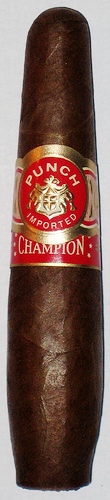
Punch’s original lineup of cigars has a tendency to get overshadowed by the brand’s more visible offshoots, such as Grand Cru, Rare Corojo, and Gran Puro. The exception to the rule, however, seems to be the Champion vitola, a short and quirky figurado that we named a Gold Star Smoke almost two years ago.

Punch ChampionWhile this four and a half inch stogie is said to look like a bowling pin, I think my colleague put it best in an old Quick Smoke when he said it resembles “a python swallowing a pig.” He refers, of course, to the fact that the Champion swells to a 60 ring gauge at about the one inch mark and then narrows to a 30 ring gauge at the head.

That unique shape has helped make this cigar an everyday favorite among enthusiasts. The price doesn’t hurt, either. JR sells boxes of 25 for just under $73 (including an Altadis-made Cigar Savor single-flame torch lighter). I capitalized on the same deal several weeks ago when the pre-SCHIP pricing was only $62.

Either way, the Champion, introduced by the General Cigar Company in 2001 and handmade in Honduras, is a steal. It features the same building blocks as the other vitolas in the original Punch blend—an Ecuadorian Sumatra wrapper, a Connecticut binder, and filler tobaccos from Honduras, the Dominican Republic, and Nicaragua—but is in its own class.

I smoked half a dozen Champions for this review (many more previously, including one right after a marathon) and all were terrific-looking sticks. Few veins, well-packed, shapely, and a tempting pre-light aroma of cedar, leather, and spice.

You only need to barely puncture the slender cap to establish a clear draw. The foot takes to a match nicely, yielding some vanilla, cherry, and a bit of typical Punch spice. The flavor of Honduran tobacco is more prominent after the burn passes its widest point, and the final third is characterized by a finale of medium-bodied spice.

Like many figurados, in my experience, the Champion also boasts outstanding combustion qualities, including a razor-sharp burn and an ash that holds strong for longer than you’d expect. Those characteristic undoubtedly enhance the enjoyment of this 40-minute smoke.

So, whether or not you’re impressed with other cigars that bear the Punch name, don’t dismiss the brand until you’ve tried the Champion. For its delicious taste, distinctive physique, and tremendous value, it earns a special place in my humidor and four stogies out of five.

[To read more StogieGuys.com cigar reviews, please click here.]

Patrick A

photo credit: Stogie Guys

Stogie Reviews: Montecristo Buena Fortuna

29 Apr 2009

Montecristo Buena FortunaWhen I slid the cheesy mustard-yellow cardboard sleeve from the Montecristo Buena Fortuna, I thought I’d gotten lucky. Several years in my humidor had greatly improved the look of the Habana 2000 wrapper. It was dark and oily, nearly shiny enough to reflect the light. And the aroma was rich and mouth-watering.


Hmm, I thought. Maybe I gave up on these sticks too soon. I’d bought a few five-packs from a North Carolina JR outlet, smoked a number of them without enthusiasm, and more or less forgot the rest. I’m not sure what prompted me to pick up this one the other day; perhaps it was the size, since I was seeking a small cigar. With its five inch by 47 ring gauge frame, the Buena Fortuna is a comfortable quick smoke.

My newfound enthusiasm soared with the first couple of puffs. It was thick and tasty, saturated with coffee and cocoa flavors and a little leather. I was ready to find the JR catalog for a re-order.

Ah, the foolishness of first impressions. Quickly, the cigar’s mix of Dominican, Nicaraguan, and Peruvian filler returned to form and became the bitter, unpleasant cigar I recalled. By the midpoint, it had become truly nasty, and I left it dying in the ashtray.

I thought this was one of the Altadis brand extensions produced exclusively for JR, which it owns. But I saw Buena Fortuna for sale at a couple of other sites on the web, so I’m no longer sure. At any rate, it doesn’t appear on Altadis’ own website. And while I don’t recall what I paid, JR lists a five-pack at $18. I cannot imagine I paid that much, but maybe that’s just wishful thinking.

I can’t really think of any reason to recommend this cigar. I’d be hard-pressed to smoke one as a gift. As such, I’m afraid the Montecristo Buena Fortuna rates only one stogie out of five.

[To read more StogieGuys.com cigar reviews, please click here.]

George E

photo credit: Stogie Guys

Stogie Reviews: Tesa Series Gran Cru No. 2

27 Apr 2009

It wasn’t so long ago that I named Isla de Cuba, Cuban Crafters, and Bucanero as my favorite boutique manufacturers. Well, after smoking a handful of exceptional cigars from Tesa’s Series Gran Cru line—one of nine blends from the Chicago-based producer—I’m ready to add that company to my short list of top boutiques.

Tesa Series Gran Cru No. 2Located in a shop on the Near North Side of the Windy City, Tesa cigars are “meticulously blended by Chicago area resident Chris Kelly and crafted in the Tesa Cigar factory in Estelí.” Their naked, tiger-endorsed blends make use of a variety of enticing wrappers and filler tobaccos from Nicaragua.

The criollo ’98 maduro-wrapped Gran Cru line is no exception. It was created to fill the need for a cigar with balance yet full flavor “without the in-your-face strength,” according to Tesa’s website.

The six inch by 54 ring gauge No. 2, a torpedo-shaped vitola with a beautiful cap, features hearty pre-light aromas of espresso and cocoa. It manages to command attention without flash (or a band for that matter) due to its oily sheen, dark and textured wrapper leaf, and solid cross-section of filler tobaccos. Veins are plentiful but not a cause for concern.

Right off the bat I could tell this cigar had little in common with the Series Finos F500 I reviewed (and loved) earlier this month. While that Connecticut shade  smoke is mild and creamy, the Series Gran Cru No. 2 starts with a flavor that instantly reminds me of a 601 Green—specifically, a rich and well-rounded profile of black coffee, roasted nuts, leather, and cocoa bean.

I would say that this cigar, however, is better balanced, complete with subtle nuances that drift in and out. If you pay attention and smoke through the nose, for example, it isn’t difficult to detect a sweet flavor that’s akin to moist chocolate cake. Delicious. And with a fairly straight burn that requires just a few touch-ups, a smooth draw, and a solid ash, the combustion qualities are fine.

One drawback of this outstanding smoke is its limited availability and relatively high cost. As far as I can tell, the only way to get it is to either visit the shop in person or purchase it from Tesa’s online shop for $11.70 per single. Before you dismiss trying this cigar for those reasons—a huge mistake in my opinion—consider that Tesa donates 10% of its profits to benefit the housing, education, and sustenance of the Nicaraguan people.

Still, I realize that’s a lot to pay for a cigar you’ve probably never heard of. Despite that likelihood, I have no reservations about wholeheartedly endorsing the Tesa Series Gran Cru No. 2 and giving it four and a half stogies out of five.

[To read more StogieGuys.com cigar reviews, please click here.]

Patrick A

photo credit: Stogie Guys

Stogie Reviews: Montecristo Edmundo (Cuban)

23 Apr 2009

The Montecristo Petit Edmundo, launched in the summer of 2007, remains one of the most exciting sticks to come out of Cuba in the past few years. I was, and still am, a huge fan of that five stogie-rated masterpiece, on board with the bandwagon that ensued when Cigar Aficionado awarded the pudgy smoke a rating of 94.

Montecristo EdmundoBefore the Petit Edmundo hit the market, though, there was the Edmundo vitola. It, like its shorter and younger offspring, was named for Edmond Dantès, hero of The Count of Montecristo. That adventure novel, as I wrote in my review of the iconic Montecristo No. 2, was the inspiration for the brand’s name because it was a popular choice of rolling floor lectors when Montecristo was established in 1935.

When the Edmundo came out in 2004, it was the first new size to be added to the Montecristo lineup in over 30 years. Composed of tobaccos from the Vuelta Abajo district in the Pinar del Río Province of Cuba, it measures 5.3 inches by 52 ring gauge and sells for approximately $11-14 per stick when bought by the box of 25 or 3-pack.

Unlike the Petit Edmundo, which boasts a fine oily sheen, the Edmundo is drier and wrinklier with a few green spots (also known as “frog eyes”). But it is by no means unattractive. The cigar has a nice reddish hue, a firm feel, a tightly rolled cross section, and a perfect cap.

Smooth spice, nuts, and leather dominate the outset—quite a bit of flavor for a cigar that has very little pre-light aroma. And, reminiscent of the Petit Edmundo, floral hints are also present. As the relatively tight draw opens up after the first inch, the flavors mellow and take on a meaty characteristic. Then, just before that taste overstays its welcome, the profile turns bolder and finishes with a full-flavored pepper spice down the stretch.

All the while the burn line weaves in and out, meandering but not causing any problems. One of the two Edmundos I smoked for this review required a few touch-ups from my torch, and both featured solid gray ashes that held firm until tapped.

I enjoyed this Cuban thoroughly, albeit not as much as the Petit Edmundo. In some ways it was a little greener, a little less complex, and not quite as creamy as its shorter cousin. While that may be due to aging differences, I’ll likely never know; I didn’t buy a whole box of Edmundos so I have no idea when they were rolled and boxed. Still, without that knowledge, I am confident in awarding the Montecristo Edmundo four stogies out of five.

[To read more StogieGuys.com cigar reviews, please click here.]

Patrick A

photo credit: Stogie Guys

Stogie Reviews: 5 Vegas Classic Torpedo

16 Apr 2009

Before the Miami, Series A, or any Limitada, at all started for 5 Vegas with the Classic. This moderately priced blend has since built a loyal following of smokers who enjoy its consistency and traditional medium-bodied taste.

5 Vegas Classic TorpedoAlso known as the “Reserva” or “Red” line, 5 Vegas Classic is not without impressive critical acclaim, the most prominent of which originates from a position of prestige in the industry. I refer, of course, to the well-publicized claim that Cigar Aficionado gave this line the highest rating for a non-Cuban cigar in a blind test.

I’ll take this blend’s ratings of 90, 88, and 87 with a grain of salt. I can’t help but hope, however, that the folks over at CA are on to something, especially because the Torpedo (6 x 54)—the most intriguing vitola in the Classic lineup—sells for only $70 per box.

With a towering point, this sharp-looking smoke (pun intended) looks like it could be dangerous if used improperly. The fairly smooth Sumatra wrapper gives off mouth-watering pre-light notes of cocoa and herbs.

I was pleasantly surprised to find an easy draw after snipping off just a quarter of an inch from the cap. Once lit, the concentrated smoke pulls through to reveal plenty of spice with accompanying flavors of roasted nuts, damp earth, and warm tobacco.

The taste becomes slightly bitter as the burn progresses through the Nicaraguan binder and the Cuban-seed filler from Nicaragua and the Dominican Republic. Then some charred steak-like qualities enter the equation after the midway point. And while this cigar is no elite treat with copious subtleties or complexities, it still offers plenty of character for the money.

Handmade in Estelí, the Classic Torpedo consistently makes a combustion comeback unlike any other smoke I’ve seen. Each stick I sampled started with a finicky burn that required constant touch-ups only to completely even out after the first 15 minutes. You’ve got to be happy with a cigar that rallies to finish strong.

All told, I may not be as enamored as the reviewers over at Cigar Aficionado, but I can certainly see where they were coming from. With a solid gray ash that holds well for over two inches, a nice yet simple flavor, and a comfortable price point, I feel confident recommending this as a low-cost everyday cigar. That’s why I give the 5 Vegas Classic Torpedo three and a half stogies out of five.

[To read more StogieGuys.com cigar reviews, please click here.]

Patrick A

photo credit: Stogie Guys

Stogie Reviews: Cabaiguan Robusto Extra

15 Apr 2009

Combining the talents of master Cuban cigar blender Don Pepin Garcia and Pete Johnson, the man behind Tatuaje, the Cabaiguan (pronounced kah-bei-gWAHN) comes to the table with high expectations. With such a pedigree, it shouldn’t surprise anyone that it retails for around $10 per smoke.

cabaiguanThe Cabaiguan was the first cigar made by Johnson’s Tatuaje company that didn’t bear the Tatuaje name. Instead, the cigar, which is made in Don Pepin’s El Rey de Los Habanos factory in Little Havana, was named after the the town of Don Pepin’s birth in Cuba. It features a Connecticut seed shade-grown Ecuadorian wrapper, which surrounds Nicaraguan binder and filler leaves.

The wrapper, which is almost completely vein-free, is a classic representation of an attractive Connecticut leaf. Of the three Robusto Extras (5.25 x 50) I sampled for this review, one had a few spongy spots, but otherwise they were firm. Each cigar had excellent construction.

While there was no distinctive pre-light flavor, this long robusto provided an abundance of flavor once lit, most notably a rich, creamy taste of what seemed like roasted pecans. Underneath were some toasty notes and subtle bread flavors.

Later, some subtle spice creeps in (particularly when smoked through the nose), but it doesn’t overwhelm the Cabaiguan’s excellent balance. The finish is long and toasty.

Overall, this medium-bodied cigar has none of the chemical flavors that sometimes plague Connecticut-wrapped smokes. And nothing in the construction of the cigar—with its even burn and easy draw—distracted from its complex flavor profile.

With bold, rich spice being the trend (a trend led by Don Pepin himself), I must say the Cabaiguan impressed me most for its subtlety. It’s plenty flavorful and complex, but also nimble and refined. I’ve heard the Cabaiguan compared to the Partagas Serie D No 4, but I think another top Cuban, the Romeo y Julieta Short Churchill, might be a better comparison.

Either way, that’s high, well-earned praise. That’s why the Cabaiguan Robusto Extra earns our highest rating of five out of five stogies.

[To read more StogieGuys.com cigar reviews, please click here. A list of other five stogie-rated cigars can be found here.]

Patrick S

photo credit: Stogie Guys