Quick Smoke: Sencillo Platinum Robusto

19 Feb 2012

Each Saturday and Sunday we’ll post a Quick Smoke: not quite a full review, just our brief verdict on a single cigar of “buy,” “hold,” or “sell.”

From Keith K. Park, the man who launched the high-dollar God of Fire, the Sencillo Platinum (Spanish for simple) is a Honduran puro aimed further down the line at the everyday cigar level. I found it milder than I would have expected, with earth and wood notes predominating. I had some minor burn issues and the draw was very open. According to the Sencillo site, each of the six sizes presents a different flavor profile. If you’re looking for something a little different, pick up one of these. The Robusto (5.25 x 50) lists at $7.95.

Verdict = Buy.

George E

photo credit: Sencillo

Quick Smoke: Romeo y Julieta Exhibición No. 4 (Cuban)

18 Feb 2012

Each Saturday and Sunday we’ll post a Quick Smoke: not quite a full review, just our brief verdict on a single cigar of “buy,” “hold,” or “sell.”

My previous experiences with this Cuban have ranged from, “Eh, not worth the price,” to, “Excellent, as long as you age it for a year or more.” I recently gave the Exhibición No. 4 (5 x 48) another shot, this time with a specimen that had been in my possession for over a year. What a disappointment. The bland profile tasted of dry wood and ammonia. The physical properties were good, but who cares about construction when you invest $8-11 and a year of humidor space to get a crummy-tasting stick? I’m starting to think my good experiences with this smoke were mere anomalies.

Verdict = Sell.

Patrick A

photo credit: Stogie Guys

Stogie Guys Friday Sampler No. 277

17 Feb 2012

As we have since July 2006, each Friday we’ll post a mixed bag of quick cigar news and other items of interest. Below is our latest Friday Sampler.

1) Maryland Gov. Martin O’Malley (pictured) is proposing to raise his state’s excise tax on all cigars from 15% to 70%. “Advocates of this tax hike say it’s necessary to decrease teen cigar use, but both the facts about youth cigar use and the tax design indicate this rationale is simply a smokescreen,” writes Marc Kilmer of the Washington Examiner. “Instead, the tax hike seems a clever way to manipulate concern about youth tobacco use to funnel more revenue to the state government… If O’Malley is really concerned about the cheap cigars being sold to youth, why penalize all tobacco products if the real problem is with only a small subset of the cigar market?”

2) As anti-tobacco forces continue to push for a statewide smoking ban in Indiana, a similar battle is brewing in Indianapolis to expand the city’s smoking regulations. Last week, Mayor Greg Ballard vetoed a bill that would have criminalized smoking in hotel rooms, most bars, bowling alleys, and private clubs because he objects to the idea of banning smoking in private clubs. But now a similar bill is expected that would allow smoking in private clubs as long as the only minors present are members’ children or grandchildren. No word yet on whether Ballard would support this bill.

3) Inside the Industry: E.P. Carrillo will begin shipping its newest Short Run cigar in the next two weeks. The “New Wave Connecticut Short Run 2012” uses the same Ecuadorian Connecticut wrapper as the New Wave Connecticut, with a Connecticut broadleaf binder (same as the wrapper on the Core Maduro line) around Dominican and Nicaraguan filler (also from the Core Maduro line).

4) Around the Blogs: Cigar Brief fires up an MK Ultra. Cigar Explorer explores an Ortega Serie D. Cigar Fan fires up a Santos de Miami by Jameson. Nice Tight Ash checks out a Paul Stulac Phantom. Stogie Review reviews the Drew Estate Liga Privada Unico Serie L40.

5) Deal of the Week: CroMagnon fans will want to checkout the new cigar “Intemperance” by the team behind CroMagnon. Currently available as a pre-release, this sampler features all eight new cigars and is discounted to just $39.

The Stogie Guys

photo credit: Flickr

News: H.R. 1639 Reaches 150 Co-Sponsors

16 Feb 2012

An important milestone was reached yesterday. The number of co-sponsors on H.R. 1639—federal legislation that would protect premium cigars from Food & Drug Administration (FDA) regulations—hit 150. That means almost 35% of the U.S. House of Representatives is co-sponsoring this bipartisan bill.

Ever since June 2009 when President Obama signed the “Family Smoking Prevention and Tobacco Control Act,” my colleagues and I have written ad nauseam about the danger of granting the FDA jurisdiction over handmade cigars. In fact, our warnings on the subject date back to the summer of 2007, when a Senate panel brought national attention to the issue.

Why have we been so outspoken and persistent in our objection to FDA regulation of cigars? According to an FDA spokesperson, the agency would make cigars subject to registration, product and ingredient listing, additional taxes, and premarket review requirements. Such regulation would be devastating to the cigar industry, and in particular to boutique cigars and the creation of new blends.

The proposition of these regulations also shows a complete misunderstanding of the handmade artisanal nature of premium cigars on the part of FDA bureaucrats. “Ingredient listing” would be nearly impossible beyond “100% tobacco” since blends are regularly tweaked to provide consistent flavor from one year to the next. Further, even if blends aren’t changed, the chemical composition of tobacco leaves changes from harvest to harvest, meaning any disclosure of “ingredients” beyond tobacco would be either completely stifling or totally meaningless.

Similarly, by forcing new cigars to go through a costly FDA approval process, the now constant stream of new cigar blends would grind to a halt. Suddenly, instead of releasing small batch blends, cigar makers would be forced to focus on large runs that they think would have mass appeal after a time-consuming approval process.

Since this issue has come to the fore, our discussions with cigar makers, retailers, and industry leaders suggest a growing consensus: FDA regulation is the single greatest threat facing the cigar industry.

So if your representative is not currently one of the 150 co-sponsors of H.R. 1639 (and if your senators are not co-sponsors of the companion bill in the U.S. Senate, S. 1461) please contact them immediately. The very survival of the cigar industry as we know it may depend on the outcome of these efforts to protect cigars from FDA regulation.

Patrick A

photo credit: Flickr

Cigar Review: NHC Surrogates Bone Crusher

15 Feb 2012

If you only pick up cigars from your local shop then you probably haven’t heard of the Surrogates Skull Breaker and Bone Crusher cigars. These cigars are only available from New Havana Cigars (NHC), an online-only shop based in Columbus, Ohio.

Unlike most online retailers, NHC’s selection is limited to a handful of more boutique cigarmakers like Tatuaje, Illusione, Viaje, E.P. Carrillo, and 7-20-4, including many hard to find limited releases. NHC has featured a number of exclusive smokes—including the NHC Selección Limitada (a box-pressed size of the Tatuaje Brown Label) and the My Uzi Weighs a Ton Bait Fish (a corona size of the Drew Estate MUWAT)—but Surrogates is the first truly new brand created by NHC.

Last August, NHC owner Dan Welsh described his thinking about the line this way: “I wanted to create a brand for NHC that would bring new customers and service our loyal customers. Looking at our business over the last four years, it was obvious that our clients demanded something special. One thing that was missing was constant availability… Surrogates was created to solve the problem of choosing whether to save or smoke that special vitola. The answer, is both.”

Beyond saying the cigar is created “utilizing a new source” (implying it isn’t made at any of the factories where the cigars he stocks are produced) Welsh reveals few details about the blend, except that the wrapper is broadleaf and it is “made in Central America.” In its current listing on the site a few more details are revealed, as the description says the cigar’s origin is Nicaragua, as is the wrapper and filler.

Shrouded in a bit of intended mystery, one is left to smoke the cigar and evaluate it on its own terms. Available in two sizes, Skull Breaker is a belicoso that measures 5.25 inches with a ring gauge of 52 and Bone Crusher (the subject of this review) is a parejo that measures 5.25 inches with a ring gauge of 54. The Bone Crusher samples I smoked are clearly well-made. The dark, nearly vein-free wrapper is framed by dual matte black bands. The cigar produces a perfectly even burn and sturdy ash that holds for well over an inch.

Bone Crusher yields heavy smoke with a density that coats the palate. Its extremely full-bodied flavors are dominated by espresso, earth, and leather. There’s a bit of pepper at the start but also some lingering bitterness, especially towards the end. All in all, Bone Crusher seems an appropriate name for this cigar. It’s powerful, flavorful, and one of the most full-bodied cigars available anywhere. But all that power comes with a price, as there’s no subtlety or finesse, and little in the way of balance.

Still, it is a cigar that can be enjoyed under the right circumstances: a full-stomach and a strong drink help. And while it’s a bit too powerful to be a favorite of mine, it’s a cigar I might turn to when I want a true flavor bomb. At $7.50 each and $120 for a box of 20, it’s worth a try if you’re a fan of strong cigars. So even though it lacks finesse, the NHC Surrogates Bone Crusher earns a favorable rating of three and a half stogies out of five.

[To read more StogieGuys.com cigar reviews, please click here.]

Patrick S

photo credit: Stogie Guys

Cigar Review: La Aroma de Cuba Edición Especial No. 3

14 Feb 2012

I remember reading about the Edición Especial from La Aroma de Cuba shortly before it was released in the summer of 2008. Somehow, three and a half years later, I’m just getting around to trying it for the first time.

The seven-size line is part of the Ashton portfolio and one of three La Aroma de Cuba blends mentioned on the Ashton website (the other two being Mi Amor and the original line). It is produced in Nicaragua by the Garcias with an Ecuadorian sun-grown wrapper surrounding Nicaraguan binder and filler tobaccos.

I finally decided to try this cigar when the toro-sized No. 3 (6 x 50) caught my eye in my tobacconist’s humidor. This is a handsome smoke. The wrapper is smooth with minimal veins, the cap is a work of art, and the seams are virtually invisible. With a firm feel from head to foot, the Edición Especial No. 3 makes a great first impression.

Fortunately, that impression is followed by a very nice introductory taste. A core of warm tobacco is complemented by dry wood, coffee, and some sweetness on the finish. Each puff yields tufts of cool smoke.

Towards the midway point, the taste grows on you until it becomes difficult to pick out individual flavors. Instead of being a contemplative cigar that rewards close attention, I find that the balanced and intermingling flavors lend themselves to conversation or reading. No, this isn’t one of those smokes that will inspire you to study a flavor wheel. But it’s an excellent choice if you’re looking for a medium-bodied, well-rounded profile to complement another activity.

As the Edición Especial No. 3 grows creamier in the final third, I take note of the physical properties. The burn requires a few touch-ups to stay even but is otherwise well-behaved. The draw is smooth and the ash holds very firm off the foot.

I understand you can find this cigar for about $6 when you buy it by the cedar chest of 25 online. In my case, I paid $8.50 at my local shop for each of the samples I examined for this review. The Edición Especial No. 3 is a solid value at $6 and a reach at $8 or more. Either way, it’s a solid smoke with a nicely balanced profile that’s worthy of three and a half stogies out of five.

[To read more StogieGuys.com cigar reviews, please click here.]

Patrick A

photo credit: Old Virginia Tobacco

Cigar Tip: Time, The Forgotten Ingredient

13 Feb 2012

Ask a cigar smoker why a cigar tastes the way it does and you’ll surely hear about the tobacco used and the proportions in which they are blended. Maybe they’ll mention the time of day the cigar is smoked or what drink, if any, they accompany the cigar with. But largely forgotten is one of the most important variables: time.
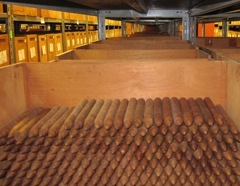
Tobacco is organic matter, which means that chemically it will change with time. During a cigar’s life, the tobacco changes, and that impacts the flavor. Today I’m breaking down aging into three basic categories:

Factory Aging

Some change, like curing and fermenting in tobacco barns or at the cigar factory, takes place relatively quickly. Other critical aging time, like time spent aging tobacco before it is rolled, or the time the rolled cigars are spent in an aging room before being boxed and shipped, can take place over weeks, months, or years. If you’ve ever smoked a cigar fresh off a rolling table you’ll remember how different that cigar would taste from the finished product, even though the difference may only be 15 of 60 days before the cigars go in the box. Obviously, unless you make your own cigars, you have no control over the factory aging process.

Short-Term Aging

Most critically (and often over-looked) is short-term aging or resting. Most people do this without even realizing it. The most obvious way is letting the cigars settle from shipping, often for a week or two, particularly when it’s extremely hot or cold out, and if your cigars may have been sitting a hot delivery truck for a few days.

Another common form of short-term aging is to let cigars get past what is often called the “sick period,” where the cigar emits ammonia and can be downright unpleasant to smoke. Cubans are known to get “sick” far more than non-Cubans, so often a six-month or more resting period is needed.

Long-Term Aging

The most discussed type of aging is long-term aging, where cigars can be aged for years or even decades. A few non-Cuban cigar makers put dates on their boxes, and all Cuban cigars have box dates, making it easier to precisely age your cigars.

Cuban cigars are notorious for benefiting from (some would say needing) time to age, often a year or more. And while most of the focus with long-term aging is on Cuban cigars, non-Cubans will also change, sometimes for the better, with months or years. Just remember that aging a bad cigar will only leave you with an old bad cigar.

Prime candidates for cigars to age are ones with full flavors that need some smoothing around the edges. Like fine wine, cigars tend to smooth out and add complexity and balance over time, trading fuller body for subtleties, though eventually cigars (like wine) lose too much flavor. So be sure to try your cigars every so often to make sure that time is making them better, not worse.

Patrick S

photo credit: Stogie Guys