Search results: site-policy/images

Cigar Tip: Beyond the Basics of Humidity

24 Apr

There was a time when I stressed over keeping my cigars at a perfect humidity. These days, I’m not so fussy about monitoring my humidors on a day-to-day basis.

cigar-humidity-tip

When you first get into cigars, you read often that 70/70 (humidity/temperature) is the ideal way to store your cigars. Soon, though, you probably realize that a slightly lower humidity (62-65%) is better, especially if you are storing cigars for long-term aging.

We’ve covered the fundamentals of proper humidity before, but as the outside temperature gets hotter it’s a good time to recap. Anywhere from 62-70% is generally fine. (You can even go all out and build your own temperature-controlled humidor.)

It’s often a matter of personal preference if you like your cigars a little drier. On the low end of that range, your cigars are certain to burn easily, but possibly a bit quick and hot.

Of course, the first step in proper humidity is making sure your hygrometer is properly calibrated, especially for the inexpensive spring-loaded hygrometers that come with most humidors. For that you want to to use the salt calibration test.

Eventually, though, you might get to the stage where you don’t even need a hygrometer. I now keep most of my cigars in humidors without one, since I can tell by feel, and by how my cigars are smoking, when it’s time to add a little more distilled water or humidor solution.

I’ve gotten to the point where I’m really only concerned about keeping a select few cigars at their ideal humidity. Over time I’ve found certain cigars smoke better at slightly higher or lower humidity levels. Thick broadleaf wrappers, in particular, tend to benefit from a slightly higher humidity. This is especially true of Liga Privada, which will produce smoke like a chimney at almost any humidity. (Sometimes I’ll leave a 70% or 72% Boveda pack in a box with these cigars within my larger humidor.)

Other cigars, I may pull out of the humidor a few hours before smoking to let the humidity drop a bit before lighting it up. Cigars with a closed foot, which is becoming more common, tend to hold moisture more easily than a traditional foot so they may benefit from this. The same goes for cigars with a particularly firm draw.

Ultimately, it’s a case of trial and error, and you may want to experiment a bit. Tweaking the humidity won’t make a bad cigar good, but it might just make a favorite of yours a little bit better, so give it a try.

–Patrick S

photo credit: Stogie Guys

Postcards from Cigar Safari in Nicaragua (2014)

23 Apr

Since returning from my latest visit to Nicaragua, I’ve shared a number of photos with you, including this article focused on Drew Estate’s expansion and quality control, and this article about “DE2.” Today I provide some of my favorite photos from the trip that weren’t included in either of those two pieces.

Drew Estate Grounds

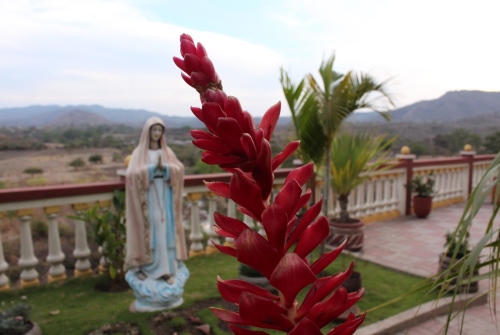
The grounds of Drew Estate’s Estelí facility are handsomely decorated and well-appointed. Included with the vegetation and sweeping views is a Liga Privada swimming pool, a shaded canopy for dining, and a clubhouse equipped with a poker table and comfortable furniture.

DE Factory Mural

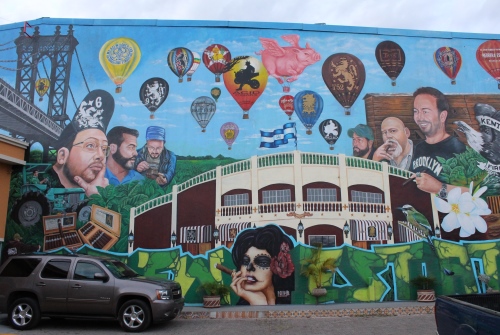
Since the last time I visited, Jesse Flores and his team in Subculture Studios have updated the massive mural that adorns the back wall of the factory. The work is characterized by hot air balloons that highlight various Drew Estate brands.

Tobacco Field

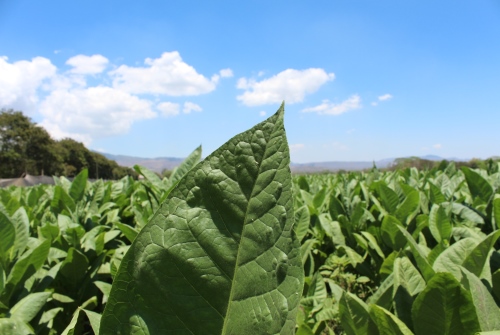
Walking the tobacco fields is a surreal experience. The whole notion of “seed to smoke” cannot be fully appreciated without visiting the sunny fields where the seeds are planted, grown, and cultivated.

Curing Barn

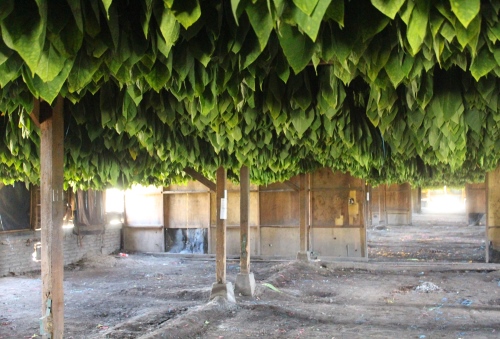
This was my first visit to a curing barn, the place where cultivated tobacco is hung to dry. Tobacco growers don’t ship their leaves green, and these barns are integral to that process.

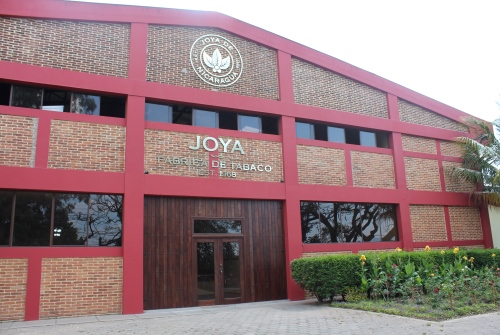
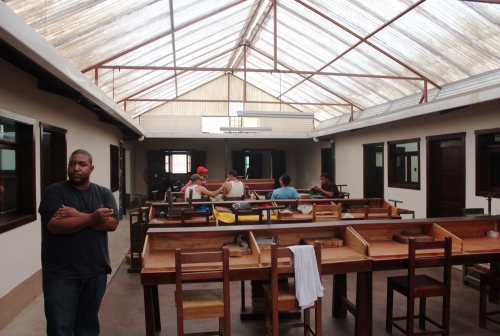
Joya de Nicaragua

I hadn’t been to the Joya de Nicaragua factory since 2012. Much had changed since my last visit. For starters, the facility had undergone a renovation—both inside and out. In addition, José Blanco, instead of recently joining the company, had already left to launch a new cigar brand out of the Dominican Republic.

Nica Sueno

Drew Estate is enormous. Joya de Nicaragua is big (and steeped in tradition). Nica Sueño, the factory of Skip Martin’s RoMa Craft Tobac, is much, much smaller than either. It was interesting to visit this tiny yet formidable operation after touring larger factories.

More of my photos from this trip can be viewed here.

–Patrick A

photo credit: Stogie Guys

Cigar Review: A.J. Fernandez Mayimbe Robusto

22 Apr

A path to prominence in the cigar business can follow any of a number of routes. Consider for a minute the divergent ways that big players—people like Rocky Patel, Don Pepín García, Ernesto-Perez Carrillo, Dion Giolito, Sam Lecia, just to name a few—earned their reputations.AJF-Mayimbe-Robusto-sq

A.J. FernandezAJF-Mayimbe-Robusto rode a wave of catalog/online sales to cigar stardom. With Mayimbe, Spanish for “big shot,” he’s making another move.

This high-dollar cigar is a big ring gauge line (all 56) to compete with the likes of top Tatuajes and Fuentes. To my taste, Fernandez succeeded. He created a cigar with power and flavor that stands apart from most others in the humidor.

Mayimbe is described as a limited edition, packaged in boxes of 10 with a run of 2,500 boxes in each of four vitolas. The five-inch Robusto runs a bit over $14 per stick. Rolled at Fernandez’s Nicaraguan factory, the cigar features a Pennsylvania broadleaf wrapper, Nicaraguan binder, and a Jamastran Honduran filler blended with Nicaraguan tobaccos and what’s called “AJF Privatio,” which I assume is a strain grown on the Ferandez farm.

The line sports a very large band as well as a foot wrap with the AJF logo. I’ve smoked two, supplied by the manufacturer in a sampler that included other Fernandez cigars.

Mayimbe is a tasty, complex cigar that’s up on the strength scale. The primary flavors are cedar and pepper, which ebb and flow throughout the length of the stick. Along the way, I also get some leather, which I often associate with Honduran tobacco, an interesting floral note, and an occasional nuttiness. This is a cigar that commands—and repays—careful attention. With its extra two inches, I can’t help but wonder what the fat Churchill would be like.

Construction and burn are excellent, as is smoke production. Strength is in the medium- to full-bodied range with a nice finish.

If you’re a Fernandez fan from his catalog productions like Man O’War or his widely available San Lotano smokes, you may find Mayimbe a bit of a surprise. For those who’ve never tried a Fernandez stick, Mayimbe could be a fine introduction. It earns a rating of four stogies out of five.

[To read more StogieGuys.com cigar reviews, please click here.]

–George E

photo credit: Stogie Guys

Quick Smoke: San Lotano Oval Connecticut Robusto

20 Apr

Each Saturday and Sunday we’ll post a Quick Smoke: not quite a full review, just our brief verdict on a single cigar of “buy,” “hold,” or “sell.”IMG_3778 - Version 2San-Lotano-Oval-Conn-sq

 San-Lotano-Oval-Conn

Making a full-bodied cigar with a Connecticut shade-grown wrapper can be a challenge. Often, either the wrapper gets overwhelmed or there are significant bitter notes. Fortunately, A.J. Fernandez hits the mark with the San Lotano Oval Connecticut, made with Nicaraguan binder and filler, with additional filler from Honduras. The Robusto (5.5 x 54) features the unique oval shape Fernandez has created and marketed. It produces thick, creamy smoke along with notes of cedar, honey, and coffee. Construction is excellent, but most of all it’s impressive for being a full-bodied, balanced, and complex Connecticut-wrapped cigar.

Verdict = Buy.

–Patrick S

photo credit: Stogie Guys

Stogie Guys Friday Sampler No. 379

18 Apr

As we have since July 2006, each Friday we’ll post a mixed bag of quick cigar news and other items of interest. Below is our latest Friday Sampler.

Tobacco Field in Nicaragua1) Nicaragua, which is on pace to surpass the Dominican Republic as the number one exporter of premium cigars to the U.S. market, has recently been hit by a series of earthquakes. For the population, the tremors are causing unease, and forcing many to recall painful memories of a disastrous earthquake 42 years ago. “Life in Nicaragua, whose capital was devastated in 1972 by a magnitude-6.2 quake that killed nearly 10,000 people, has become a tense game of waiting between shakes,” reports ABC. “The Sandinista government has placed the country on red alert, the highest possible level, and is urging Nicaraguans to sleep outside their homes until further notice.” In recent days, earthquakes with magnitudes of 6.6, 6.1, 5.6, and 4.6 have rattled the country of 6 million.

2) Atladis has announced a new H. Upmann brand called “The Banker,” which is expected to start shipping to retailers this month. It is reportedly named for a private label cigar two nineteenth century German bankers crafted from Cuban tobacco for their top clients. This time around, The Banker features an Ecuadorian Habano wrapper, a Nicaraguan binder, and filler tobaccos from Nicaragua and the Dominican Republic. It will be available in three sizes and retail for $7 to $8.40.

3) Inside the Industry: Reinado Cigars’ highly-rated Grand Empire Reserve line will be distributed by Alliance Cigars. Alliance Cigars may not be a familiar name to consumers, but it sells numerous well-known cigar brands wholesale to cigar retailers.

4) Deal of the Week: Twenty-seven dollars lands you this five-cigar Silver Tray sampler. Included are the Nat Sherman Timeless Churchill, Wynwood Rout Corona, CAO Gold Double Robusto, Rocky Patel 1950 Robusto, and Room 101 Master Roxxo.

–The Stogie Guys

photo credit: Stogie Guys

Cigar Spirits: Jefferson’s Straight Rye Whiskey

17 Apr

Rye whiskey is a quintessentially American spirit, and yet in recent decades Canada has become better known for rye than the United States. Canadian whiskey is synonymous with rye, as rye is the dominant grain in most Canadian whiskey.Jeffersons-rye-10-sq

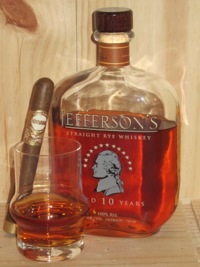
Jeffersons-rye-10But most Canadian whiskey doesn’t meet the “straight rye” designation since the rye is often mixed with neutral grain spirits (basically vodka), to produce the low-proof, smooth-drinking Canadian whiskey you might be familiar with. And yet lots of rye is made in Canada, which caught the eye of some American whiskey sellers as old aged rye has gained a larger and larger following with American whiskey fans.
Three such Canadian straight ryes are particularly noteworthy: Jefferson’s Straight Rye Whiskey (10 Year, 94-proof), Whistlepig (10 Year, 100-proof), and Masterson’s (10 Year, 90-proof). All reportedly source their straight rye from the same Alberta distillery, and all are made with a mashbill of 100% rye, which sets them apart from rye produced in the U.S. (Lots of ryes, mostly made in Indiana, use a 95% rye mashbill.)

While they are distilled in Canada, due to their marketing and style, you’ll probably find them in the bourbon and rye section of your store, not lumped in with Canadian Club and Crown Royal. In the case of Jefferson’s, the label on the side discloses its origins: “Imported by Castle Brands, Produced in Canada.” Included is a batch and bottle number (the bottle I’m using for this review is batch 41, bottle number 251).

Jefferson’s pours a lovely reddish copper color and has a nose full of floral sweetness, a hint of what’s to come. Once tasted, it reveals a very clean, balanced profile with minty spice. It’s floral, oily, and has a honey sweetness. It lacks the forward spice that characterizes most American-distilled rye, but it’s very enjoyable in its own way. The finish stays true to the taste and it lingers on the roof of your mouth.

Normally I suggest a full-bodied cigar to stand up to rye’s spice, but the more subtle aspects of Jefferson’s Rye suggest a different direction. Instead, I’d stick with a milder cigar, either a Connecticut (USA or Ecuador) or the subtle spice of a Cameroon wrapper.

I’ve become a big fan of Jefferson’s Rye, and I heartily recommend all rye fans seek it out, especially at the very fair price of $40 or less. (It’s probably obvious by now, but this is totally different than the Jefferson’s bourbons which we’ve written about here and here.)

Now for the bad news: Jefferson’s Rye, at least in its current form, isn’t going to be around for long, and may already not be available in your area. Reports are they’ve lost their source of whiskey and it will soon be replaced with rye from a different (probably non-100% rye mashbill) rye, that won’t carry the ten-year age statement. So be sure to examine the bottle closely. Personally, I scooped up four bottles when I had the chance.

–Patrick S

photo credit: Stogie Guys

News: Behind the Scenes at Drew Estate’s New ‘DE2’ Pre-Industry Building

16 Apr

On Monday I kicked off our coverage of our recent pilgrimage to Estelí with a focus on Drew Estate’s plans for expansion and dedication to quality control. Today I’ll delve into the Nicaraguan company’s new pre-industry facility, which they’ve dubbed “DE2.”

DE2

Officially unveiled in January, DE2 is a 60,000+ square foot, $4 million building that was erected directly across the street from La Gran Fabrica Drew Estate. Whereas the company was previously renting smaller facilities around Estelí to process, ferment, age, and sort the tobacco it purchases, those operations have now been expanded and centralized in DE2. Nicholas Melillo led most of our tour of the facility.

Tobaccos at DE2

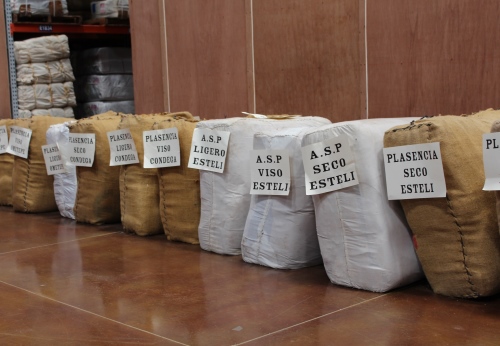
Currently Drew Estate has enough tobacco within the building to support two years of cigar making; Jonathan Drew aims to increase the supply to about four years. This will enable the company to withstand pricing pressures from its tobacco suppliers—a critical strategy especially with A.S.P. tobacco, which is in high demand.

Experimental Field

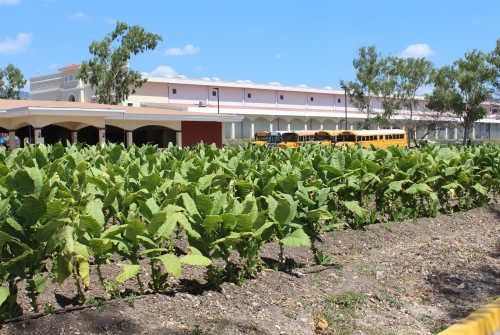
Speaking of tobacco suppliers, Drew Estate doesn’t grow any of its own tobacco, save for this small “experimental” field adjacent to DE2. But Jonathan Drew assured us that, within a few years, “you can count on Drew Estate being one of the largest tobacco growers in Nicaragua.” Such vertical integration represents a major shift in strategy for the company.

DE2 Basement

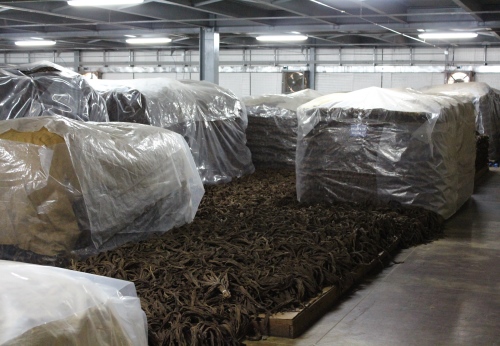
The basement of DE2 houses 300,000 pounds of tobacco (roughly $5-6 million) in pilones undergoing fermentation. It is equipped with state-of-the-art temperature gauges and fire prevention technology. One of the tobaccos aging here is a new Florida Sun Grown leaf that we’ll have more details on in the coming days.

Cafeteria

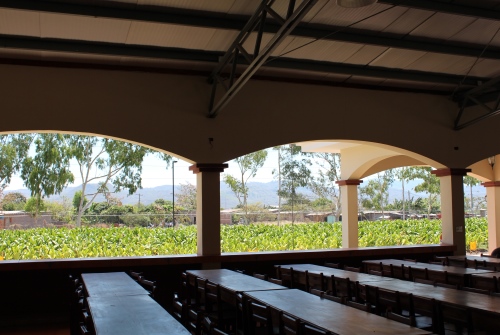
The land next to DE2 (which can be seen across the experimental field through the employee cafeteria) is also owned by Drew Estate. It is the likely site of DE3—another facility that will almost certainly be needed if the company is to meet its goals for expansion.

–Patrick A

photo credit: Stogie Guys