Archive | Tips RSS feed for this section

Stogie Tips: Japan is Awe-Inspiring, Smoker Friendly

5 Jan 2009

TOKYO – My holiday trip to Japan’s sprawling capital was awe-inspiring, intimidating, and fascinating. Coming from a monolingual Westerner who had never left North America, Tokyo’s population of 35 million—the most of any metropolitan area in the world—and spaghetti-like labyrinth of nameless streets was, to say the least, daunting.

Once you get past the shock of the wondrous, polite, and clean Japanese culture, and once you’ve taken in the temples, raw fish, sumo wrestlers, and crowded metro cars, Tokyo is an amazing place to wind down the day with a cigar. Consider this photo, taken from the balcony of the condo I was lucky enough to call home for eight days:

Tokyo

It almost looks peaceful and serene, doesn’t it? As you can imagine, Tokyo is anything but. So once I got above street level and had an opportunity to enjoy the view, I found I could sit for hours and be completely entertained by the metropolis’ sheer size. From the neighborhood of Roppongi, not far from the Tokyo Tower (pictured), skyscrapers pack the landscape as far as the eye can see.

The inhabitants of this futuristic yet traditional society are, relatively speaking, quite smoker friendly. The lamentable anti-smoking frenzy hasn’t yet reached Japan’s densely populated shores. Most bars and many restaurants welcome smokers, Tokyo’s businessmen are often seen outside puffing away on cigarettes (half of adult Japanese males smoke them), and tobacco is readily available in many vending machines.

Case in point: In a scene that could have been taken from Lost in Translation, I had no trouble lighting up a cigar in one high-end restaurant/bar with a spectacular view. No one else was packing a stogie—I didn’t see many other cigars outside the stash I brought from the U.S.—but my fellow patrons didn’t even bat and eyelash.

Heck, I would have fired up a Perdomo on the bullet train I took to Hiroshima if there was a seat to be had in the smoking car. Too bad. I think it would have been spectacular to smoke premium tobacco at 185mph while Mount Fuji flew by.

All this isn’t to say, however, that smoking is completely tolerated on the island. There are scores of “No Smoking” and smoking etiquette signs, most of them comical. And, demonstrating the choice that prevails in the absence of heavy-handed government edicts, it isn’t hard to find self-regulated smoke-free restaurants and bars.

What are hard to find are tobacco shops. Well, let’s face it; everything is hard to find in Tokyo. But I didn’t stumble across a single establishment that sold cigars in all of my lengthy excursions in Japan. I would imagine, though, that Cubans are readily available for a hefty price. (Everything is expensive in Japan, and the current dollar-yen exchange rate doesn’t do American tourists any favors.) So, if you’re planning a trip of your own, let me suggest you bring along enough cigars to last the trip. Then you’ll be all set to take in one of the most interesting and unique cultures in all of the developed world.

Patrick A

photo credit: Stogie Guys

Stogie Tips: Have a Happy Thanksgiving…With Cigars

26 Nov 2008

StogieGuys.com will be taking tomorrow off to enjoy that most American of holidays: Thanksgiving. (We will return Friday for your regularly scheduled Friday Sampler.) Known for an abundance of great food, Thanksgiving is a perfect time to enjoy cigars with gathered friends and family.

As we did last year, today we’re listing the one cigar we’ll each be firing up after the big meal.

Patrick A: Call my pick corny or contrived, but this year I’m picking the CAO America Monument. Other than the obvious patriotic connection to our nation’s greatest holiday, this torpedo-shaped behemoth packs enough coffee, pepper, and spice to help me make room for coffee and pumpkin pie. I just hope I can stay warm long enough to enjoy this twice-wrapped cigar’s fine physical properties and well-balanced smoothness.

Patrick S: While not quite a U.S.-made cigar like last year’s selection, I’m still going for a stick with a significant American pedigree: the PG Gourmet 15th Anniversary Blend Belicoso Extra. The last time I had one on a full stomach following an good meal it served me very well. Tomorrow, this balanced yet full-flavored masterpiece will be paired with a some fine American small-batch bourbon for a fantastic post-turkey pairing.

George E: I’m planning to light up a powerhouse puro that will easily cut through the afterglow of any large meal and leave its own lovely memories. The Serie 601 “Red” from EO Brands, reviewed nearly two years ago, continues to satisfy with complex, smoothly blended flavors and Nicaraguan strength that pleases rather than overwhelms. Whether your after-dinner routine revolves around a cup of coffee and quiet contemplation or friends and football, this cigar will enhance any experience.

All the best from the StogieGuys.com family to you and yours for a happy, cigar-filled Thanksgiving!

The Stogie Guys

photo credit: Flickr

Stogie Tips: From Punch to OJ

11 Nov 2008

Passing along pointers to novice cigar smokers is one of our major goals at StogieGuys.com. So, with that in mind, here are a few new tips to help you enjoy this beloved hobby even more.

A clip tip. If you’re smoking a cigar with short or mixed filler—more or less the scraps from the long-filler typically used in high-end cigars—don’t use a guillotine cutter on the head. Instead, try a V-cut or a punch. By creating a smaller opening on the cap, you’ll lessen the likelihood of bits of tobacco coming off on your lips or tongue.
Sweet success. Sometimes a cigar will land a punch with a heavy dose of nicotine. You may get a headache, feel a bit woozy, or get slightly sick to the stomach. The typical recommended remedy is sugar, which supposedly counteracts the nicotine. (I can’t vouch for the science, but it seems to work pretty well.) My suggestion is to get the sugar from a small glass of orange juice. Not only is it fairly healthy, citrus is also a nice way to cleanse your palate.

Tools you can use. We passed this tip along a year ago, but it’s worth repeating. The tiny screwdriver that comes in eyeglass repair kits can come in handy for adjusting lighter flame heights and depressing the nozzle to drain the butane take before refilling. Another inexpensive item worth picking up is a large eyedropper sold in drug stores to help with measuring medications. It’s useful in refilling humidification devices with distilled water.

George E

photo credit: Flickr

Stogie Tips: Fix That Uneven Burn

3 Nov 2008

As we wrote way back in August 2006, every stogie enthusiast will run into an uneven burn from time to time. This phenomenon can be much more than annoying; it can adversely and significantly affect the performance of an otherwise delightful cigar.

The following tips should help everyone from tobacco neophytes to seasoned stogie veterans fix an uneven burn—also called a canoe—especially if the problem stems not from the actual makeup of the cigar but from some outside interference.
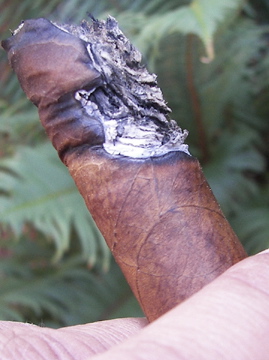
Without question, the best strategy is to avoid an uneven burn in the first place. A proper light is a good way to start every cigar. From there, if you notice the mascara (the black line between the ash and the tobacco) begin to meander, rotate the cigar so the slow burning part is at the bottom. Fire, after all, needs oxygen to burn, and the bottom of the cigar will burn faster than the top because it has more access to oxygen. This is also why you should rotate your cigar as you smoke.

Second, if placing the long end on the bottom doesn’t work, we recommend touching up the fast burning part of the wrapper by applying moisture to the wrapper to slow down the burn. Usually saliva will get the job done, but remember you just want to add a little moisture to the wrapper; you don’t want a wet stogie.

If the aforementioned two techniques don’t work, feel free to grab your lighter or matches and gently burn off the section that’s burning too fast. Don’t rush to quickly take a puff afterwards, however, as the ash is likely unstable. Wait until the burnt wrapper turns black and burns off completely.

While it’s always best to smoke each cigar as its blender intended—slowly from beginning to end in one sitting—we understand that not everyone has the time or the inclination. In order to re-establish an even burn after the foot has extinguished, tap the remaining ash and blow through the cigar before toasting the foot again. This practice will help diminish the sour, bitter flavor that’s often associated with re-lit cigars, and it should clear the way for a second shot at an even burn.

Finally, if you’ve uncovered your own unique methodology to fix an uneven burn, please share it with StogieGuys.com readers by leaving a comment below.

Patrick A & Patrick S

photo credit: Club Stogie

Stogie Tips: The Secret Word Is…

15 Oct 2008

Here’s another installment in our on-going efforts to pass along some tips and suggestions to those who are new to cigar smoking.

Slow. While it might not be as famous as the single word of advice in The Graduate—“plastics”—our word is much more important for cigar smokers to remember. Taking your time is important in just about every aspect of enjoying a cigar. Don’t rush the light; burning the tobacco can create harshness from the start. Draw slowly and evenly. If you put the cigar to your lips too often you can overheat it and adversely affect the flavors. Frankly, it’s pretty difficult to smoke too slowly.
Drawback. If you notice a difficult draw, you might try biting down gently on the head. Often this will loosen the tobacco enough to improve the flow of the smoke. Just be careful; you’re not trying to crack an ice cube. A little pressure is all that’s required. Too much and you could crack the wrapper.

Breakout. Sometimes I think I could be happy choosing all my sticks from the powerhouses put out by Pepin Garcia. But then I’ll pick up a tasty mild cigar such as the honey-hued Ybor City Handmade or a delicate Cameroon wrapped Fuente Hemingway and realize the joy of variety. Of course, you should smoke what you like. Just remember, there’s a lot out there and you might like more than you realize.

Name that cigar. Don’t be concerned if you’re having trouble remembering the definitions for all the names of different cigar sizes and shapes. The truth is there’s no standardization. While there are some generally accepted guidelines, manufacturers play fast and loose. For example, a robusto is usually 5 inches long with a 50 ring gauge. But flip through any cigar catalog and you’ll encounter cigar after cigar labeled robusto with different measurements. Heck, sometimes the industry can’t even agree on what the name is. A Rothschild—created in the 1800s and named, as I understand it, for a member of the British banking family that uses this spelling—shows up often without the “s” or ending with an “e” and other variations.

George E

photo credit: Flickr

Stogie Tips: Up to My Neck in Cigar Bands

11 Sep 2008

Not to be over-simplistic or anything but, when it comes to cigar bands, stogie enthusiasts fall into one of two categories: those that trash ’em and those that hoard ’em. For reasons heretofore unexplained, I fall into the latter category.

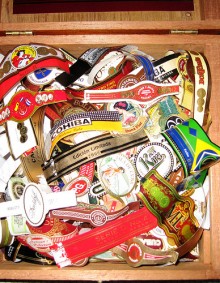
I never had a good reason to carefully remove each paper ring that adorns the many sticks I’ve smoked over the years, cautiously straightening them under the weight of my torch lighter and haphazardly placing them in old, wooden cigar boxes (pictured). Like most pack rats—and this is the one and only item that qualifies me as such—I guess I always thought I would need them one day.

But that day hasn’t come, and my mound of ornate and colorful bands keeps growing. So what do brothers of the leaf do when they’re up to their necks in cigar bands?

Well, some trade them in for other (arguably more useful) stuff. Bandwagon USA accepts cigar bands, as long as they’re on a pre-accepted list of manufacturers, in exchange for all sorts of items—from flasks and money clips to polishing appliances and luggage. Even some retailers, most notably United Tobacco, are in on the game, allowing fans of their products to trade in bands for company T-shirts, humidors, and LCD TVs. This option seems to be best for smokers who find little or no inherent value in the cigar bands themselves.

Many smokers, however, do and therefore go out of the way to stash away their stockpiles. While the International Label, Seal and Cigar Band Society said back in 1994 that the popularity of U.S. cigar band collecting was dwindling, a quick search on Ebay reveals some are still willing to pay cash, albeit very little, for hundreds of bands. My understanding, though, is that you can’t get into this hobby expecting a big payout.

The final cigar band option, if you’re not going to commit them to the trash, is to use them for decoration. I’ve seen homes with framed assortments of bands on the walls and, depending on the décor, it could work. My dream is to one day have a smoke-filled study complete with wooden bookshelves, dark green walls, and leather chairs. Perhaps portions of my collection could be on display there.

But I haven’t decided what I’m going to do with my bands yet. One thing is for certain, though: I will hang on to a select group that were smoked on memorable occasions because (try not to laugh) they carry some sentimental value. Maybe I’ll trade in others for a cigar store Indian for my future den or a ridiculous coat. What will you do?

Patrick A

photo credits: Stogie Guys

Stogie Tips: Do Cigars Get Better With Age?

4 Sep 2008

When many of us pull a cigar from the humidor after six or eight months, we think of it as having some age. But for most connoisseurs of aged cigars, sticks at that stage have barely begun to get settled.

Some serious smokers wouldn’t dream of lighting up a cigar that hasn’t been set aside at least a few years; others smoke fresh and aged cigars. The one thing you can count on in any discussion about aging is that there’s little agreement and lots of personal preference.

My own experience with aging cigars is fairly limited. Most of my aging occurs more by accident than design. Other than a few sticks I’ve been holding for five or six years, the older cigars in my humidor usually result from just not getting around to smoking them in a timely fashion. Consequently, I have quite a few that have six to 18 months of age and some a little older. For example, I’m still working my way through a box of Toraño Exodus 1959 Silver Editions I’ve had for at least a couple of years. To me, they’re as tasty now as the day I smoked the first one, maybe even a bit smoother.

If you’re considering serious cigar aging, I can pass along a little advice I’ve garnered conversing with some top collectors:

1) Be sure your humidor setup is accurate, and monitor it carefully. Many connoisseurs store cigars at temperatures in the 60°-65°F range to limit the possibility of beetle infestation, and they keep the humidity below 70 percent. I think the most important factor is long-term consistency.

2) Commit to boxes. It’s obviously expensive, but you eliminate the possibility of flavors from different cigars merging, and you can try a stick periodically to check progress.

3) Don’t expect every aged cigar to be a sublime smoke. Sometimes, you’ll find the stick is no better—or even worse—than when you bought it.

4) There’s some agreement, though it’s by no means universal, that stronger cigars tend to age better and that moderate ring gauges do better as well.

In an upcoming Cigar Insider, I’ll talk with Doc Stogie of Stogie Fresh, who does extensive reviewing to evaluate the effect of aging on the cigars he rates.

George E

photo credit: Clauss.dk